

Static recompilation is accelerating past the 32-bit and 64-bit eras of the 1990s and 2000s and setting its sights squarely on modern console architectures. In a breakthrough development for modern Nintendo Switch reverse engineering, developer RussoPhone has released tomodachi-ltd-recomp—a static recompilation project that compiles Tomodachi Life: Living the Dream into a 100% native PC executable running with zero CPU emulation.
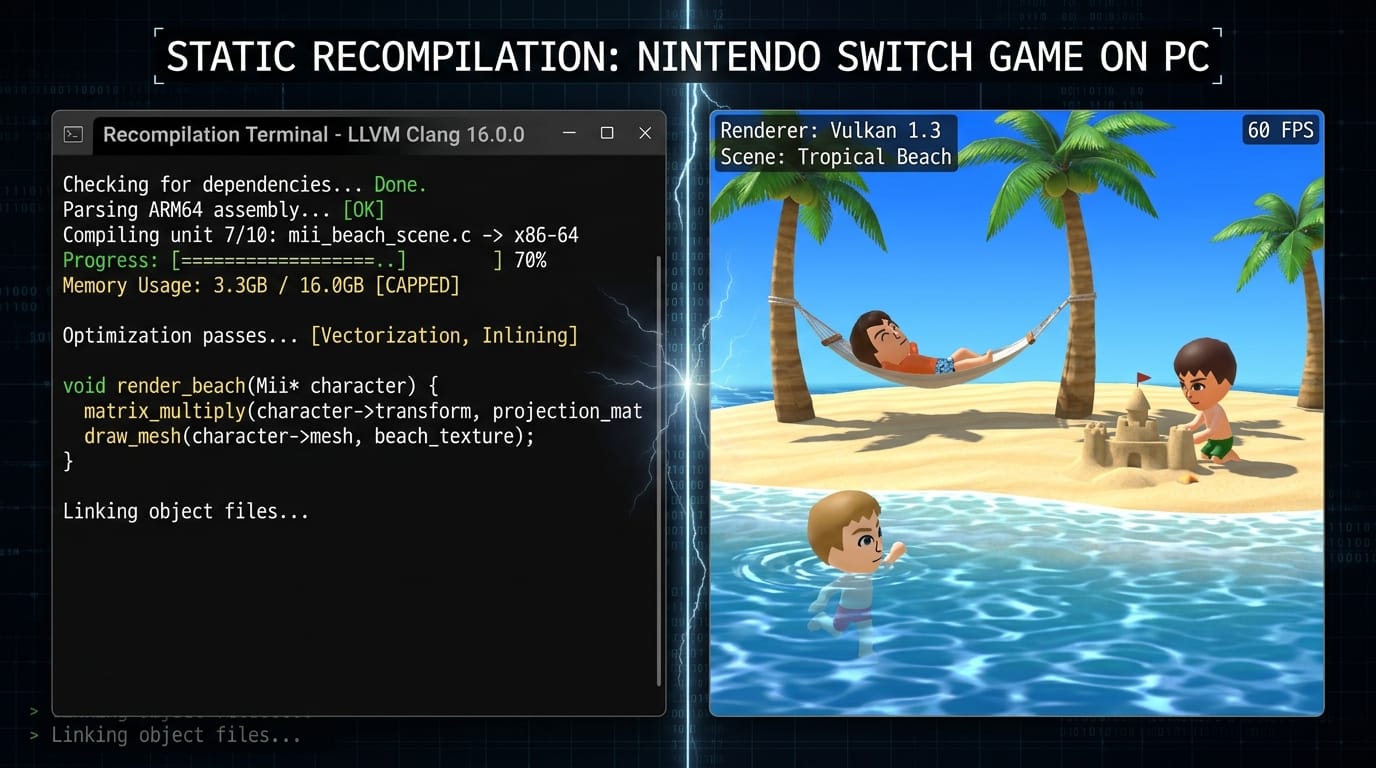
Leveraging an automated pipeline that translates AArch64 (ARM64) guest instructions directly into optimized C units, the project completely eliminates dynamic binary translation (JIT) in favor of native host execution. Paired with native Vulkan graphics and native audio, Tomodachi Life runs on PC hardware with integer scaling up to 4K, rock-solid frame times, and no emulator overhead.
Beyond Emulation: How the Recompilation Pipeline Works
Traditional emulation tools like Ryujinx or Yuzu/Suyu rely on just-in-time (JIT) dynamic compilation to interpret ARM64 instructions into x86-64 on the fly. While effective, JIT execution incurs constant runtime caching overhead, CPU branch prediction penalties, and unpredictable micro-stuttering during code discovery.
tomodachi-ltd-recomp builds upon the foundation established by Doug Chan’s mk8-recomp, utilizing Suyu’s high-level hardware libraries for Vulkan graphics, audio, and OS syscalls, but stripping out the virtual CPU core entirely. When you feed your legally dumped .nsp and prod.keys into the project’s installer, it performs an end-to-end static transformation:
- AArch64 De-construction: The installer reads the decrypted guest binaries (
main,sdk, andrtld) and maps out every basic block, instruction, and branch target. - ARM64-to-C Transpilation: Every single machine code routine is translated ahead-of-time into high-level, human-readable C code.
- Native Clang Compilation: The generated C units are fed to LLVM Clang, producing native x86-64 object files that are linked directly to native Vulkan, SDL3, and audio backends.
- Decrypted & Standalone Runtime: Once compiled, the resulting game is entirely self-contained. The original
.nsp, firmware files, andprod.keysare no longer needed at runtime.
Solving the Compiler RAM Explosion: The 15,000 Instruction Cap
One of the most persistent hurdles in modern static recompilation is compiler resource exhaustion. Generating C from massive commercial binaries frequently produces individual translation units tens of megabytes in size. Because modern optimizing compilers like Clang and GCC build massive internal Abstract Syntax Trees (ASTs), Clang requires approximately 100 MB of heap memory for every single megabyte of generated C code.
Without intervention, compiling a full Switch title can easily consume 40 to 64 GB of RAM, triggering Out-Of-Memory (OOM) killer terminations on standard desktop PCs. RussoPhone engineered a dedicated solution via Patch 0002 (suyu-aot-unit-insns-split):
“Block counts alone let a unit of unusually long blocks reach hundreds of megabytes of C, and the compiler needs roughly 100 MB of heap per MB of it at any optimization level.”
By introducing a strict instruction ceiling (SUYU_AOT_UNIT_INSNS=15000), the recompiler cuts off translation units before they balloon, capping peak compiler memory usage at ~3.3 GB per unit. This allows standard consumer PCs with 16 GB of RAM (and 8 GB of swap) to build the game cleanly across two parallel worker threads (-j2) without system lockups.
Furthermore, Patch 0003 (suyu-aot-unit-span-stable) implements address-aligned compilation windows, ensuring that small incremental patches or future updates only invalidate specific cached units rather than forcing a 3-hour recompile from scratch.
Conquering Modern Nintendo SDK Internals
Beyond compiler optimization, Tomodachi Life: Living the Dream runs on Nintendo’s modern SDK revisions (requiring Switch system version 21.1.0). These newer binaries broke existing recompilation toolchains in subtle, catastrophic ways that RussoPhone resolved with low-level engineering patches:
- Version 1 Module Headers (Patch 0004): Modern Nintendo SDKs format the start of
.rodatawith a versioned module header (version = 1, header size, and module name strings). Legacy tooling failed to locate these identifiers, preventing AOT images from learning their base addresses and forcing execution to miss directly into JIT fallbacks. Patch 0004 decodes this format natively. - Deep MOD0 Pointer Navigation (Patch 0005): In older Switch titles, the
MOD0metadata header was located within the first 16 KiB of the binary. In newer titles, Nintendo placedMOD0deep into.rodata—tens of megabytes intomainandsdk. Patch 0005 follows the 4-byte pointer atmod+4directly. Without this fix,sdkexports were never indexed, causingrtld(the runtime linker) to branch into null address space (0x0) at boot. - Zero-JIT Verification Map (Patch 0008): To rigorously prove that no emulation JIT is running underneath, the build includes a lock-free open-addressing dispatch map (
SUYU_RECOMP_DISPATCH_MAP). If any indirect branch attempts to trigger an unmapped address, the binary halts immediately with a fatal diagnostic error rather than silently degrading into JIT emulation.
Features & Installation: Linux First, Windows Experimental
The project offers an automated 10-step installation script (./install.sh) designed for Linux environments (tested on Arch Linux / EndeavourOS). A clean build on a modern laptop (such as an Intel Core i5-13450HX) takes approximately two hours, resulting in a persistent desktop entry and launcher script (./play.sh).
Key gameplay and engine features include:
- Arbitrary Integer Resolution Scaling: Launch with
./play.sh --scale 2(or1.5,3,4) for crisp high-DPI rendering far surpassing the Switch’s 720p/1080p output. - Custom Input Mapping: Built-in F12 overlay menu for configuring keyboard and gamepads directly through SDL3.
- Experimental Windows Support: A newly added
install.batand PowerShell script leveragewingetto automatically pull Clang, CMake, Ninja, and Visual Studio 2022 Build Tools to compile on Windows 10/11. - Safe Save System: Saves are stored natively in
local/package/tomodachi/user/nand/user/save/, allowing easy manual backups and transfers.
A New Frontier for Modern Preservation
For years, static recompilation was viewed as a technique limited to simple 8-bit, 16-bit, and early 3D consoles (like N64 and PlayStation 1). The emergence of projects like mk8-recomp and now tomodachi-ltd-recomp demonstrates that 64-bit ARM-based modern consoles are completely viable candidates for static translation.
By compiling entire game binaries into native machine code on the user’s machine, developers are eliminating the hardware tax of emulation and providing future-proof, archive-grade PC ports that can run indefinitely across future hardware architectures.
The full open-source project and installation instructions can be inspected on GitHub at RussoPhone/tomodachi-ltd-recomp.