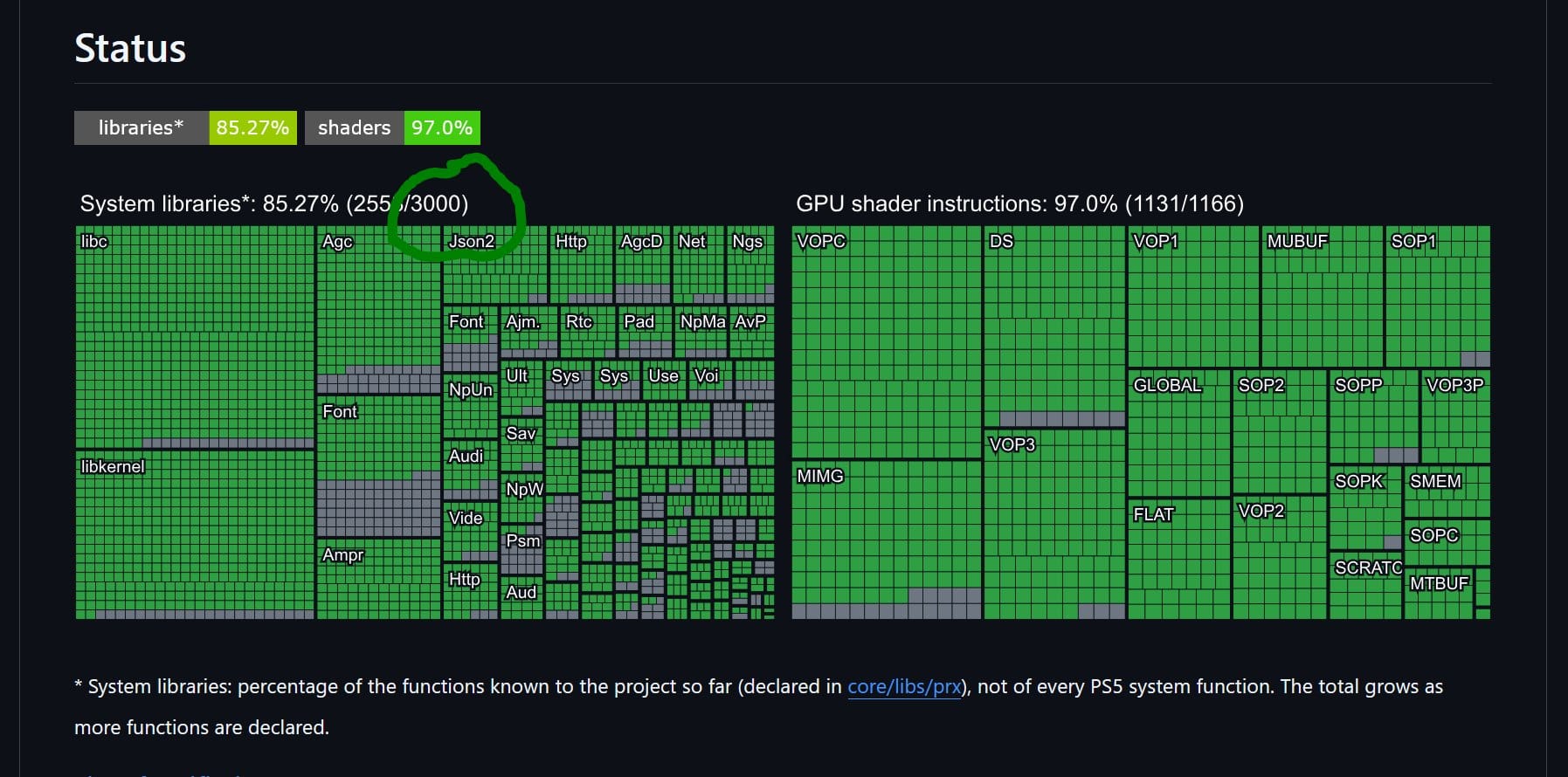

Progress on running ninth-generation console software on PC is accelerating at a pace that is catching even seasoned hardware observers off guard. Tech analyst RedGamingTech recently drew attention to the latest progress dashboard for AnyPS5, clearing up a common misconception about the project’s velocity while highlighting a monumental milestone: GPU shader instruction translation has officially reached 97.0%.
AnyPS5 progress update. Notice, more system Libraries have been discovered so progress seems to have gone back, but instead they've simply added more info about it.
— RedGamingTech (@RedGamingTech) October 8, 2026
From what I've read, some GPU instructions are also undiscovered.
Important thing is - it's moving and fast. pic.x.com/wMSsfz2vtp
The Denominator Effect: Why 87% Became 85%
To casual observers tracking progress trackers, seeing a completion percentage go backward usually signals setbacks or broken regressions. On October 6, AnyPS5’s dashboard reported 87.0% of system libraries completed. Two days later, that figure read 85.27%. As RedGamingTech correctly pointed out, the reality is the exact opposite of a regression—it reflects aggressive discovery:
- October 6 Dashboard: 2,449 out of 2,815 known system functions implemented.
- October 8 Dashboard: 2,558 out of 3,000 known system functions implemented.
In just 48 hours, the development team discovered and declared 185 new proprietary system functions across Sony’s .prx module space (expanding the known denominator to an even 3,000), and immediately implemented 109 of them. The percentage dropped only because the scope of the known mountain grew larger—while the team climbed 109 steps in two days.

More impressive still is the GPU pipeline. AnyPS5’s shader recompiler now supports 1,131 out of 1,166 GPU shader instructions, achieving a staggering 97.0% coverage across vector operations (VOPC, VOP1, VOP2, VOP3), memory buffers (MUBUF, MTBUF), and scalar arithmetic. Only 35 exotic RDNA2 instructions currently remain unmapped.
Not an Emulator: The Relinker Paradigm
To understand why AnyPS5 is moving with such velocity (amassing over 12,200 GitHub stars under developer boykopovar), it is vital to dispel a fundamental misconception: AnyPS5 is not a CPU emulator.
Unlike historical systems like the PlayStation 3 (which required RPCS3 to simulate an exotic, heterogeneous 8-SPE Cell processor on consumer CPUs), the PlayStation 5 is architecturally a standard PC. It runs on an 8-core AMD Zen 2 CPU and an AMD RDNA 2 GPU. Emulating an x86-64 processor on an x86-64 host machine makes no sense and wastes precious performance.
Instead, AnyPS5 functions as a binary relinker and translation runtime, operating closer in spirit to Wine or Proton than an emulator:
- Executable Relinking: The tool takes a decrypted PS5 executable (
input.elf) and modules, parses its imports by Network Identification (NID) hashes, lowers AMD-specific instructions to Intel where required via--to-intelcodegen, and repacks the binary as a native Linux ELF or Windows PE.exe. - Native PRX Implementations: The converted binary executes as a normal native host process, linking directly against AnyPS5’s clean-room implementations of Sony’s system libraries (
libc,libkernel,Agc,Pad,Audio). - Vulkan Shader Transpilation: Proprietary PS5 RDNA2 bytecode is translated directly into standard SPIR-V shaders and submitted straight to native PC Vulkan drivers.
Because there is zero CPU interpretation or dynamic JIT translation, CPU performance overhead is effectively zero. The converted binary runs natively at full host processor speed.
Current Compatibility & Anti-Scam Boundaries
According to the project’s official documentation, the first commercial title—the 2D platformer Dreaming Sarah (Title ID PPSA02929)—is already documented as in-game and fully playable at a locked 60 FPS on modest hardware (an Intel Core i5-7500 paired with a GeForce GTX 1050 Ti), and 36 FPS on an integrated Intel HD Graphics 620.
However, users hoping to boot Demon’s Souls or Marvel’s Spider-Man 2 tomorrow must temper expectations. Complex 3D commercial titles rely heavily on Sony’s low-level graphics API (Agc and AgcD) and advanced compute dispatches that are still being fleshed out. Crucially:
- Strict Crash-on-Error: AnyPS5 is engineered with uncompromising rigor. Any unexpected system state or unmapped API call throws a fatal
std::runtime_errorand terminates the process immediately, ensuring developers catch missing functions rather than silently ignoring bugs. - No Public Pre-Compiled Builds: The repository maintainers maintain a strict policy against releasing general user installers until full commercial games boot reliably. Any website offering a “downloadable AnyPS5 setup.exe” is an outright scam or malware trap. All legitimate testing currently requires building from source via the official GitHub repository.
Why PS5 Is Falling Faster Than PS4 Did
When the PlayStation 4 launched in 2013, it took nearly a decade before compatibility layers like fpPS4, Spine, and ShadPS4 could boot complex 3D titles like Bloodborne. Why is the PS5 scene achieving 97% shader coverage and commercial boot cycles while the console is still in its retail prime?
The answer is architectural compounding. Sony’s operating system for the PS5 (internally dubbed Prospero) is a direct evolution of the PS4’s Orbis OS, both built on FreeBSD foundations. The system call conventions, dynamic library loaders, NID symbol mangling, and graphics pipelines share enormous lineage with the PS4. The grueling decade spent reverse-engineering the PS4 gave the community the exact Rosetta Stone needed to unlock the PS5.
With RDNA2 instruction sets almost completely mapped and system PRX libraries crossing 2,500 implemented functions, the barrier separating Sony’s flagship console from open PC compute is dissolving in real time.
RECOMP THE PLANET.