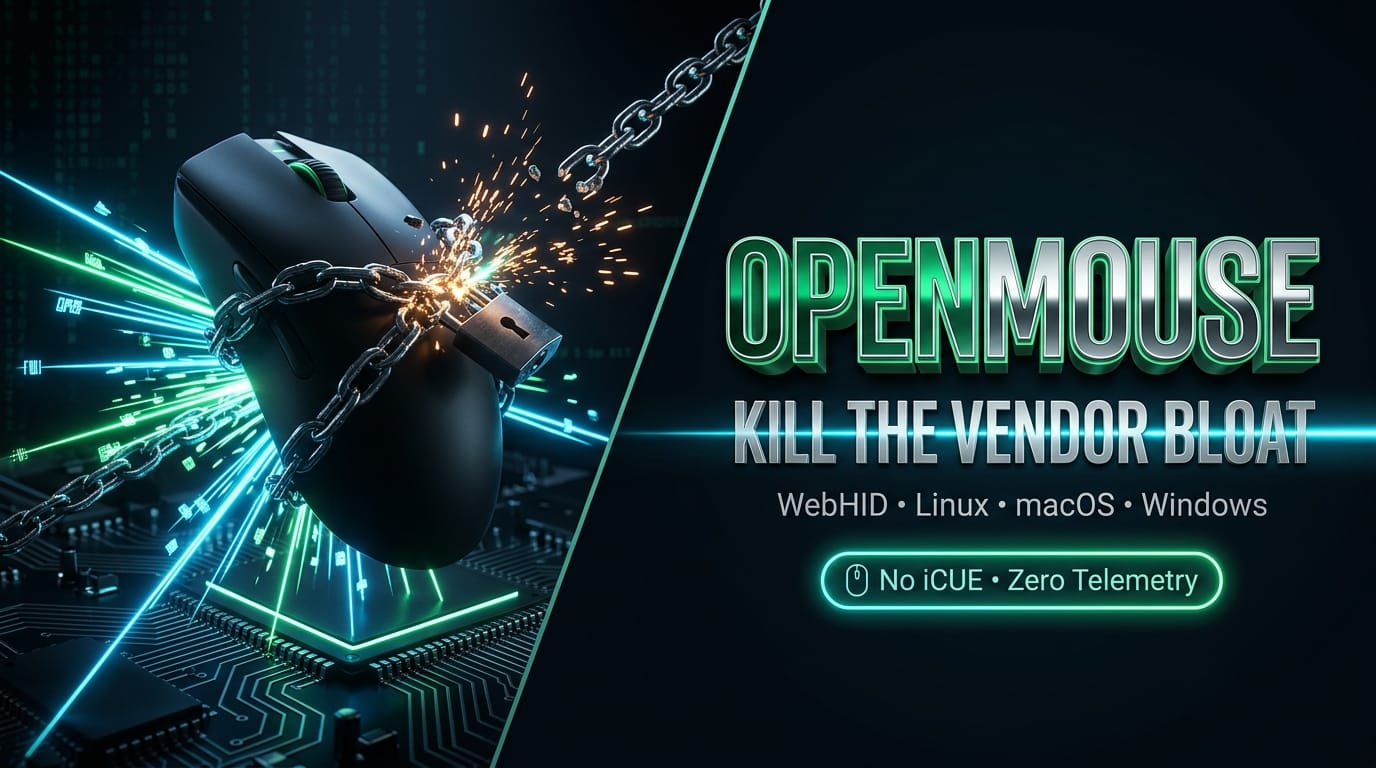

Over the past four years, Valve's Proton, the Steam Deck, and modern Vulkan translation layers achieved the impossible: they eradicated the game compatibility barrier that kept PC gamers chained to Windows. Today, 90% of your Steam library runs flawlessly on Linux. But as thousands of power users, esports competitors, and streamers attempt to make the permanent migration to a free desktop, they slam headfirst into the last fortified wall of the Windows monopoly: the proprietary peripheral driver cage.
Enter OpenMouse (openmouse.app)—a free, open-source mouse configurator that operates entirely inside your web browser via the WebHID standard. By stripping away multi-gigabyte vendor installers, background telemetry trackers, and mandatory cloud logins, OpenMouse does more than just tweak your DPI: it proves that modern hardware can be completely liberated from corporate bloatware. And more importantly, it marks the critical first step in a much bigger battle to bring tools like Corsair iCUE, Elgato Stream Deck, and Voicemod into the open Linux era.
The Peripheral Lock-in Trap: Windows' Last Hostage Moat
Consider the absurd reality of owning modern PC hardware. You purchase a $150 high-end wireless gaming mouse or an ultra-low-latency 8,000 Hz optical pointer. To adjust basic hardware parameters—polling rates, sensor debounce, lift-off distance (LOD), or DPI stages—the manufacturer demands you install a monstrous software package:
- Razer Synapse: A 1.5 GB installation that spawns dozens of background processes, aggressively promotes cloud storage syncing, and requires a registered user account just to save a mouse profile.
- Logitech G HUB: Infamous for infinite loading screen loops, silent background telemetry updates, and memory leaks that degrade gaming frame rates.
- Corsair iCUE: A heavyweight behemoth that regularly consumes 1 GB to 2 GB of active system RAM merely to keep RGB lighting and sensor polling alive.
On Windows, these suites are bloated annoyances. But on Linux, macOS, or lightweight operating systems, they represent a total brick wall. Because peripheral manufacturers refuse to release native Linux versions or open their communication protocols, users who switch to Linux are left stranded: their expensive mice revert to default factory DPI steps, high-polling rate 4K/8K toggles become inaccessible, and customized button macros evaporate into thin air.
This is the hidden moat keeping power users shackled to Microsoft's operating system. And it extends far beyond mice:
STREAMING HARDWARE Elgato Ecosystem
Stream Deck macro keys, Wave Link virtual audio matrixing, and 4K60 Pro capture cards remain tethered to proprietary Windows utilities with patchy, reverse-engineered community workarounds.
SYSTEM & LIGHTING Corsair iCUE & CAM
PWM fan curve controllers, AIO coolant pump telemetry, and DDR5 memory addressable RGB channels require heavy proprietary daemons that lock cooling profiles behind Windows services.
REAL-TIME AUDIO DSP Voicemod & Sonar
Low-latency microphone voice changers, soundboard keybinds, and SteelSeries Sonar parametric game EQ filters have zero native Linux equivalents, stalling creator transitions.
GAMING SENSORS Proprietary Mouse Protocols
Every gaming mouse manufacturer invents a bespoke, obfuscated HID packet dialect specifically designed to prevent cross-platform configuration.
How OpenMouse Works: Raw Hardware Control via WebHID
OpenMouse cuts through this entire parasitic paradigm by utilizing WebHID (Web Human Interface Device), a modern browser API available in Chromium-based browsers (Google Chrome, Brave, Edge, Chromium).
When you connect a compatible mouse and visit openmouse.app, the web application requests access to the raw HID device node. Once granted, OpenMouse speaks directly to the mouse's onboard micro-controller (MCU) over USB or 2.4GHz wireless:
- Zero Installation & Zero Background Daemons: No background services eating CPU cycles while you play. You open a tab, change your settings, and close the browser.
- Direct Onboard Memory Writes: Settings are written directly into the mouse's non-volatile EEPROM/flash memory. Once saved, your settings persist permanently—whether you reboot, unplug the mouse, or plug it into a PlayStation 5, a Steam Deck, or a Linux tournament rig.
- Comprehensive Hardware Tuning: Depending on the sensor and MCU capabilities, OpenMouse lets you configure:
- DPI stages and custom color indicators
- Report rates (125 Hz, 500 Hz, 1,000 Hz, up to 4,000 Hz and 8,000 Hz)
- Lift-Off Distance (1mm / 2mm low/high presets)
- Debounce time (preventing double-clicks)
- Motion Sync and Angle Snapping toggles
- Button remapping and onboard RGB lighting
- 100% Privacy & Zero Telemetry: No analytics, no account registration, no tracking beacons. Just pure hardware configuration.
LINUX QUICKSTART // UDEV PERMISSION RULE
# On Linux, grant non-root browser access to raw HID devices:
sudo usermod -a -G plugdev $USER

# Add udev rule for WebHID access (or use OpenMouse's universal udev package):
echo 'KERNEL=="hidraw*", SUBSYSTEM=="hidraw", MODE="0660", GROUP="plugdev"' | sudo tee /etc/udev/rules.d/99-webhid.rules
sudo udevadm control --reload-rules && sudo udevadm trigger

# Launch Chromium/Brave and navigate to https://openmouse.app/
The Roster: Actively Adding New Mice Every Week
The biggest hurdle facing universal hardware configurators is that no two mouse manufacturers talk the same language. Logitech uses proprietary G-series HID feature reports, WLMouse uses distinct Nordic MCU commands, and Endgame Gear utilizes custom high-speed packet framing for its 8,000 Hz sensors.
Because of this, the OpenMouse Project is actively working on expanding hardware support model by model. The project maintains a decoupled protocol library (OpenMouse-Project/mouse-protocol) that reverse-engineers the packet structures of individual gaming mice:
Currently Supported & Active Scope
- Logitech: G Pro X Superlight 2, Superlight 2C, G Pro X Superstrike (including ongoing research into Logitech's LIGHTFORCE hybrid optical-mechanical switches).
- WLMouse: Beast X, Beast G, Huan series.
- Endgame Gear: OP1 8K, OP1we.
- Pulsar: X2 CrazyLight.
- Orbital: Pathfinder.
- In Protocol Development & Roadmap: Select models from Razer, Corsair, HyperX, VGN, ATK, Finalmouse, and Hitscan Hyperlight.
Because the protocol decoder is completely open source under the MIT license, community members with USB packet sniffers (like Wireshark with USBPcap) can capture their vendor software's raw traffic, map the byte offsets for DPI and polling rate registers, and submit PRs to instantly add support for their favorite mouse.
The Catalyst: Bringing Stream Deck, iCUE, and Voicemod to Linux
OpenMouse is much more than a convenient utility for esports competitors—it is the proof-of-concept vanguard for the broader hardware liberation movement.
For years, the Linux community has struggled with peripheral support because developers assumed hardware configuration required massive, monolithic desktop applications running with elevated root privileges. OpenMouse flips that entire philosophy on its head: modern web standards like WebHID and WebUSB are powerful enough to eliminate dedicated vendor installers completely.
This approach is desperately needed to kickstart the next phase of Linux workstation adoption:
- The Stream Deck Revolution: While tools like
streamdeck-uianddeckmasterexist, an open WebHID/WebUSB control standard could allow creators to drag-and-drop animated key icons, Twitch chat integration, and OBS scene switches directly in a browser without fighting broken Python dependency chains. - Dismantling iCUE's Cooling Moat: While OpenRGB has made heroic strides in synchronizing LED headers, comprehensive AIO liquid cooler fan curves, pump RPM profiles, and thermal probe telemetry still lack a unified, zero-bloat cross-platform controller. Applying modular protocol reverse engineering to Corsair Commander and NZXT Smart Device hubs would finally allow enthusiasts to build watercooled Linux rigs without compromising fan curves.
- The Voicemod & Audio DSP Migration: One of the single biggest pain points preventing content creators and VTubers from switching to Linux is the absence of Voicemod. Low-latency voice morphing, virtual soundboard routing, and noise suppression are completely achievable on Linux via PipeWire and native LV2/VST audio filters—what is missing is the intuitive, zero-friction interface.
The Nocturnal Verdict
TERMINAL // ACCESS REPOSITORIES
Web Control Panel:  https://openmouse.app/
Web Landing Page:   https://openmouse.app/landing
Main Repository:    https://github.com/OpenMouse-Project/openmouse
Protocol Decoders:  https://github.com/OpenMouse-Project/mouse-protocol
Desktop Version:    https://github.com/OpenMouse-Project/Desktop (Tauri)
License:            Free & Open Source (MIT / GPL)
True PC ownership means owning the physical hardware sitting on your desk. You should never have to surrender your telemetry, install a 2 GB background service, or boot into a specific operating system just to tell your mouse sensor to track at 800 DPI.
OpenMouse is taking the first swing at dismantling the proprietary peripheral monopoly. If you own a supported mouse, ditch G HUB and Synapse today. And if your mouse isn't supported yet, grab a packet log, join the OpenMouse GitHub, and help build the open peripheral future the PC gaming world so desperately needs.