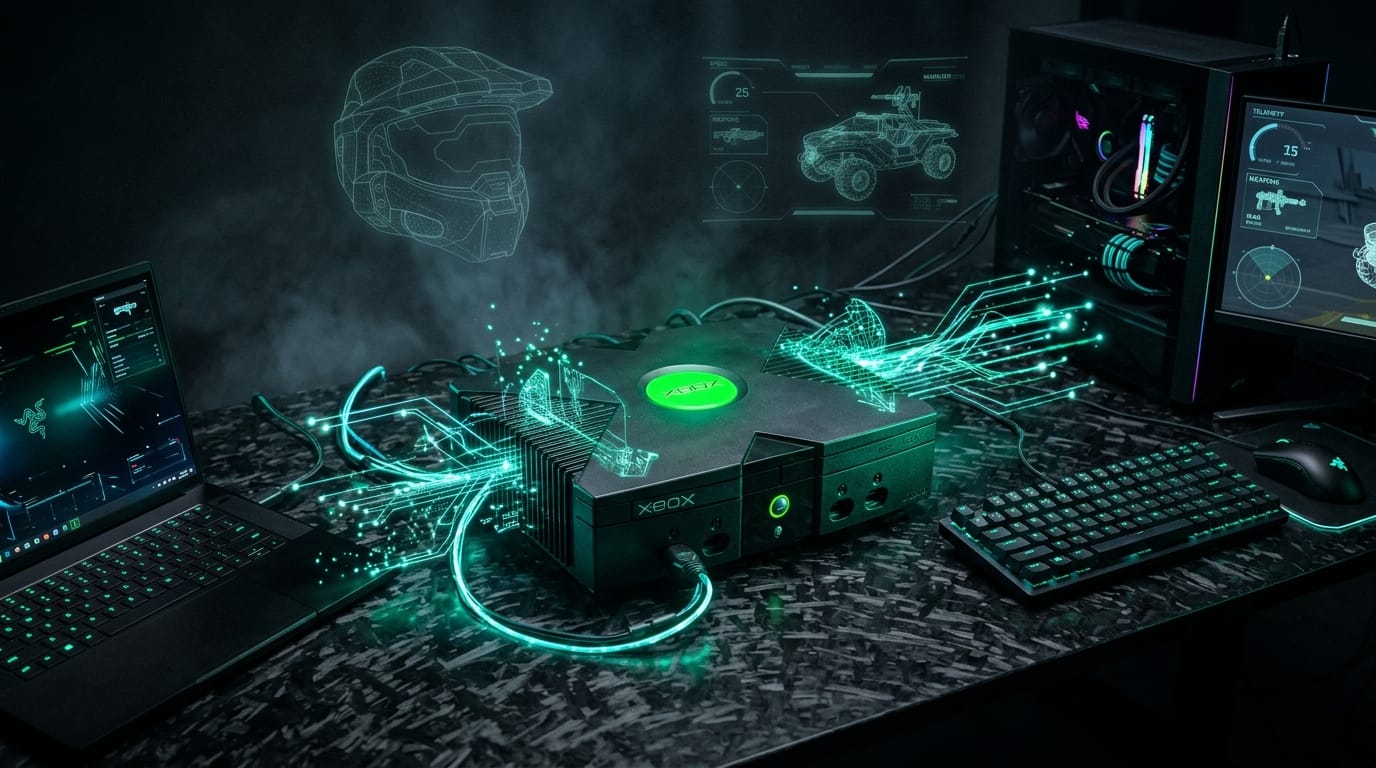

Twenty-five years after Bungie first revolutionized console first-person shooters, the open-source reverse-engineering community has achieved a milestone once deemed technically impossible: an original 2001 Microsoft Xbox, running native decompiled C code, has connected over the open internet to play live, public cross-platform multiplayer alongside modern PC and Mac gamers.
ChupathingyCE v0.7.0b is out, and it's the biggest thing we've shipped.
Quick recap of the last 24 hours:
We merged OpenCE all the way through network version 20. Online co-op, SMAA/FXAA, per-pixel lighting, reverb, password lobbies, two rounds of hardening. All in.
Then we launched Delta.
Delta is our open, documented network layer. It runs beside OpenCE's protocol, never instead of it.
ChupathingyCE machines recognize each other, say what they are (PC, Mac, Linux, Android, Steam Deck, dedicated server, consoles) and what they can handle.
OpenCE players still drop into the same games like nothing happened. One player base. No walls.
The fun part: Delta carries a signed version table. When OpenCE bumps their network version and our wire is still compatible, we sign a new table and every ChupathingyCE player follows it. No new build. No download. No "please update" screen at 2am.
About an hour after we tagged the release, OpenCE bumped to network version 21.
Love that for us.
Also in this release:
- Halo PC (Custom Edition) and HaloMD maps on every build: Windows 32 and 64-bit, Mac, Linux, Android, Steam Deck
- Crouch-walking on keyboard (finally)
- Windows 7 boots again
- QWERTZ keyboards show the right keys
- Your D-pad stops walking you off a cliff in the pause menu
- Our dedicated servers run it all, today
And the thing I've wanted to say for a while:
Warthog is public. That's ChupathingyCE on the original Xbox. Same code. Tonight a devkit joined a public ChupathingyCE server over the internet and played a full match with Mac and PC players. Halo, on the box it was made for, in the same lobby as everyone else.
Bring your own copy of Halo. We don't ship maps, discs, or SDKs.
Open source. Open network. Same players.— Milenko (@dtoxmilenko) October 7, 2026
The landmark demonstration was made possible by the simultaneous rollout of ChupathingyCE v0.7.0b—a high-velocity community fork of the OpenCE decompilation project—and the public unveiling of Project Warthog, which ports the entire modernized game engine back onto the sixth-generation console that birthed it.
During the public debut, an original Xbox development kit booted into Warthog and joined a public dedicated server hosted under the moniker [D] Xbox Debug. The match—a competitive 15-kill Slayer contest on Hang 'Em High—ran seamlessly for over six minutes, pitting console hardware manufactured in 2001 directly against contemporary desktop machines. The entire showdown is recorded in permanent history on the community's live Carnage Report (Match #458), complete with weapon heatmaps, multi-kills, and kill/death ratios.
From Xbox Build 2342 to Open-Source Sovereignty
For more than two decades, the preservation of Halo: Combat Evolved was fractured by platform compromise. While the 2001 original Xbox release established the franchise's legendary physics, CRT-tuned lighting, and atmospheric shader pipelines, Gearbox Software's 2003 PC port introduced severe technical regressions: broken bump mapping, missing fog volumes, altered transparent shaders, and compromised networking—flaws that lingered through multiple commercial remasters.
The paradigm shifted with clean-room decompilation initiatives like punpckhdq/halo and bnunu/halo-1, which systematically disassembled and decompiled retail Xbox build 2342 into compilable, auditable C. That foundation gave birth to OpenCE (Open Community Edition), engineering a native, modernized PC runtime.
Lead developer Milenko and contributors launched ChupathingyCE (a beloved nod to Red vs. Blue's famous Warthog naming dispute) to accelerate feature development, harden networking, and push cross-platform parity across modern operating systems.
The Core Philosophy: Open source. Open network. One unified player base. Rather than splintering the community across isolated forks and closed platforms, every engineering decision in ChupathingyCE is designed to dissolve platform walls.
The "Delta" Network Layer: Zero Fragmentation via Signed Tables
The cornerstone of ChupathingyCE v0.7.0b is the debut of Delta, an open, thoroughly documented peer network layer designed to sit directly alongside OpenCE's wire protocol without replacing or breaking it.
Historically, community-driven game clients suffered from agonizing network fragmentation: whenever an upstream project updated its packet layout or bumped its network version, players on divergent forks were instantly locked out with incompatible handshake errors.
Delta eliminates this bottleneck entirely through a multi-layered design:
- Universal Machine Handshake: Machines announce their architecture—Windows (x86/x64), macOS (Intel/Apple Silicon), Linux, Android, Steam Deck, dedicated server, or Xbox console—along with hardware capability flags. Upstream OpenCE clients continue to drop into identical matches completely unaware of the Delta layer.
- Cryptographically Signed Legacy Tables: Delta incorporates an Ed25519-signed version table. When upstream OpenCE pushes a network version increment that remains wire-compatible, the ChupathingyCE maintainers sign a tiny (<16 KB) table update. Clients ingest the signed table dynamically—eliminating the dreaded 2:00 AM mandatory update prompt. (Comically, OpenCE bumped to network version 21 barely an hour after v0.7.0b tagged, immediately validating the design).
- Fuzzed, Hostile-Input Security: Delta treats every network packet as inherently adversarial. The packet parser was subjected to 5 million randomized messages prior to launch, with an automated 300,000-message fuzzer embedded in continuous integration. Peer handshakes, signature checks, and message queues are strictly rate-limited per machine.
- Hermetic Build Pipeline: Signing keys are generated exclusively within automated GitHub Actions secrets and are never exposed to human operators, with rotating recovery keys provisioned for security contingencies.
Universal Map Loading Across Desktop and Mobile
Beyond network resilience, v0.7.0b establishes universal map loading parity. Halo PC (Custom Edition) .map packages and classic Mac HaloMD files now load natively across every platform profile:
- Full Custom Edition Support: 32-bit Windows builds and native Android ports can now load complex Custom Edition maps and custom scenario tag caches directly.
- macOS OpenGL 4.1 Fixes: macOS rendering has been fully restored, working around OpenGL 4.3 features introduced in upstream merges while delivering hardware FXAA and SMAA anti-aliasing.
- PC Keyboard Controls: Re-implements native keyboard crouch-walking, allowing players to crouch fluidly at any movement speed as originally experienced on PC.
- System Compatibility: Restores legacy Windows 7 execution, resolves QWERTZ European keyboard mapping offsets, and fixes controller D-pad drift inside pause menus.
- Headless Dedicated Servers: Packaged for Linux x64, ARM64 (enabling zero-cost hosting on Raspberry Pi 4/5 and Oracle Cloud instances), and x86 architectures.
Project Warthog: Squeezing Modern Cross-Play into 64 MB of RAM
While multi-OS desktop support is impressive, Project Warthog represents the technical crown jewel of the release: recompiling and running the modernized ChupathingyCE codebase directly on original 2001 Xbox silicon.
Making a modern, 128-player-capable game protocol communicate with 2001 hardware required navigating staggering hardware limitations:
| Specification | Modern PC / Desktop Client | Original Xbox Hardware |
|---|---|---|
| Total System RAM | 8 GB – 64 GB+ High-Speed DDR4/DDR5 | 64 MB Unified DDR (128 MB on Devkits) |
| Max Player Slots | 128 Network Players | 16 Players (Hardware Ceiling) |
| Network Objects | 8,192 Dynamic Objects | 2,048 Dynamic Objects |
| Game Settings Record | 13,120 Bytes (Full 128-slot state) | 3 MB Total Game Heap Allocation |
To bridge this architectural divide without breaking protocol compatibility, Warthog implements dynamic record folding. When joining a PC-hosted game, the Xbox client accepts the full 13,120-byte settings record and dynamically folds the data into its native 16-slot memory structure at runtime, validating layouts with compile-time assertions.
For internet multiplayer, Warthog bypasses dead Microsoft Xbox Live servers entirely. The console executable bundles modern Monocypher encryption and low-latency KCP tunneling protocols via open XNet mode (bypass_security.txt), while preparing native addressing hooks for XLink Kai.
Most remarkably, the entire Warthog repository is clean-room: it was built on macOS using the open-source OXDK toolchain and modern LLVM/Clang. It contains zero proprietary Microsoft SDK headers, zero retail game assets, and zero copyrighted maps. Players provide their own lawfully dumped retail discs and map files.
The Future of Cross-Platform Classic Gaming
Project Warthog maintainer Milenko has confirmed that work is already underway to bring full Delta protocol support directly to the Xbox runtime, while community contributors have begun laying the groundwork for additional console targets—including the Nintendo Switch, Xbox 360, and Nintendo Wii U.
The achievement represents the pinnacle of what game decompilation and open networking can accomplish: erasing artificial corporate obsolescence and allowing gamers on 25-year-old hardware to battle shoulder-to-shoulder with modern rigs on the very maps where console multiplayer began.
Resources & Downloads
- ChupathingyCE v0.7.0b Release: GitHub Releases (Windows, macOS, Linux, Android)
- Project Warthog (Xbox): GitHub Repository (branch: main)
- Match #458 Carnage Report: halo.milenko.org Match Statistics
- Xbox vs. PC Gameplay Footage: Watch on X (@dtoxmilenko)