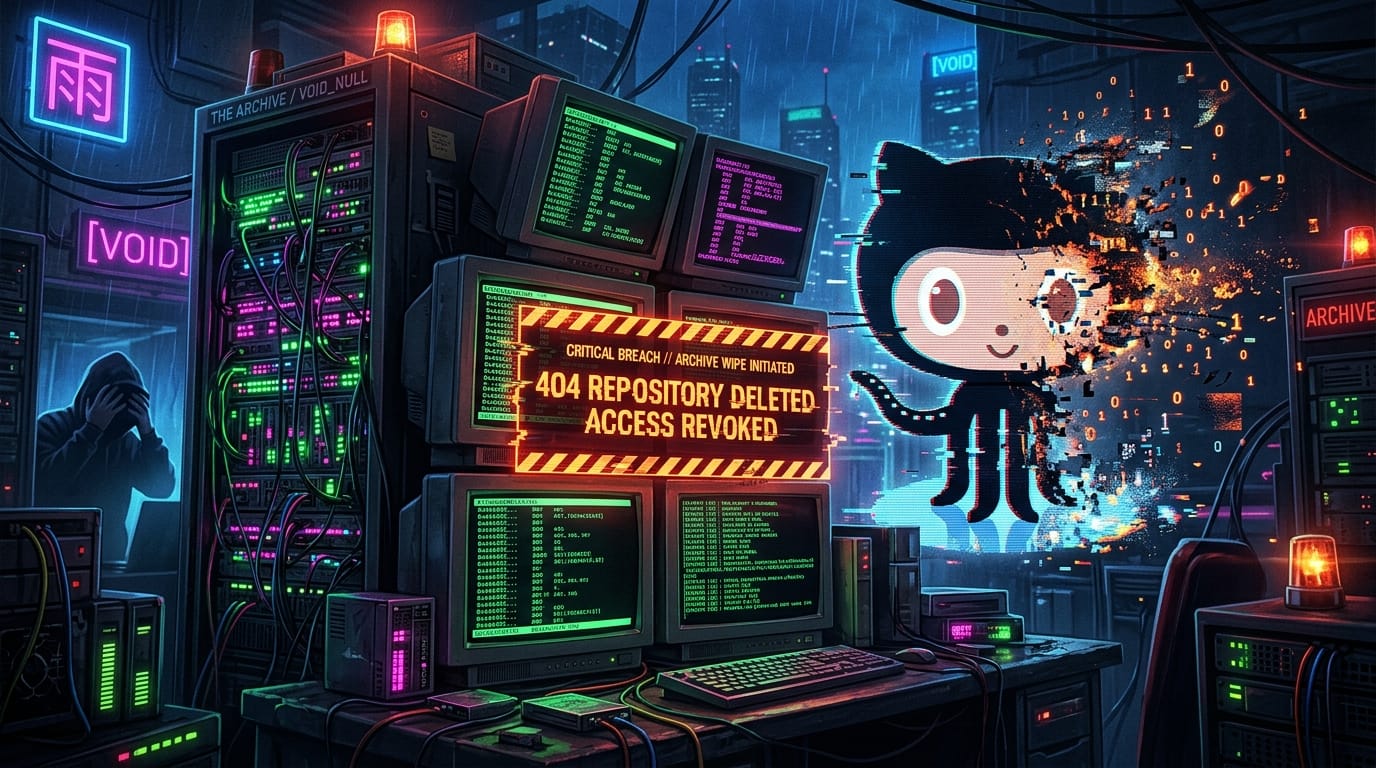

For nearly seven years, the global cybersecurity community treated vx-underground's flagship repository—unambiguously titled "Malware Source Code collection"—as the Library of Alexandria for digital pathogens. Amassing over 12,000 stars, integrated into university computer science syllabi, and relied upon by Cyber Threat Intelligence (CTI) analysts reverse-engineering historical attack vectors, the project was an open-source staple. Today, GitHub nuked the entire repository—and the organization profile along with it—into a barren 404 void.
The Automated Hammer Falls
The abrupt takedown didn't just prune a handful of suspect files; it completely erased the vx-underground GitHub organization. Repositories containing academic whitepapers, educational disassemblies, and historical malware specimens were wiped in an instant.
The sudden disappearance quickly caught the attention of GitHub leadership. Martin Woodward, VP of Developer Relations at GitHub, addressed the takedown publicly on X, suggesting that automated platform detection mechanisms were the likely culprit:
If you can write in with details or send over a support ticket number can take a look, there should be an email from us. But I can def see how malware would have got detected by the malware detection logic and taken offline. We do allow research orgs but good to flag them with us so we know what is legit and what’s not.— Martin Woodward (@martinwoodward) October 6, 2026
While Woodward’s response was professional and offered an avenue for review, it exposed the core absurdity of modern corporate platform moderation: an opaque, automated heuristic scanner had suddenly classified a seven-year-old, world-renowned educational museum as an active, malicious threat campaign.
"A Goofy Goober Beef" vs. The Reality of Self-Hosting
Rather than jumping through support-ticket hoops to beg for reinstatement, vx-underground took to social media to provide clear context—and laid out why begging centralized platforms for permission to preserve history is a dead end:
I'm not even writing this to diss Martin, I'm not going to beef with GitHub over social media like a goofy goober. It truthfully isn't a problem. I have everything backed up locally.
But, the repository was called "Malware Source Code collection". The repo has been up for about 6 years (maybe 7 years?).
The repo was one of the most starred projects on GitHub, it was some absurd number like 12,000 or something. I can't remember (it's deleted).
Hence my profound confusion that the repo, which is cited by Universities, Cyber Threat Intelligence companies, and Cybersecurity companies, and has been persistent for 7 years, is banned arbitrarily.
I'm not sure if I want to deal with creating a support ticket, I know it won't take long, but it seems silly to me to get banned, having to plead my case, when I could simply move the collection to own Git instance (which i will do).
Also, if we're being totally honest, GitHub likely doesn't give a shit either way. The malware source code collection being there doesn't benefit them in any meaningful way.
Pic unrelated— vx-underground (@vxunderground) October 6, 2026
vx-underground also pushed back against any misconceptions that the repository harbored operational, bleeding-edge cyberweapons:
Also, that code isn't like, super fancy high tech goop, it is not comparable to the stuff NightmareEclipse released. This malware is primarily older stuff, stuff that's been leaked publicly, etc. it was just an archive— vx-underground (@vxunderground) October 6, 2026
The Bizarre Inconsistency of Platform Moderation
Perhaps the most technically baffling aspect of the purge is what GitHub left behind. While the upstream vx-underground organization and primary repository were wiped, hundreds of community forks containing the identical malware source code remain completely untouched on GitHub.
I have been informed the vx-underground GitHub profile has been banned, as well as the repos, however the forks of the repo have not been banned or removed.
I don't understand how that works. Wouldn't a ban also ban or remove the forks?
I'm confused— vx-underground (@vxunderground) October 6, 2026
The contradiction is staggering. The reputable upstream maintainer—the one that provided provenance, disclaimers, educational context, and vetted contributions—was vaporized. Meanwhile, unmaintained, uncurated clones of the exact same code remain scattered across the site. If the code itself was too dangerous to exist on Microsoft's infrastructure, why are the forks alive? If it wasn't, why destroy the canonical archive?
Preservation Cannot Rely on Centralized Landlords
This incident reflects a broader, ongoing crisis across digital preservation. Whether it's the gaming community fighting to preserve abandonware, ROMs, and reverse-engineered source trees against copyright takedowns, or security analysts preserving historical viruses so future defense engineers can understand how memory corruption works, centralized platforms have repeatedly proven hostile to historical curation.
When an archive exists on a corporate platform like GitHub, it exists strictly on borrowed time. It is perpetually at the mercy of arbitrary Terms of Service shifts, liability-averse legal departments, and automated AI scanners that cannot distinguish between a dangerous biohazard and a medical specimen in a museum jar.
The Core Takeaway: You cannot build permanent archives on leased digital ground. vx-underground’s decision to bypass the bureaucratic support-ticket pleading process and migrate the collection to a sovereign, self-hosted Git instance is the correct, inevitable conclusion for any serious digital preservation effort.
The code isn't lost—it is safe in offline backups and will soon reappear on an independent server beyond the reach of corporate banhammers. But GitHub's unceremonious purge serves as an unmistakable warning: if you care about preserving history, host it yourself.