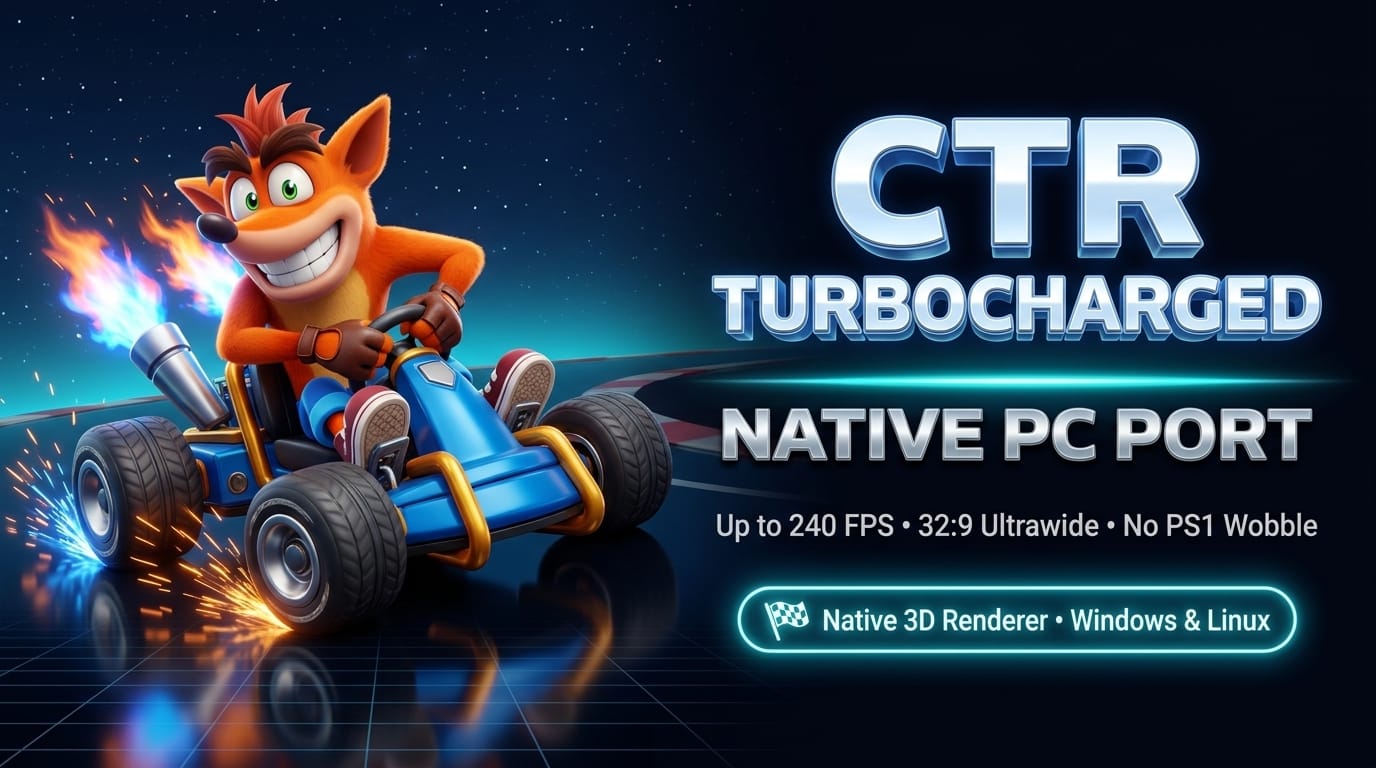

For over twenty-five years, kart racing purists have maintained that Naughty Dog's 1999 PlayStation swansong, Crash Team Racing (CTR), remains the mechanical pinnacle of the genre. Between its sacred boost-reserve physics, air-braking, hang-time turbo, and razor-sharp track design, CTR offered a skill ceiling that few arcade racers have ever matched. Now, thanks to developer Cameron Redmore and the tireless work of the ctr-native reverse-engineering community, CTR has officially transcended emulation: Crash Team Racing: Turbocharged has launched its first public release natively on PC.
Built directly on top of the community C-decompilation and forking Rinnegatamante's High Octane project, Turbocharged is a dedicated Windows and Linux source port engineered to elevate the 1999 original into a modern competitive PC title. From 240 FPS rendering and 32:9 super ultrawide support to sub-pixel geometry correction and decoupled character driving stats, it is the definitive way to play the game on modern hardware.
Banishing the PS1 Polygon Wobble
The original PlayStation's lack of a hardware floating-point unit and per-pixel depth buffer produced the console's unmistakable visual signature: polygon jitter, swimming textures, and aggressive affine warping. While charmingly nostalgic on a 240p CRT television, these quirks can quickly become disorienting on high-resolution modern monitors.
Turbocharged completely overhauls the graphics pipeline with an all-new depth-first Native 3D Renderer:
- Sub-Pixel Precision & PGXP: Eliminates affine warping and polygon swimming, delivering perspective-correct textures and rock-solid geometry.
- Hardware Depth Buffer: Proper per-pixel Z-buffering resolves the classic sorting glitches that plagued complex PlayStation geometry.
- Maximum Level of Detail (LOD): Forces maximum geometry detail across every track, utilizing static GPU meshes and BSP frustum culling.
- Advanced Anti-Aliasing: Includes FXAA, MSAA (up to 8x), and SSAA (up to 4x) for razor-sharp fidelity.
- Preserved Nostalgia: "Every option is its own switch." Players who prefer the authentic 1999 aesthetic can toggle the classic PS1 low-resolution affine renderer while retaining modern frame rates.
High Refresh Rates & Ultrawide Immersion
The original game was locked to 30 frames per second on original hardware. Turbocharged breaks those shackles completely, offering selectable refresh rates of 30, 60, 90, 120, 144, and up to 240 FPS.
Crucially, this is not a crude speedhack: character animation interpolation, particle emitters, race timers, and surface-friction calculations are dynamically scaled to match the targeted tick rate. The game even introduces independent Original and Smoothed floating-point modes for player physics, collision detection, and AI steering behavior, ensuring that CTR's sacred turbo-slide mechanics feel pixel-perfect.
On the display front, the game natively renders any aspect ratio from standard 4:3 and 16:9 up to 21:9 Ultrawide and 32:9 Super Ultrawide. The entire interface—including speedometer dials, wumpa fruit counters, mini-maps, and TrueType fonts—dynamically anchors and reformats without stretching.
Adventure Mode Quality-of-Life: Decoupled Engines
In addition to audiovisual overhauls, Turbocharged introduces long-overdue quality-of-life improvements to CTR's legendary single-player Adventure mode:
Decoupled Engine Archetypes: In the 1999 original, driving archetypes (Speed, Acceleration, Turning, Balanced) were strictly hardcoded to specific characters. Turbocharged completely separates the engine stats from the character model. You can now race as Polar with a Speed engine, or dominate as Tiny Tiger with nimble Turning handling.
- Seamless Title Screen Continue: Instant "CONTINUE" quick-load on the main menu, paired with atomic auto-saving and automated recovery from corrupted save files.
- In-Game Unlocks Menu: Dedicated rewards tracker detailing unlock conditions for characters, paint jobs, and cups.
- Expanded Roster Challenges: Brand new, legitimate unlock challenges to earn both Penta Penguin and the final boss Nitros Oxide.
- Relic Target Clocks: Sapphire, Gold, and Platinum relic target times are displayed directly on the HUD race clock during challenges.
- Kart Color Customizer: Experimental kart hue and paint options.
- 4-Player Split Screen: Local split-screen multiplayer carried over and polished from the High Octane branch.
How to Play (Windows & Linux)
Following strict reverse-engineering and preservation best practices, the Turbocharged repository distributes zero copyrighted assets, proprietary game code, or ROM data. To play, you provide your own lawfully obtained NTSC-U disc image (.bin).
On first launch, Turbocharged features a built-in disc importer that validates your disc image, rips the required tracks, sound banks, and character models into an internal assets folder, and launches straight into the game.
Pre-compiled releases are available immediately for Windows (x86, x64, and Windows on ARM) as well as Linux (standalone AppImage and tarballs for x86_64 and ARM64):
- Official Website & Downloads: ctr.cmzi.uk
- Source Code & Bug Tracker: GitHub Repository (branch: turbocharged)