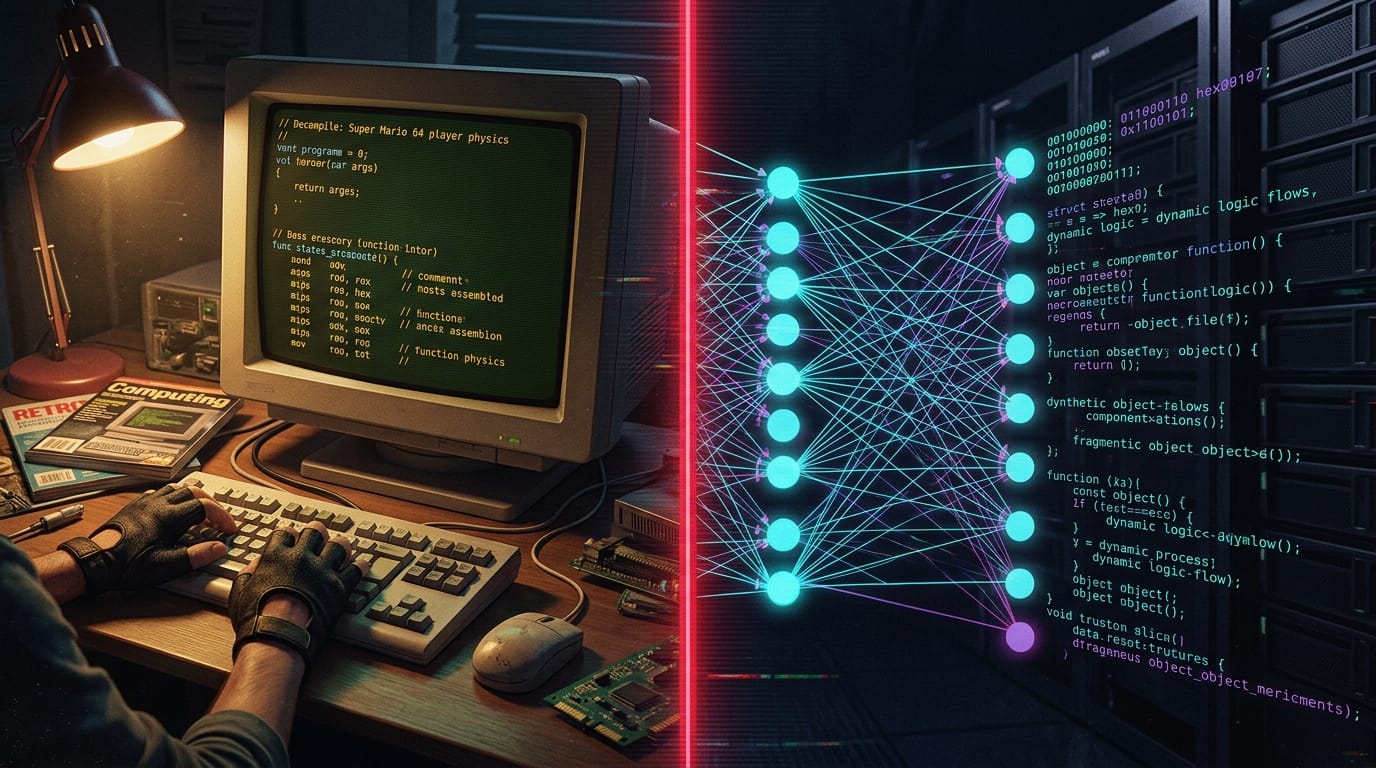

In the nocturnal corners of systems programming, few disciplines command as much reverence as video game decompilation. It is an art form of monastic patience: taking raw, stripped machine binaries from vintage silicon—N64 MIPS, PlayStation MIPS R3000A, GameCube PowerPC—and painstakingly reconstructing byte-for-byte matching C/C++ source code through sheer architectural intellect.
Over the past five years, this discipline sparked a golden age of retro gaming. Flawless PC ports like Ship of Harkinian, Super Mario 64 PC, Banjo-Tooie Recompiled, and Need for Speed: High Stakes shattered original console constraints with 4K widescreen, 144Hz physics, RT64 path tracing, and seamless modding ecosystems.
Yet this week, the reverse-engineering scene collided head-on with the defining technological clash of the decade. A viral community initiative attempting to catalog exclusively "Non-AI Decomps and Recomps" exploded across social feeds, generating nearly half a million impressions, intense praise from game preservationists, and a blistering counter-reaction from veteran engineers who argue the premise fundamentally misunderstands how modern software is built.
The Spark: The Viral "Non-AI" Decomp Manifesto
The catalyst arrived via a tweet from FunkyLion 'Yuyake' (@Funky90sLion), a contributor to the popular SM64CoopDX multiplayer port:
"Getting tired of untested vibecoded ports that are just buggy and because no experienced coders are around, they can't fix it? Never fear, as I have listed decomps and recomps done by actual people and it will continue expanding! If you know any, lemme know!"
Attached to the post was a living Google Document that pulled no punches in its opening declaration:
"Now we’re in the mid-2020s, and AI has gotten a hold of everything, with people that have little to NO programming experience porting games completely untested, leading to a wave of buggy AI ports of games that are completely broken. And the sad part is, they overshadow the quality work of decomps/recomps done by actual people. THAT’S GONNA CHANGE! This document will list every decomp/recomp project done 100% by human hands!"
The sentiment resonated instantly. Within 48 hours, the post amassed over 460,000 views, 20,000 likes, and thousands of bookmarks. For hundreds of retro enthusiasts who had recently downloaded janky, un-debuggable homebrew forks that crashed at title screens, FunkyLion had given voice to a growing exhaustion with low-effort AI shovelware.
The document chronicled decades of monumental human achievements: Super Mario World reimplementations, Sonic Mania and RSDK decompilations, LumaWorkshop’s AstroCore, Severed Chains (The Legend of Dragoon), Sonic Unleashed Recompiled, and the pret Pokémon repositories.
Yet almost immediately, the pushback began from the very engineers who live in the assembly trenches.
The Reality Check: "You Can't Tell AI Code Apart"
Leading the counter-argument was reverse-engineer patchzy (@patchzyy), whose response cut straight to the core hypocrisy of software purity tests:
"This is stupid, there were multiple de/recomps here that used AI and don't disclose it. All this will do is cause people to lie about their AI usage. (spoiler: a lot of people do. If someone knows what they're doing, you can't tell AI code apart)."
Patchzy quickly clarified the crucial technical dividing line:
"Very obviously not talking about fully vibe'd projects... you can tell they run like donkey ass."
Other developers chimed in, with engineer Vision dismissing strict human-only certification badges as "simply virtue signaling."
The debate exposed an open secret within systems programming in 2026: skilled reverse engineers are already using Large Language Models—they just aren't bragging about it on Twitter.
THE ARCHITECTURAL DICHOTOMY
[PIPELINE A: "VIBECODED" HALLUCINATION]
Raw Assembly -> Generic Prompt -> Unchecked LLM C Code -> Compiles With Warnings -> Runtime Desync / Unmaintainable Crash

[PIPELINE B: HIGH-LEVERAGE SYSTEMS REVERSE ENGINEERING]
Raw Assembly -> Ghidra / IDA Disasm -> LLM-Assisted Scratching -> Diff Tooling (diff.py) -> 100% Byte-for-Byte SHA1 Hash Match
"Vibecoding" vs. Byte-Matching: Why Video Games Reject Slop
To understand why this discourse is so volatile, one must understand how "vibecoding" operates in web development versus retro console architectures.
In high-level web development, an LLM generating React components or Python scripts can "vibe" its way to success. If CSS is slightly unoptimized or a function handles edge cases loosely, the browser runtime absorbs the slack. The app works, the user is happy, and the vibes remain immaculate.
In retro systems programming, the silicon does not tolerate vibes.
When disassembling an N64 or PS1 executable, you are dealing with bespoke compiler quirks from the mid-1990s:
- Branch Delay Slots: On MIPS architectures, the instruction immediately following a jump or branch executes before the branch is taken. A novice feeding assembly to an LLM will receive standard C control flow that completely scrambles the original timing.
- Structure Padding & Memory Alignment: Legacy compilers like SGI's IDO 5.3 or SN Systems 32-bit GCC padded C structs according to exact word boundaries. An AI hallucinating struct definitions will misalign memory by 4 bytes, quietly corrupting audio buffers or physics pointers ten minutes into gameplay.
- Floating-Point Register Allocation: The Nintendo 64 Reality Coprocessor (RCP) and MIPS R4300i CPU relied on specific register pairing for vector math. If generated C code doesn't produce the exact register assignments expected by assembly subroutines, game logic desynchronizes.
When a non-programmer prompts Claude or ChatGPT to "port this game" by blindly piping decompiled assembly into modern C++, the result is what the community rightfully calls un-debuggable sludge. The game might compile. It might even render a 3D model for 30 seconds. But the moment a race condition occurs in an audio thread or a memory pointer wraps around, nobody on the project knows how to fix it because nobody wrote the underlying architecture.
The Paradox of Byte-Matching: Can Math Be "Impure"?
Here lies the central irony that the "Non-AI" manifesto struggles to reconcile: formal decompilation has the most objective verification metric in all of computer science.
In projects hosted on platforms like decomp.me, developers do not judge code by who or what typed it. They judge it by compiler hashing.
The developer writes a C function, feeds it into the exact compiler executable used by Nintendo, Sega, or Konami in 1997, and runs a diff tool against the original game binary:
DECOMP.ME // MATCHING VERIFICATION
$ python3 tools/diff.py -m player_physics
Comparing build/src/player_physics.o with baserom/player_physics.o
>> Instruction match: 100.0% (342/342 instructions)
>> Register allocation: IDENTICAL
>> SHA1 HASH: 7e89ab01cd84e... [MATCH CONFIRMED]
If an engineer uses an LLM to quickly restructure a 200-line switch-case statement or deduce variable typing, and that function compiles into a 100% byte-for-byte binary match, what difference does it make?
The compiler output is identical to what a human developer wrote thirty years ago. The machine code is mathematically verified. Declaring such code "illegitimate" because an LLM served as an interactive macro is akin to banning code because a developer used syntax autocomplete or an optimizing disassembler like Ghidra.
The Real Danger: Why Purity Tests Create Underground AI
As patchzy astutely noted, the greatest threat posed by "human-only" lists is not that they protect the community from bad code—it's that they incentivize developers to lie.
When a community establishes cultural purity tests, several predictable phenomena occur:
- Chilling Open Research: Skilled engineers building custom LLM-assisted decompilation plugins (such as automated decomp.me scratch solvers or Ghidra struct analyzers) are driven underground for fear of being canceled or excluded from community hubs.
- Virtue Signaling Over Verification: Projects that claim to be "100% handmade" receive blind trust, even if their code is riddled with unmaintainable spaghetti, while high-quality, rigorously unit-tested ports that leveraged modern tooling face suspicion.
- Loss of Institutional Tooling: The reverse-engineering talent pool is already microscopic. Reverse-engineering a 3,000-function game by hand can take a decade. If pragmatic AI assistance can accelerate tedious leaf-function scratching from ten years to two years without sacrificing a single byte of accuracy, dismissing it wholesale is an act of preservation self-sabotage.
The Consensus: Quality, Verification, and the Path Forward
Where does this leave the recompilation community in late 2026?
The frustration voiced by FunkyLion is completely real and justified: nobody wants the decomp scene drowned in broken, half-baked GitHub forks abandoned by tourists chasing clout. The craftsmanship of veteran engineers who understand MIPS pipelines and memory registers deserves every ounce of credit.
The solution is not banning the chisel; it is judging the statue.
The reverse-engineering world does not need a purity test based on disclosure or toolchains. It needs what it has always possessed: unforgiving standards of technical excellence.
| Attribute | "Vibecoded" Slop | Skilled Reverse Engineering (Human or AI-Assisted) |
|---|---|---|
| Verification | None; "it compiles" is considered done. | Byte-matching assembly diffs or rigorous regression suites. |
| Architectural Knowledge | Zero comprehension of memory layouts or bus timing. | Deep mastery of hardware quirks and compiler behavior. |
| Maintainability | Unfixable; creator vanishes when a crash occurs. | Clean, modular C/C++ capable of native modding and 4K scaling. |
| Performance | Frame pacing stutter, audio desyncs, memory leaks. | Rock-solid 144Hz execution, low input latency, unlocked FPS. |
The future of decompilation will not belong to purists who refuse every new tool, nor will it belong to prompt-engineers who don't know what a pointer is.
It will belong to the master craftsmen who wield modern intelligence with uncompromising standards—demanding 100% compiler precision, preserving gaming history, and letting the code speak for itself.