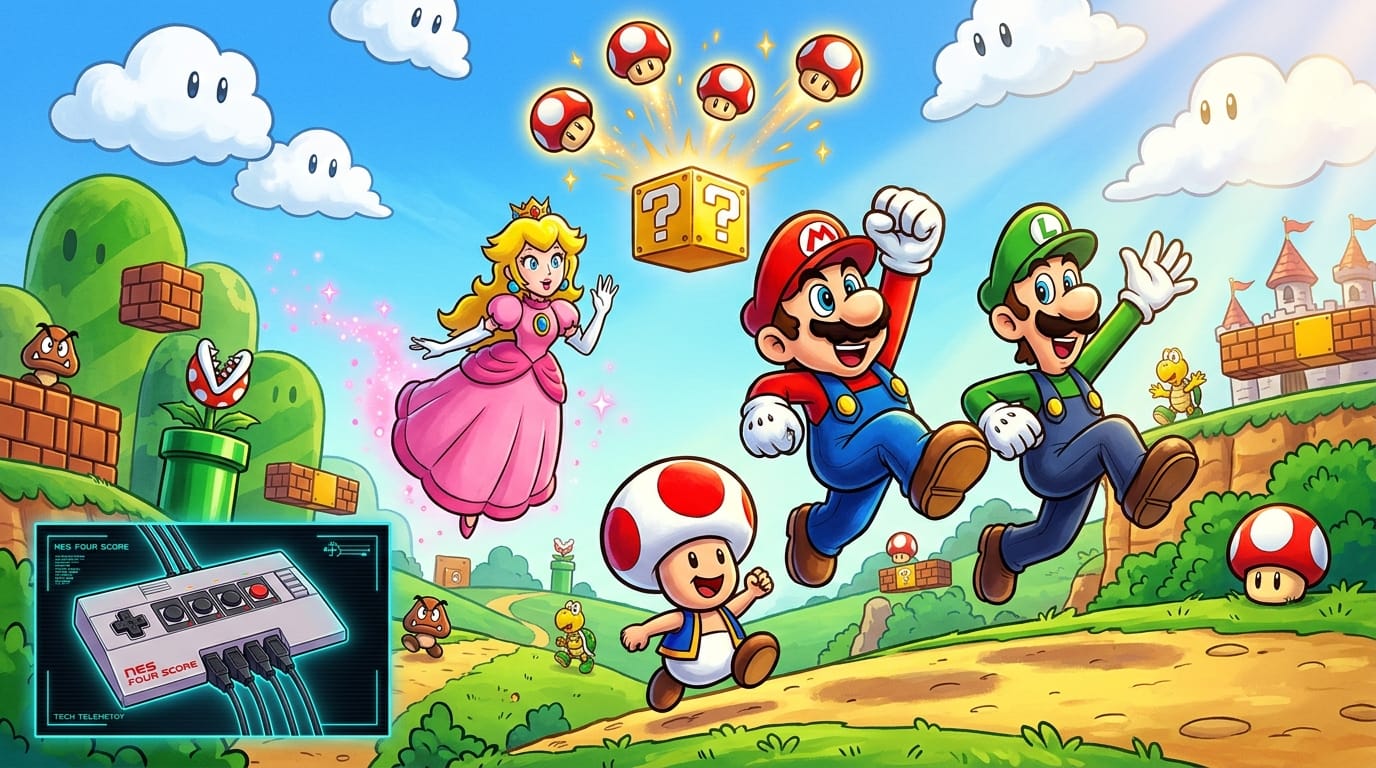

For forty years, one of the greatest minor heartbreaks of retro gaming has been passing the controller. In 1985, Shigeru Miyamoto and Takashi Tezuka gifted the world Super Mario Bros. on the Famicom and NES. But if you had a sibling, cousin, or friend over, "2 PLAYER GAME" was an agonizing exercise in taking turns. You didn't run through the Mushroom Kingdom together—you sat on the rug waiting for Luigi to die so Mario could take his next turn.
When tech journalist and legendary retro computing historian Benj Edwards (author of Vintage Computing and Gaming) sat down with his kids to play the NES original, they faced that exact same 1985 disappointment. So Edwards decided to fix history.
Unboxing a mint-in-box NES Four Score adapter he bought on clearance at Toys "R" Us for $2.98 back in the 1990s, Edwards teamed up with Anthropic’s Claude Opus 5.5 via Claude Code to tackle one of the most ambitious 6502 assembly retroengineering projects in recent memory: Super Duper Mario Bros. 4P.
The result is nothing short of magical: up to four players, on one shared screen, playing simultaneously on real NES hardware—complete with character selection, modern catch-up mechanics, head-bouncing, shared lives, and protective bubbles straight out of New Super Mario Bros. Wii.
The Gang’s All Here: Mario, Luigi, Toad, and Floating Peach
Unlike simple color-palette swaps, Super Duper Mario Bros. 4P elevates the 1985 sandbox into a legitimate four-player party platformer. From the title screen, players use their individual controllers to select from an iconic roster:
- Mario: The classic, balanced plumber who started it all.
- Luigi: Mario's taller brother, sporting his trademark green-and-white palette.
- Toad: The speedy Mushroom Kingdom retainer, with custom sprites adapted from Super Mario Maker 2.
- Princess Peach: Fully playable with custom sprites adapted from Super Mario Bros. 2 and Super Mario Maker—and crucially, her signature hovering jump ability from SMB2 is fully backported into the SMB1 physics engine! Holding Jump allows Peach to float gracefully across gaps, opening up entirely new routing possibilities through classic stages.
Every character features fully distinct small, super, and fire-flower states. And in a delightful touch of retro fan service, if someone plays through World 8-4 as Princess Peach, the captive princess waiting in Bowser's castle isn't a duplicate Peach—it’s Rosalina, and the final congratulatory castle banner proudly proclaims: "THANK YOU EVERYONE!"
Modern Co-Op Mechanics on 8-Bit Silicon
Making a four-player game fun requires far more than just rendering four sprites on screen. Without modern quality-of-life mechanics, classic platformers become frantic meat-grinders where one player drags everyone else into bottomless pits. Edwards and Claude solved this by backporting the best cooperative innovations from Nintendo's 2000s and 2010s playbook into 1985 assembly:
- The Bubble Rescue System: Borrowed directly from New Super Mario Bros., any player can press Select at any time to retreat safely into an invincible floating bubble that drifts behind active teammates. Pressing Select again pops you right back into the action. It is the ultimate anti-frustration feature for playing with young kids or navigating precision platforming sections.
- Drop-In / Drop-Out Co-Op: Controllers without an active player can simply press Start to drop into the current level instantly.
- Shared Lives & Seamless Respawns: When a player falls, they don't wait for a Game Over screen. They immediately respawn beside an active partner, borrowing a life from whoever has the largest stash. The level only resets if all four players are wiped out simultaneously.
- Head Bouncing: Players can bounce off each other's heads to reach high coin blocks, bypass tricky hazards, or accidentally launch friends into Piranha Plants.
- Four-Player Item Drops: Hitting a Power-Up block doesn't cause a fight over a single Super Mushroom—it spawns an item for every active player on the screen.
- Redesigned Status Bar: The iconic top HUD has been overhauled to cleanly track scores and coin counters for all four players simultaneously.
- Infinite Lives Toggle: For chaotic, low-stakes family game nights, pressing Select repeatedly on the title screen toggles an official Infinite Lives mode.
Engineering Magic: Breaking the NROM Barrier with MMC3
The original 1985 Super Mario Bros. was engineered within microscopic hardware boundaries. It ran on Nintendo's discrete NROM cartridge board, restricted to just 32 KB of Program ROM (PRG) and 8 KB of Character ROM (CHR). In that constrained sandbox, there was literally zero room to store additional character sprite tables, Four Score input polling routines, four distinct player velocity states, or bubble physics.
To overcome this, Edwards and Claude migrated the codebase from Doppelganger’s famous SMB disassembly to MMC3 (Mapper 4)—the sophisticated memory management chip that powered late-era NES masterpieces like Super Mario Bros. 3. By upgrading to MMC3, the mod expands the cartridge to:
- 256 KB of Program ROM: Providing ample banked memory for four parallel player routines, custom AI behaviors, and expanded level scripts.
- 8 KB of CHR-RAM: Allowing dynamic loading of custom Toad and Peach sprite sheets on the fly.
- 8 KB of Work RAM: Dedicated memory for multi-player collision caches, bubble physics arrays, and Four Score state tracking.
Because the NES Picture Processing Unit (PPU) is hard-wired to render a maximum of 8 hardware sprites per horizontal scanline (and a super character consists of 8 sprites), four players standing on the same plane inevitably trigger hardware sprite multiplexing and visual flicker. Yet through optimized frame interleaving, testing across real NES consoles and MAME cycles confirmed the engine runs between 92% and 100% full speed even in packed levels.
How to Play It on Real Hardware & Emulators
Super Duper Mario Bros. 4P is distributed as a clean, legal BPS patch (available on GitHub) that you apply directly to your legally owned copy of Super Mario Bros. (World) for the NES.
1. Real NES Hardware & Flash Carts
Flash the patched ROM (Super Duper Mario Bros 4P.nes, 262,160 bytes) to an MMC3-compatible flashcart such as the EverDrive N8 Pro or RetroUSB PowerPak. Plug an NES Four Score or NES Satellite into Ports 1 and 2, ensure the physical switch is set to "4 Players", and plug in four original NES controllers. (On original Famicom hardware, controllers plugged into the front expansion port serve as Players 3 and 4).
2. Modern Emulators
Load the ROM into any modern accurate NES emulator with multitap support:
- Mesen / FCEUX / Nestopia UE: In the input settings, toggle Port 1/2 from Standard Controller to NES Four Score.
- RetroArch: Under Quick Menu > Controls, set Device Type for Port 2 to NES Four Score.
MAME: Launch with multitap controllers mapped via:
mame nes -cart "Super Duper Mario Bros 4P.nes" -ctrl1 4score_p1p3 -ctrl2 4score_p2p4The Creative Potential of AI-Assisted Retro Development
Beyond being an absurdly fun couch co-op brawler, Super Duper Mario Bros. 4P represents a milestone in how modern AI tooling can collaborate with human domain experts. Tech historians and retroengineers often possess deep conceptual knowledge of vintage hardware architectures, mappers, and register constraints, but writing tens of thousands of lines of cycle-accurate 6502 assembly by hand has historically been a multi-year slog.
By pairing Benj Edwards’ design direction, hardware testing on real CRTs, and historical context with Claude Opus 5.5’s ability to parse, refactor, and bank-switch assembly code, a forty-year-old childhood wish became a living, breathing reality in a matter of weeks.
Grab three friends, plug in the Four Score, and pop those bubbles. The Mushroom Kingdom has never felt so lively.
Check out the project, grab the patches, and follow ongoing development at GitHub: benj-edwards/SuperDuperMarioBros4P.