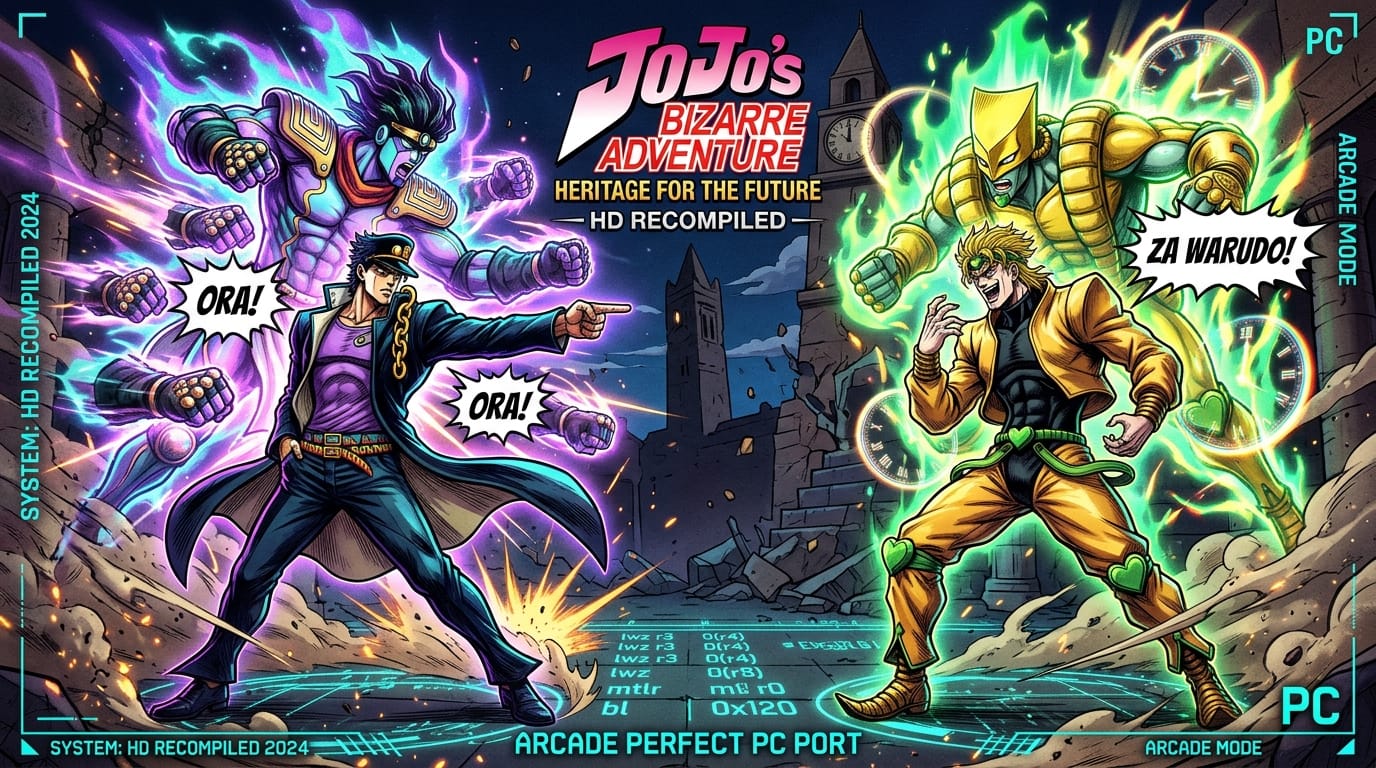

For more than a decade, one of Capcom’s greatest and most visually exquisite 2D fighting games has been a digital ghost. In August 2012, Capcom released JoJo’s Bizarre Adventure HD Ver. on Xbox Live Arcade and the PlayStation Network—a lovingly upgraded remaster of the legendary 1999 CP System III (CPS3) arcade masterpiece, Heritage for the Future. It offered pixel-perfect arcade sprites, redrawn high-definition user interfaces, optional graphic smoothing filters, and online netplay.
Yet barely two years later, in September 2014, Capcom’s publishing licensing agreement with Shueisha and series creator Hirohiko Araki expired. Overnight, the title was permanently delisted from both the Xbox 360 Marketplace and the PS Store.
For twelve years, JoJo HD existed as trapped abandonware—playable only on dying hardware or shackled to the high CPU overhead, shader-compilation stutters, and input latency of Xbox 360 emulators like Xenia. Today, that digital purgatory has been shattered.
Developer UNREALWINS has released jojo-hd-recompiled (v1.0 Beta), a native, static-recompilation PC port of the Xbox 360 release powered by ReXGlue that executes natively on Windows with zero emulation overhead, crystal-clear 4K rendering, and frame-perfect response times.
The Power of ReXGlue: Turning Xbox 360 Binaries into Native PC Code
Unlike traditional emulation—which must simulate an entire Xbox 360 console (three 3.2 GHz PowerPC Xenon CPU cores, an eDRAM-backed Xenos GPU, and an OS kernel) in real time—static recompilation takes the original executable (default.xex) and translates its PowerPC machine code directly into native C/C++ x86-64 instructions before runtime.
Built upon the ReXGlue v0.10.0 recompilation framework, JoJo HD Recompiled eliminates the heavy emulation tax entirely. By leveraging native graphics plugins like Xenos / DirectX 12 / Vulkan, the game communicates directly with modern PC GPUs, ensuring silky 60 FPS fighting game gameplay without the microscopic hitching that can ruin tight combo executions and Stand activations.
The public v1.0 Beta release includes:
- Full-Game Playability: Reaching full gameplay testing across character selection, Arcade Story ladders, Challenge modes, and local Versus matches without illegal-instruction crashes.
- Native Windows Launcher & Helper: A lightweight, portable C++ launcher (
JoJo HD Launcher.exe) and background session helper that manages display resolution, true fullscreen execution, clean cursor capture, and F12 exit confirmations. - Local File Verification: Automated scripts (
PREPARAR_JOGO.bat) that verify the user's legally extracted game files without uploading or modifying copyrighted assets.
The 257-Crash Nightmare: Solving the PowerPC bctr Codegen Flaw
Getting JoJo HD to run natively was not a straightforward automated translation; it required unraveling a deep, elusive architectural flaw in ReXGlue's code generator.
In Xbox 360 PowerPC assembly, indirect branching and dynamic jump tables rely on the Count Register (CTR) via the bctr (Branch to Count Register) instruction. In stock ReXGlue v0.10.0, the compiler generator (build_bctr) had a fatal flaw: it generated jump-table switch dispatchers based on the original general-purpose register (GPR) index (e.g., ctx.r7.u32) instead of the actual resolved destination stored in the CTR (ctx.ctr.u32).
In JoJo HD, Capcom's compiler aggressively optimized control flow by constantly overwriting, scaling, or loading new destination pointers into that register prior to jumping. Consequently, ReXGlue's generated C++ code would attempt to match an overwritten index against the original table, fail the switch, fall into __builtin_trap(), and instantly hard-crash the game to the desktop.
During the arduous development series, UNREALWINS manually tracked down and documented 257 individual function overrides across critical routines (including sub_822C6420, sub_8212B868, sub_82121D20, and sub_821704D0). But requiring community members to hand-edit 257 overrides across millions of lines of generated C++ was untenable.
Instead, UNREALWINS engineered a systemic fix to ReXGlue's source itself (control_flow.cpp):
- Automatic CTR Address Switching: Overhauls generated jump-table dispatchers to switch on resolved
CTRtarget addresses rather than fragile general-purpose index registers. - Destination Deduplication: Prunes duplicate jump targets from generated switch cases.
- Indirect Fallbacks: Replaces the catastrophic out-of-range
__builtin_trap()with a safe indirect fallback jump to theCTRdestination. - Automated Tooling: The project includes an automated patcher (
APLICAR_PATCH_REXGLUE.bat) and a validation audit script (AUDITAR_BCTR_GERADO.bat) that scans the generated C++ to guarantee zero vulnerable dispatch patterns remain.
Why JoJo HD Remains a Fighting Game Masterpiece
For fighting game purists and anime fans alike, Capcom’s JoJo adaptation holds legendary status. Built during the peak of Capcom's 2D sprite golden age alongside Street Fighter III: 3rd Strike, the game captured Hirohiko Araki’s Part 3 (Stardust Crusaders) with unmatched visual flair.
The game pioneered the revolutionary Stand System—allowing players to summon their spectral avatars (from Jotaro's Star Platinum to DIO's The World) to fight alongside them, alter their movesets, execute tandem attacks, and manage a dedicated Stand Gauge that could be broken by sustained pressure.
With JoJo HD Recompiled, players finally have access to the ultimate version of this combat engine: the razor-sharp visual clarity and remastered UI of the 2012 release, combined with the zero-latency responsiveness and native resolution freedom that only native PC compilation can provide.
The Recompilation Revolution Is Unstoppable
The release of JoJo HD Recompiled adds another dazzling victory to what has become the greatest week in video game preservation history. In the span of mere days, we have witnessed:
- Demon's Souls Recomp: The 2009 PS3 classic running natively on PC in 4K at 240+ FPS via
ps3recomp. - Super Duper Mario Bros. 4P: Tech historian Benj Edwards and Claude Opus 5.5 bringing 4-player simultaneous co-op to the 1985 NES original.
- Bloodborne (bbport 0.6): Fully online on PC with 5-player seamless co-op and player notes.
- Destiny 1: Running natively inside the Destiny 2 PC engine in an unprecedented "Tale of Two Wastelands" triumph.
- Halo CE (Chupathingy) & SSX 3 Recompiled: 6th-gen console titan ports delivering native 120 FPS Vulkan gameplay.
When corporate rights-holders abandon their catalogs due to expired licensing contracts, digital storefront shutdowns, and corporate apathy, the gaming community no longer shrugs its shoulders. Open-source recompilation tools are liberating history from the dustbin of lost media—one binary at a time.
Prepare your Stand. Time has officially unfrozen.
Check out the project repository, build scripts, and automatic codegen patch at GitHub: UNREALWINS/jojo-hd-recompiled. (Note: You must provide your own legally extracted default.xex from a licensed copy of the Xbox 360 release).