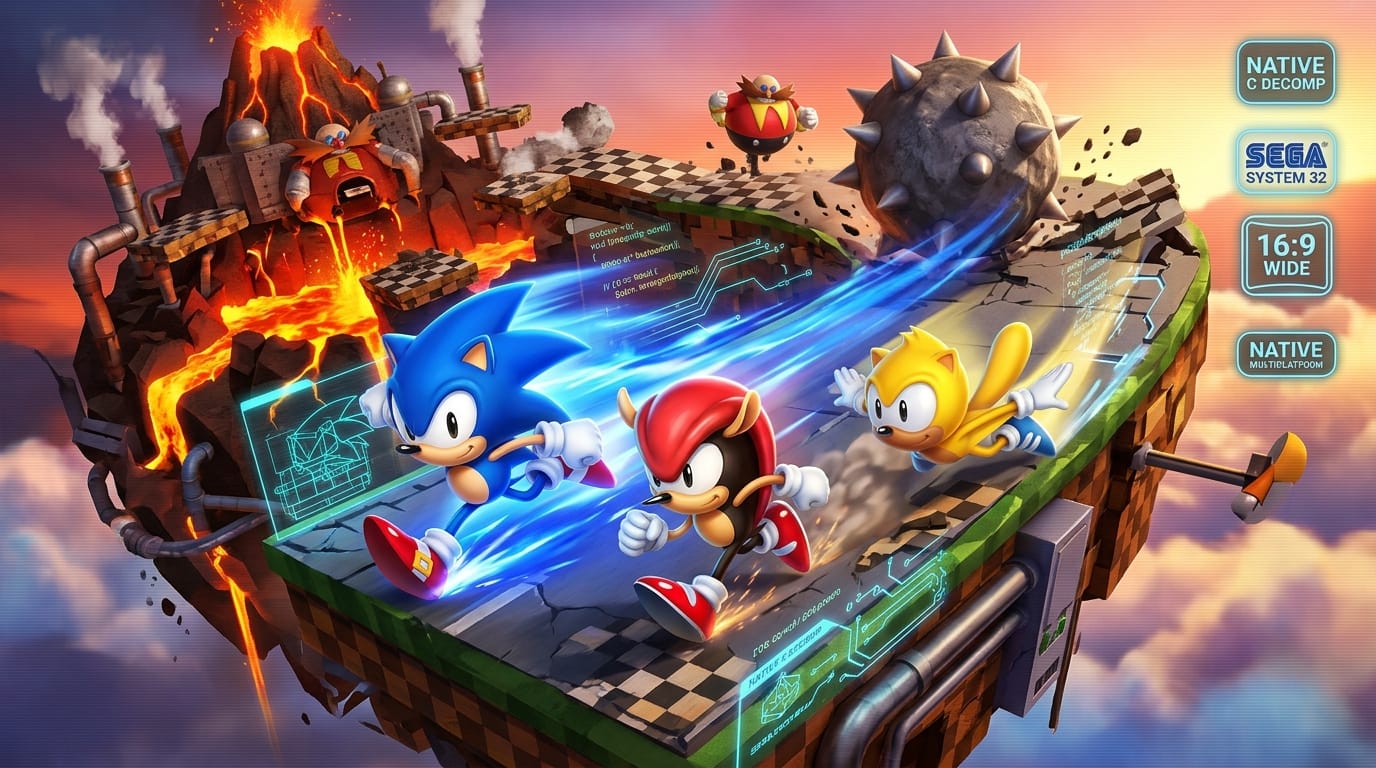

For over three decades, SegaSonic The Hedgehog remained one of the most tantalizing white whales in video game preservation. Released exclusively in arcades in 1993 on Sega's formidable System 32 hardware, the game introduced Sonic fans to Mighty the Armadillo and Ray the Flying Squirrel in an isometric, high-speed escape across Eggman's trap-filled volcanic island. Yet despite Sonic's astronomical popularity, the game never received an official home console release, passed over for the Mega Drive, Sega Saturn, Dreamcast, and multiple retro compilations.
The primary culprit was its hardware: SegaSonic was designed entirely around high-speed, dual-axis arcade trackballs that players furiously spun to outrun collapsing bridges, falling stalactites, and giant rolling boulders. Emulating trackball physics on standard gamepads proved awkward, and the complex System 32 board created emulation bottlenecks for decades. Today, developer cheviman has shattered that barrier with segasonic-port, a native C port built from the ground-up source code decompilation project segasonic-decomp.
From Motorola 68000 Assembly to Native C
Rather than packaging the original ROMs inside an emulator, cheviman painstakingly reverse-engineered the arcade binary into clean, readable, portable C. By decompiling the Sega System 32's dual-CPU architecture (a primary Motorola 68000 paired with a Zilog Z80 for Yamaha YM2612 and Ricoh RF5C68 audio), the game now compiles into pure native machine code for modern operating systems:
- Windows x64: Standalone portable desktop binaries.
- Linux x64: Full native support for desktop Linux and handheld PCs like the Steam Deck.
- macOS Universal: Native execution across both Apple Silicon (M1/M2/M3/M4) and Intel Macs.
- Nintendo Switch: Full homebrew release running at locked native framerates.
- Android: Complete touchscreen and gamepad package for mobile phones and retro handhelds.
- Anbernic H700: Optimized builds for affordable budget Linux handhelds like the RG35XX series.
Like other premier decompilation projects, the repository adheres strictly to digital copyright ethics. Zero proprietary assets, sprites, or sound effects are distributed in the codebase. Instead, the port includes an automated extraction pipeline: players provide a legally dumped MAME ROM set (sonic.zip, Japan Revision C), and the tool extracts every graphic, audio sample, and level script into a clean, modern segasonic.assets container in seconds.
Two Ways to Play: Pure Arcade Parity vs. Modern Console Edition
Recognizing that purists and modern players have different desires, cheviman structured the project around two distinct executables, each offering a fundamentally different experience:
1. SegaSonic Arcade (1:1 Frame-by-Frame Parity)
For purists, competitive speedrunners, and arcade cabinet owners, SegaSonic Arcade delivers 100% mathematical fidelity with the original 1993 System 32 PCB. It retains the coin-insertion mechanisms, service menus, DIP-switch configurations, original 4:3 CRT aspect ratio, and raw trackball impulse routines. If you have an arcade cabinet equipped with USB trackballs, this executable drops right in with zero emulation latency.
2. SegaSonic (“The Console Remaster”)
The crown jewel of the release is the dedicated “Console” executable. Cheviman reimagined what an official Sega Saturn or Dreamcast home port would have looked like if Sega had invested modern remaster budgets into it:
- 16:9 Widescreen Mode: Rather than stretching or cropping the image, the engine dynamically expands the rendering camera, revealing previously off-screen terrain on the isometric plane.
- Gamepad & Analog Controls: Smooth analog stick motion that translates modern controller vectors into the game's directional velocity curves, alongside mouse trackball simulation for PC desktop setups.
- 3-Player Simultaneous Play: Full plug-and-play support for three separate gamepads, allowing Sonic, Mighty, and Ray to race together on modern couches without coin counters.
- Restored English Localization: The original arcade release only appeared in Japanese arcades, though an incomplete English translation existed in the ROM. This port restores and integrates clean English text boxes for international audiences.
- Quality-of-Life Upgrades: Unlimited free play, modern save states, stage select, practice modes, CRT scanline filters, and dedicated Time Attack leaderboards.
- One-Click Handheld Builders: Bundled utility executables (
SegaSonic NSP.exeandSegaSonic APK.exe) allow users to generate Switch and Android installation packages with a single click.
The Golden Age of Game Decompilations Continues
The release of segasonic-port marks another massive milestone in the golden age of source decompilations. Following recent community triumphs with Super Mario 64, The Legend of Zelda: Ocarina of Time (Ship of Harkinian), SSX 3, Panzer Dragoon Saga, and Futurama: The Game, reverse engineering continues to prove that game preservation is best handled by passionate fans.
For thirty-one years, SegaSonic The Hedgehog was treated as an inaccessible historical curiosity. Now, it is one of the most accessible and versatile retro titles on PC, Steam Deck, Switch, and Android. You can explore the project, inspect the source code, and download the latest release binaries directly from the segasonic-port GitHub repository.