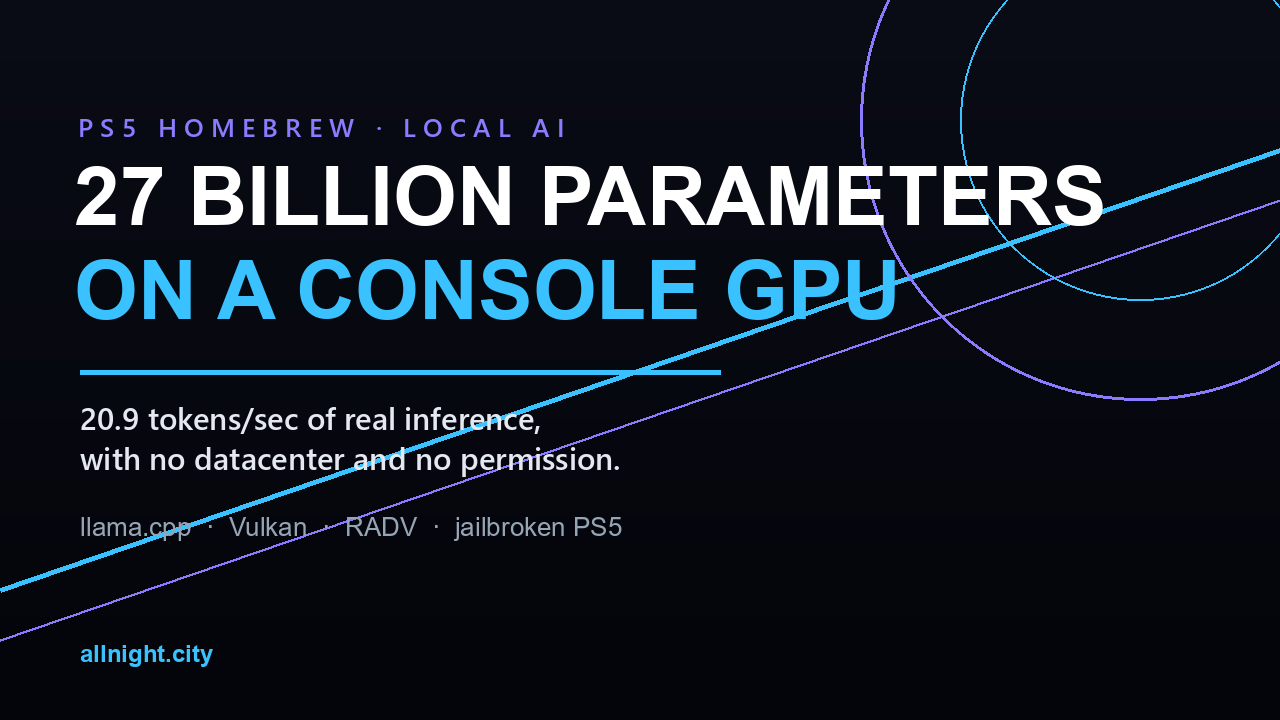

Here is a sentence that should not be possible: someone took a retail PlayStation 5, jailbroke it, and is now running a 27-billion-parameter AI language model on its GPU at roughly 20 tokens per second. Not a toy demo. Not a stripped-down 1B model. Qwen 3.8 27B, the real thing, generating text on a games console, locally, with no cloud, no subscription, and no permission from anyone.
The claim comes from chasm (@chasmmmmmmmmmmm), who posted it on October 14, 2026 alongside a link to the project behind it. The detail that makes it land is the comparison: the same 27B model, running on the PS5's CPU, managed about one token per minute. On the GPU, it does twenty per second. That is not an improvement. That is a different universe.
NOT EVEN THE PLAYSTATION 5 IS SAFE. Someone jailbroke a PS5 and got Qwen 3.8 27B running on its GPU at 20 tok/s. That's a real 27B AI model running locally on a games console. The same model on the PS5's CPU did about one token a minute. Meanwhile, DDR4 prices are up 24% in 3 months, AMD just raised GPU memory prices, and 5090s are basically gone. PS5 coming to a datacenter near you. Posted by chasm (@chasmmmmmmmmmmm) October 14, 2026
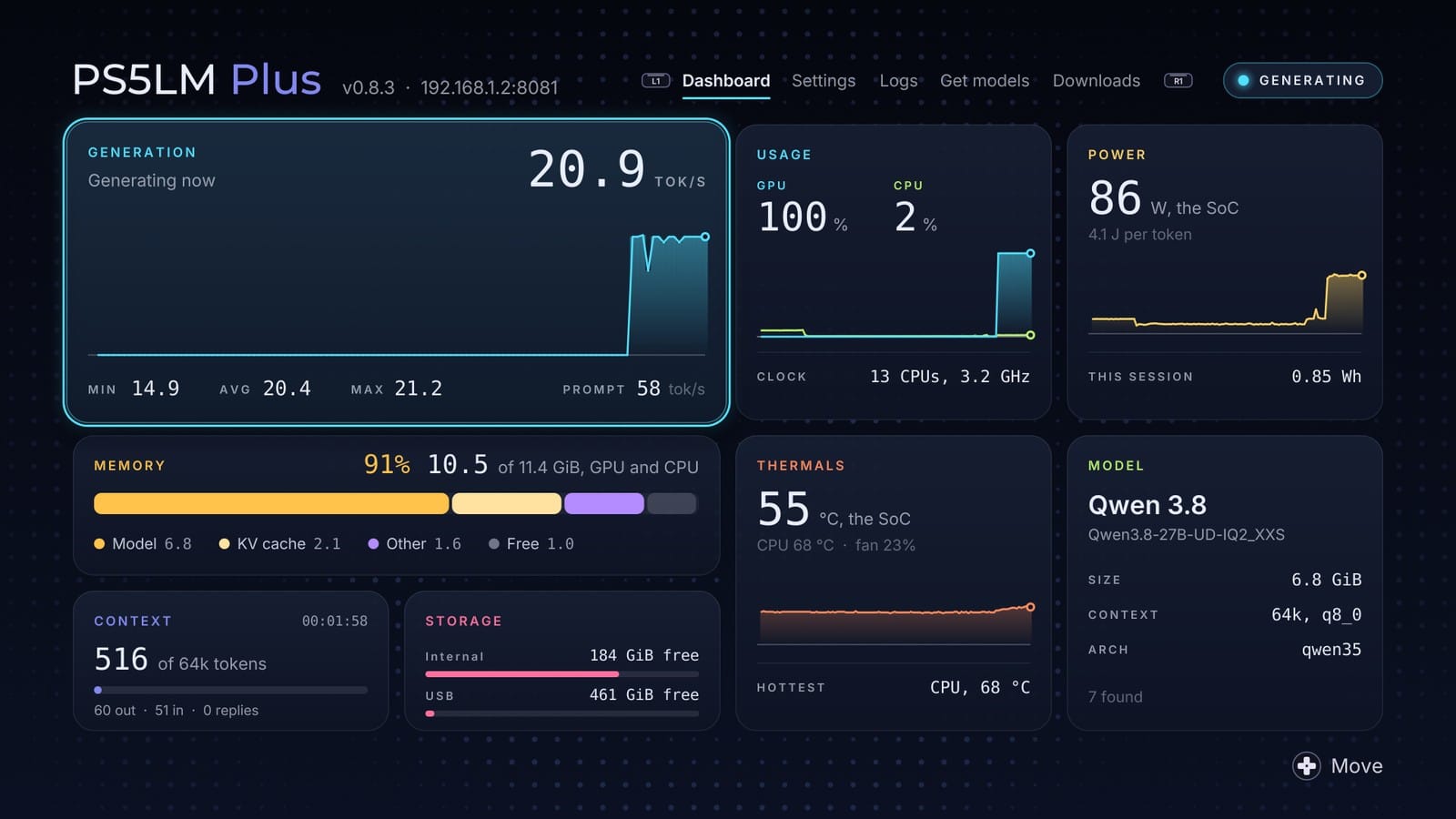
What PS5LM Actually Is
PS5LM is a port of llama.cpp to the PlayStation 5. It was created by Mert Cobanov (cobanov/PS5LM, ps5lm.cobanov.dev), whose work covers the llama.cpp port, the original payload, its model library, and the research underneath it all.
The version climbing the charts right now, abhi245y/PS5LM, is a fork called PS5LM Plus. It adds a native GPU application on top of Cobanov's foundation, and the author has offered it back upstream. The distinction matters, because the whole trick is in the difference between a payload and a native app.
The core insight, in one line: a payload gets about 6 GiB of memory and no GPU. A native app (a title) gets the console's full 12 GiB of direct memory and the GPU. Running llama.cpp as a title is what turns a curiosity into a genuinely useful machine.
Under the hood, PS5LM Plus is llama-server running on ggml's Vulkan backend, through RADV, the open-source Vulkan driver that Mihawk-99 ported to the PS5. The whole thing lives in a single 11.44 GiB device heap. No Sony SDK. No proprietary GPU drivers. Just open-source graphics plumbing aimed at hardware it was never meant to run on.
The Numbers
The project publishes its own benchmarks, and they are the reason people are paying attention. These are real, measured generation speeds on the console's GPU:
| Model | Size | Context | Generation |
|---|---|---|---|
| Qwen 3.8 27B (UD-Q2_K_XL) | 9.2 GiB | 32k, q4_0 cache | 20.3 tok/s (a 7,775-token answer held at 19.7) |
| Qwen 3.8 27B (UD-IQ2_XXS) | 6.8 GiB | 64k, q8_0 cache | 20.7 tok/s |
| Gemma 4 E4B QAT q4_0 (USB) | 4.8 GiB | 64k, q4_0 cache | 61 tok/s |
| Llama 3.2 3B Instruct Q4_K_M (USB) | 1.9 GiB | 64k, q8_0 cache | 124 tok/s |
For scale: 20 tokens per second is faster than a lot of people read, and it is genuinely usable for chat, coding help, and long-form text generation. The 3B model at 124 tokens per second is faster than most cloud endpoints feel. And then there is the CPU number, sitting there like a punchline: the same 27B model, run as a payload and streamed from disk, produced roughly one token per minute. The GPU is not a nice-to-have here. It is the entire product.
Why a Games Console Is Suddenly an AI Box
Here is the part that turns a neat hack into something that should make the hardware industry nervous. A PlayStation 5 contains a Zen 2 CPU, an RDNA 2 GPU, and 16 GB of fast unified GDDR6 memory, and it can be bought used for a fraction of what a graphics card with comparable VRAM costs right now. That last clause is doing a lot of work.
As chasm points out in the tweet, the memory market is a mess: DDR4 prices up around 24% in three months, AMD raising GPU memory prices, and flagship cards like the RTX 5090 effectively unavailable. When dedicated AI hardware gets scarce and expensive, a cheap, powerful, memory-rich box starts to look very attractive, especially one that already sits under millions of televisions and can now run a 27B model locally. Hence the tweet's punchline, delivered half as a joke and half as a prophecy: PS5 coming to a datacenter near you.
The uncomfortable math: a console built to sell you games, jailbroken, running open-source software, is now competitive at a task the manufacturer never intended it for and actively tried to prevent. The hardware was always capable. The only thing missing was the lock, and the lock is gone.
The Hardware Was Never the Problem
We have said this before, and we will keep saying it: the PlayStation 5 is a general-purpose computer wearing a console's clothes. It is an AMD x86-64 machine with a modern GPU and a generous pool of unified memory. Nothing about running a language model on it is exotic. What kept it locked to games was never silicon. It was software, licensing, and a hypervisor configured to keep the owner out.
That is exactly why the hypervisor work matters. As we covered in our report on Byepervisor Reborn, the deepest layer of the PS5's security model fell on modern firmware. Once the machine stops fighting its owner, the same pattern shows up everywhere: the hardware was fine, the software was fine, and the only real obstacle was a permission bit that somebody else controlled. PS5LM is what that unlocked hardware looks like when you point it at something other than a game.
What You Actually Get
PS5LM Plus is not a command-line curiosity. It is a full application built to run on the console and be driven from the couch or from your PC. According to the project, that includes:
- A live dashboard on the TV: generation speed with history, GPU and CPU load, SoC power draw and energy per token, temperatures and fan speed, the memory pool and how the model, KV cache, and everything else split it, context in use, and storage across every drive.
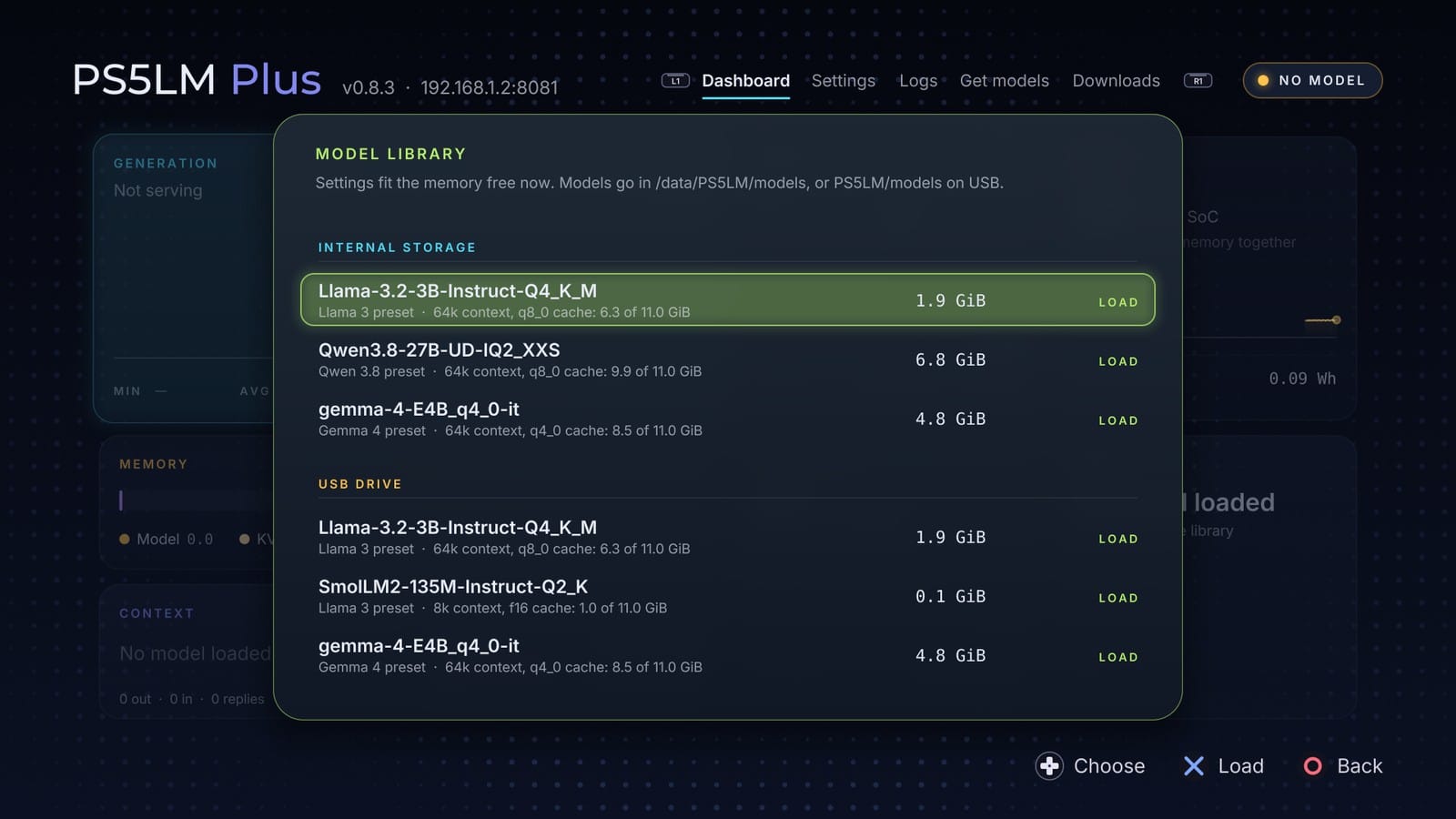
- A model library: every
.gguffile on internal storage, an M.2 drive, or USB, grouped by drive, each shown with the context and KV cache it would receive and whether it fits. A model on USB or M.2 loads straight from the drive. - A built-in model store: Hugging Face's GGUF repositories, sorted by most downloaded or by family, with each file's size and a fit check read from the first 16 MiB of the file.
- Real downloads: a queue that survives dropped connections, pauses, and app restarts, resuming where it stopped, retrying on its own, and verifying every file against its SHA-256 hash.
- An OpenAI-compatible API: so any device on your network can talk to the model running on your console.
And because it is llama.cpp underneath, it is not tied to one model. Qwen, Llama, Mistral, Gemma, and anything else llama.cpp supports comes along, across quantizations from 1-bit to 8-bit. Earlier console AI experiments hand-wrote GPU kernels for a single model at a time. Porting llama.cpp itself means you inherit the entire ecosystem the day it boots.
The Bigger Picture
Step back and look at the pattern. Within a single week, the community ran a 27B language model on a PlayStation 5's GPU, cracked open the console's hypervisor on modern firmware, and kept rebuilding decades-old games into native PC code. None of it was asked for. None of it was funded. None of it needed a roadmap, a marketing budget, or a permission slip. It needed people who wanted the machine they bought to do more than it was allowed to.
Every locked platform in existence is built on the same assumption: that the owner will accept the boundary as permanent. PS5LM is another crack in that assumption, and this one is unusually hard to argue with. A box designed to sell you games is now a perfectly serviceable local AI machine, running open software, on hardware you paid for, with a dashboard on your TV. The manufacturer's only contribution was the lock, and the community took that off too.
The console you bought is more powerful than the console you were sold. It took a jailbreak, a Vulkan driver, and a port of llama.cpp to prove it, but the proof is now generating text at twenty tokens per second, out loud, on a machine that was never supposed to be able to do this at all. Nobody gave them permission. Nobody needed to.
Resources & Links
- Source (fork, "PS5LM Plus"): abhi245y/PS5LM on GitHub
- Original project: cobanov/PS5LM by Mert Cobanov (ps5lm.cobanov.dev)
- The claim: chasm (@chasmmmmmmmmmmm) on X
- Engine: llama.cpp / ggml · PS5_Vulkan (RADV)
- Enabling exploit: Byepervisor Reborn: the PS5 hypervisor falls
- Requirements: A jailbroken PS5 on supported firmware, the PS5-Payload-Dev toolchain for building, and GGUF model weights you supply yourself. The repository ships no Sony SDK files, no keys, no firmware, and no model weights.