
There is a certain kind of developer who looks at a piece of software and decides the reasonable thing to do is build it again. Not a clone of the interface, not a skin over the same engine, but the whole thing, from an empty file, because the idea is worth having and nobody is going to hand it over.
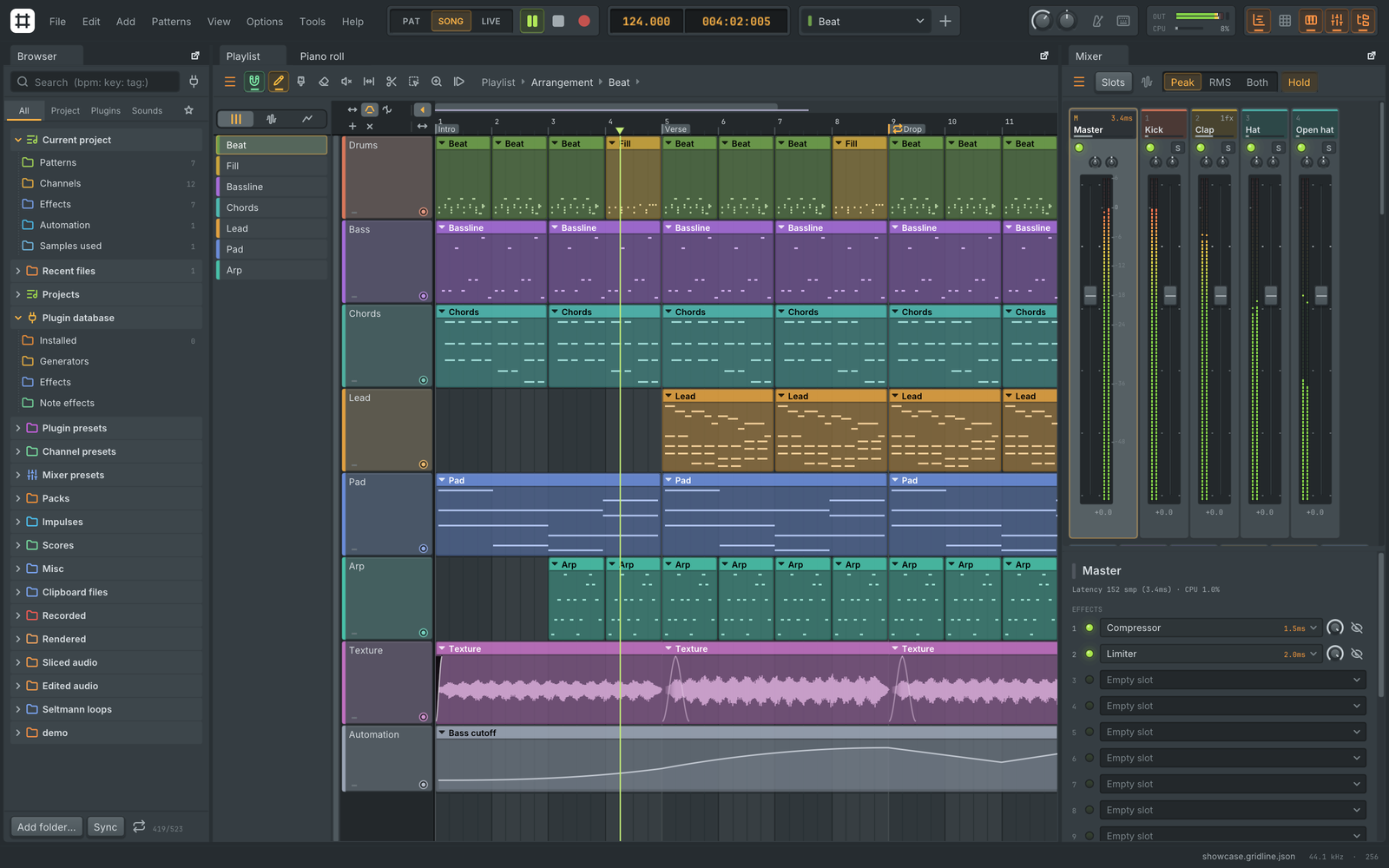
Gridline is that, aimed at FL Studio. It is a free, open source music workstation built around the grid: channel rack, step sequencer, piano roll, playlist, mixer, written from scratch in C++17 under GPL-3.0. The first commit is from 18 October 2026 and it was pushed to again this morning, which tells you how much of it is somebody else's evening.
The part that makes it interesting
Plenty of people write a DAW. Far fewer write the part where it opens your old projects, and that is where Gridline stops being a nice idea and starts being a replacement:
- It opens FL Studio projects.
.flpfiles, FL Studio zipped loop packages (.zip) and.fstpresets open like any other project. Channels, patterns, notes, playlist clips, automation, markers and mixer routing come across, including projects saved by FL Studio 2026. - It translates FL Studio's own plugins. Image-Line instruments and effects are mapped to Gridline equivalents with their settings, and Slicex chops land in Gridline's Kerf exactly: each region on its key, in its order, with its start, end and name.
- It writes them back. File, Export, FL Studio project saves a
.flpagain, or a zipped loop package with the samples and relative paths. Parts you never touched are written back exactly as they arrived, FL's own plugins keep their settings, and third-party plugins keep their host state. - It never overwrites quietly. Opening an
.flpasks where to keep the result and in which format the first time you save, so the original survives.
That is two-way project file compatibility with a commercial DAW, done by reading the format rather than licensing it. The repository lists flp as one of its topics, which is either confidence or a wiring diagram.
What else is in there
The compatibility layer is the hook, but the rest is not filler:
- Collaboration, peer to peer. One project, several people, on the same network or across the internet, end to end encrypted, no server and no account. You invite someone with a one-time code and each collaborator gets a colour, a cursor and a picture, while everyone keeps their own windows and transport.
- The Gridline Suite. 119 of its own instruments and effects as VST3, CLAP and, on macOS, Audio Unit, plus Suite Mini with 35 compact effects. They work in any DAW, not only in Gridline.
- Platter, Seltmann and Turntable. Two DJ decks and a mixer on a channel with recorded, editable automation, tempo detection and chopping for anything you drop in, and scratching on a sample.
- Stem splitting on your own machine. Any clip separates into vocals, drums, bass and other, or six stems with guitar and piano, straight onto new tracks under the clip.
- One stretch and pitch engine across clips, sampler, slices, the audio editor and the DJ decks, with Stretch, Resample and Rubber Band, sounding the same live and in the render.
- Mixer and render discipline. Plugin delay compensation, sidechains, groups, stems, a per-track EQ, and offline renders that are bit-identical whatever the buffer size.
- Lua scripting for the piano roll and for hardware controllers, a spectral audio editor, and an optional MCP server, off by default, so an AI assistant can read and edit a project.
It runs everywhere, which is the quiet part
The 0.7.0 release carries Windows on x64 and ARM64, a universal macOS build for Apple Silicon and Intel, Linux on x86_64 and aarch64 as AppImage, .deb, .rpm and tarball, and tarballs for FreeBSD, OpenBSD and NetBSD built and tested on each. SHA-256 sums ship with every release. The builds are unsigned, so macOS wants a right-click and Open the first time and Windows will mutter through SmartScreen.
On Wayland it runs natively through SDL, with one honest caveat in the notes: plugin interfaces are X11 windows and open through XWayland, and windows outside the main window need X11 or XWayland.
The trend, not the product
We have spent the last year watching static recompilation turn Nintendo 64 games into native executables, and decompilation projects rebuild whole consoles' worth of software from the binary outward. Gridline is the same instinct pointed at a tool instead of a game. The target is not a cartridge, it is a project file format and a workflow that a lot of music was written in, and the argument is the one that keeps turning up: the work should outlive the program that made it.
None of it is finished. This is a 0.7 series, one project with 28 stars, an issue tracker with nothing open and a README long enough to be a specification. Beta versions ship as pre-releases, so the stable line stays the boring one. If you make music and have a folder of old .flp files, that is the interesting test: open one, see what survived.
Downloads and source: github.com/lolitemaultes/Gridline. Gridline is an independent project, not affiliated with or endorsed by Image-Line; FL Studio is a trademark of Image-Line Software and appears here only to describe file compatibility.