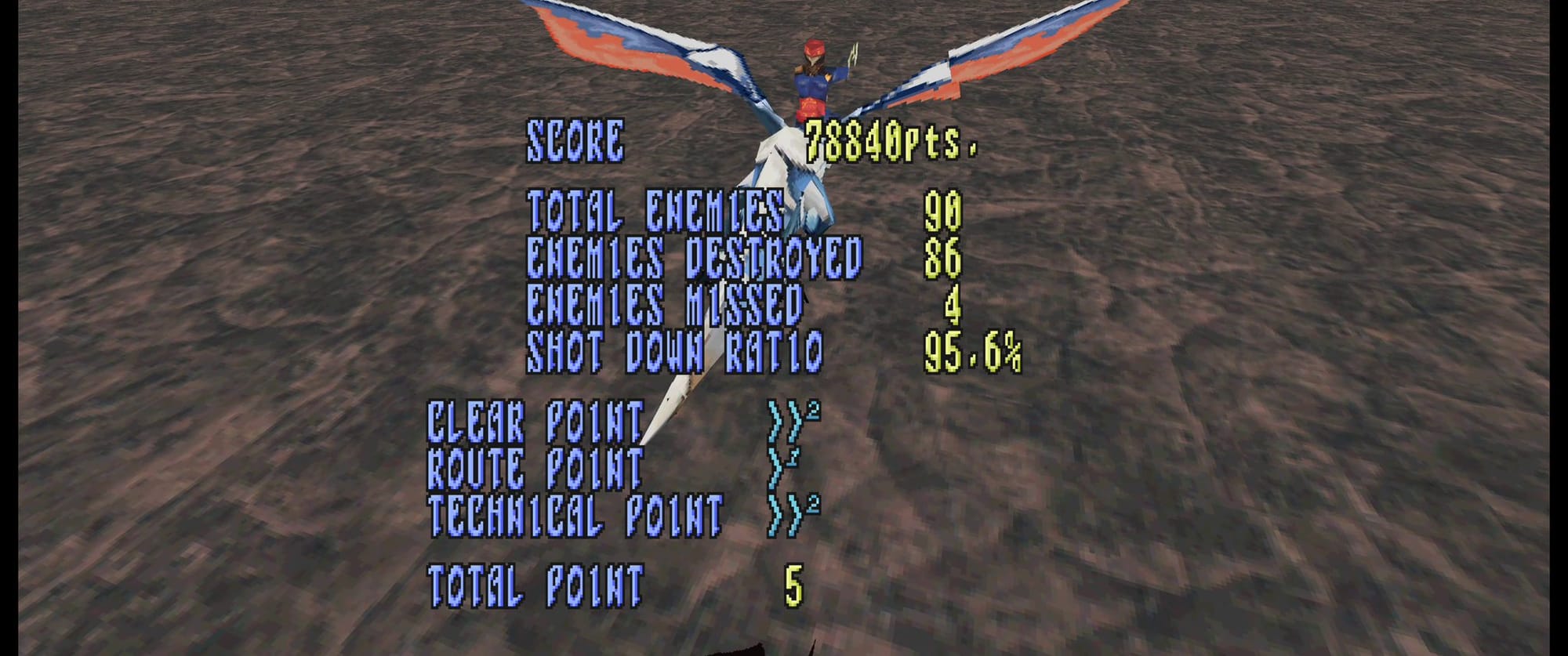

devMiyax does not do things by halves. The author of the Yaba Sanshiro Saturn emulator, who earlier this month released a native PC recompilation of Panzer Dragoon Saga - the game Saturn owners have been asking for since 1998 - has started on his second: Panzer Dragoon Zwei, the 1996 prequel that quietly outdid its more famous predecessor.
He announced it on 30 October with a feature list that reads less like a port and more like a correction of the original hardware's compromises: high-resolution rendering, accurate floating-point coordinate transformations, perspective-correct texture mapping using preserved Z-values, and one genuinely new addition that the AZEL recompile never had - 60 FPS support through frame interpolation.

I'm working on Panzer Dragoon Zwei as my second Sega Saturn recompilation project!
Building on the improvements I made in Panzer Dragoon Saga (AZEL):
High-resolution rendering
Accurate floating-point coordinate transformations
Perspective-correct texture mapping using preserved

What carried over from the AZEL work
The first three bullets are housekeeping in the best sense - they are the things that make a recompilation feel like a fixed version of a game rather than a clever hack wearing its ROM as a hat.
High-resolution rendering is the obvious one. The Saturn drew internally at 320x224 or 352x224; a modern renderer resolves that geometry at whatever your display actually is, so the polygons stop being suggestions.
Accurate floating-point coordinate transformations matter because the Saturn's SH-2 CPUs did geometry maths in fixed point, with all the rounding and clipping that implies. Recomputing those transforms in floating point removes the crawl and jitter the original hardware produced when objects moved near the camera - the wobble people remember as the "Saturn look" even where it was never intended.
The new feature: 60 FPS via frame interpolation
This is the headline, and it deserves a precise description, because "60 FPS" means two very different things in this scene.
Frame interpolation does not make the game simulate at 60Hz. Panzer Dragoon Zwei's logic still ticks at its original rate; what changes is that intermediate frames are generated from the motion between the real ones, so the display shows a smooth 60. Think of it as motion interpolation done in the renderer rather than inside your television - the same idea, but with access to the game's own motion and none of the display's guessing.
For a rail shooter this is a genuinely good fit. Zwei is a game about tracking targets as the camera sweeps along a fixed path; smoothness there is not cosmetic, it is aiming feedback. It is also the sort of feature that is easy to get wrong - badly tuned interpolation smears fast sprites and adds a frame of perceived latency - so shipping it as a toggle, if it ships that way, will matter.
Why Saturn recompilation is brutal
Worth restating for anyone who has not tried it. The Saturn is two Hitachi SH-2s, a VDP1 sprite and polygon unit drawing quads, a VDP2 background plane generator, a Motorola 68k driving the sound, and a small army of DSPs, all coordinated by software written to the metal and frequently timed to the scanline. There is no z-buffer to port, no clean graphics API to translate, and almost every effect in the library is the result of a programmer fighting the machine rather than asking it for something.
That is why Saturn recompilations are rare, and why devMiyax shipping two - while still maintaining an emulator that has to run the rest of the library - is a serious amount of work. It is also why the framing in his own video title is deliberate:
Panzer Dragoon Zwei - Recompile, not Remake.
No redrawn assets. No reimagined art direction. No "modernised" soundtrack. The original data stays the authority; the work is rebuilding the execution environment around it so that thirty-year-old content can run at a resolution it was never allowed to see. That distinction is the whole ethical argument for the scene, in five words.
The allnight.city Slant: interpolation is the feature every recomp should steal
The most telling detail is in the replies. Asked what they wanted, one fan aimed it straight backwards:
"60 fps for Azel, please?"
That is the market speaking. The AZEL recompile was a landmark, and the first request from the community was not more resolution or another aspect ratio - it was the smoothness its sibling project just announced. Frame interpolation is, per unit of effort, probably the highest-impact feature available to anyone recompiling a 30Hz-locked classic, and it requires touching neither the game's logic, its assets, nor its physics.
So here is the argument we would make to the scene at large: treat interpolated 60 FPS as a standard, optional, user-toggleable presentation layer, the way widescreen and 4K output became defaults. Leave it off by default for the purists, expose it for everyone else, and document what it does and does not change - so nobody mistakes a smoother picture for a different game underneath.
Zwei is a better test case than most: it is fast, it is camera-driven, and its art depends on large textured surfaces where bad interpolation would be obvious immediately. If devMiyax lands this well, the technique is proven for a large slice of the Saturn catalogue - including, one hopes, a second pass at AZEL.
Follow the project through yabasanshiro.com, where the emulator and the recompilation work live side by side.
Sources: @miyaxdev's announcement (30 October 2026, ~1,600 views), the accompanying video "Panzer Dragoon Zwei - Recompile, not Remake", and yabasanshiro.com. Feature descriptions are as stated by the developer; no build has been released at time of writing.
Perspective-correct texture mapping using preserved Z-values is the most technically interesting of the three. The Saturn has no z-buffer in the modern sense; VDP1 draws textured quads and sorts them itself, with affine mapping that warps visibly across large polygons. Keeping the original Z-values while applying perspective-correct interpolation means the textures stop swimming over surfaces exactly as they did on real hardware in 1996, without having to invent depth information the game never stored.