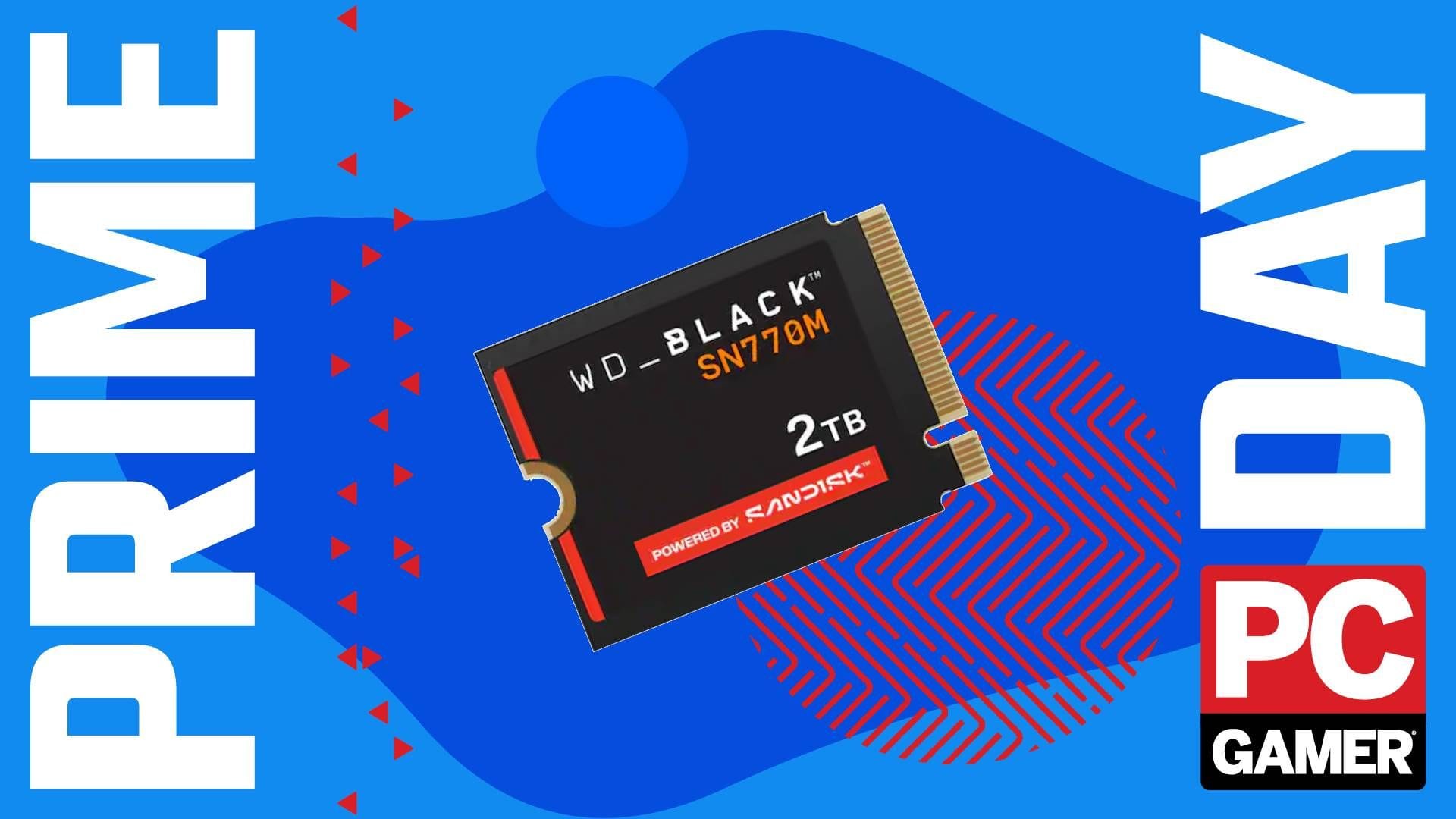

If you’ve opened any major tech publication over the past 48 hours, you have been bombarded by an avalanche of breathless affiliate banners. "Prime Day SSD Steals!" "Unbeatable Storage Deals!" "The Best Way to Beef Up Your Handheld!" Mainstream outlets are genuinely looking PC gamers and homelab builders in the eye and declaring $0.13 per gigabyte—a staggering $260 for a 2TB NVMe drive—a triumphant bargain. We need to call this exactly what it is: You are being taken for a ride.
The consumer electronics industry is running a psychological stress test on your wallet. Under the convenient banner of an "ongoing chip and wafer shortage," retailers and memory manufacturers are manufacturing artificial scarcity, testing how high they can anchor baseline prices before consumer demand breaks. But look closely at the math, the inventory, and the global fab pipeline: the narrative collapses under its own weight.
Our advice is simple, unapologetic, and urgent: Hold the line. Do not buy storage at these inflated prices. Stretch your existing hardware, purge your bloated game libraries, and starve the cartel until the market cracks.
The Memory Mirage: How We Went from $0.04 to $0.13 per Gigabyte
Corporate marketing relies on short consumer memories. Let’s refresh the historical ledger.
In mid-2023, high-performance PCIe 4.0 2TB NVMe drives—drives with DRAM caches and 7,000 MB/s sequential speeds like the Lexar NM790, WD Black SN770, and Crucial P3 Plus—were routinely selling for $75 to $85. That was roughly $0.038 to $0.042 per gigabyte. Four-terabyte drives were dipping below $160. Silicon was abundant, competition was fierce, and consumer storage felt like a solved problem.

Fast forward to late 2026. Retailers jacked the arbitrary "list price" of a 2TB 2230 handheld SSD up to $289.99, slashed thirty bucks off the top for Prime Day, and tech blogs celebrated a $260 price tag as a consumer victory. Liquid-cooled Gen5 drives from Corsair routinely clear $320 for 2TB. That is an astronomical 250% to 300% markup over historic market baselines.
Ask yourself a fundamental economic question: If global silicon foundries were genuinely gripped by an existential, famine-level shortage, why are warehouse shelves overflowing with enough consumer SSD inventory to fuel synchronized site-wide discount festivals across Amazon, Newegg, and B&H?
Real shortages produce empty shelves, backorders, and allocation queues. What we are witnessing today is an artificial pricing ceiling enforced through coordinated production cuts.
The AI Squeeze: How Enterprise Hyperscalers Starved the Consumer
The current storage market is dominated by an oligopoly: Samsung, SK Hynix, and Micron control the vast majority of global NAND flash and DRAM production. Following the catastrophic price crash of 2023, the memory cartel made a calculated strategic pivot:
- Coordinated Wafer Cuts: Beginning in late 2024 and accelerating through 2025, major suppliers slashed consumer NAND wafer starts by 20% to 35%, intentionally drying up retail channel liquidity to force contract prices back into high-margin territory.
- The HBM & Datacenter Land Grab: Rather than allocating cleanroom floor space to commodity consumer M.2 drives, foundries aggressively re-tooled advanced lithography lines for High Bandwidth Memory (HBM3e / HBM4) and high-density U.2/U.3 enterprise SSDs. Hyperscalers like Microsoft, Amazon AWS, Google, and Meta are willing to pay astronomical premiums to satisfy the insatiable KV-cache and training demands of multi-billion-dollar AI clusters.
In short: PC gamers, handheld owners, and homelabbers are being squeezed to subsidize the margins of enterprise AI infrastructure. Retailers are using Prime Day to test whether consumers will accept $0.13/GB as the "new normal." If you buy now, you validate their pricing model.
Fact Check: The 2027 Chinese Fab Tsunami Will Break the Cartel
Many readers have asked whether relief is actually on the horizon, or if consumer storage will remain trapped in this artificial bottleneck indefinitely. The answer lies in the massive semiconductor fab expansion currently reaching commercial fruition across Asia.
The claim that Chinese memory fabs will come online to break the shortage going into 2027 is 100% verified by hard industry data:
1. YMTC (Yangtze Memory Technologies Corp) & Fab 3
China's premier NAND manufacturer, YMTC, is actively completing initial equipment installation for its massive Fab 3 in Wuhan in late 2026, with aggressive volume ramping scheduled throughout 2027. Despite being placed on the U.S. Commerce Department's Entity List, YMTC successfully localized critical supply chains with domestic toolmakers (Naura, Piotech, SMEE):
- YMTC’s proprietary Xtacking 3.0 and Xtacking 4.0 architecture—which bonds a dedicated CMOS peripheral logic wafer directly to the 3D NAND array—delivers bit densities and I/O speeds that rival or surpass Samsung’s V-NAND and Micron’s 232-layer dies.
- By mid-2027, YMTC's total monthly output is projected to reach 300,000 to 400,000 wafers per month, with an explicit corporate roadmap to capture over 20% of global NAND bit supply and challenge Samsung for the global volume crown.
2. CXMT (ChangXin Memory Technologies) DRAM Expansion
In the memory space, CXMT is executing a multi-billion-dollar capacity expansion. Operating at roughly 300,000 wafers per month in late 2026, CXMT is targeting an unprecedented 420,000 wafers per month by 2027 on its advanced G5 process, flooding domestic markets with high-yield DDR5 and LPDDR5X silicon.
The Market Impact
Once domestic Chinese smartphone, server, and consumer electronics markets are fully saturated by low-cost domestic NAND and DRAM, the global memory equilibrium will fracture. Samsung, SK Hynix, and Micron will lose massive chunks of their captive Asian customer base. They will be forced to either break their artificial production discipline and slash prices to compete, or drown in unsold inventory. We will buy Chinese silicon if we have to—market competition does not care about cartel margins.
The Consumer Battle Plan: How to Hold the Line
You do not need to reward corporate price-fixing. Here is your tactical playbook for navigating the remainder of this artificial shortage without spending a dime on inflated storage:
TACTICAL // STORAGE DEFENSE PLAYBOOK
[RULE 01] RESCUE OLD SILICON
- Pull older Gen3 and Gen4 drives from retired laptops and motherboards.
- Buy a $15 10Gbps or 40Gbps USB-C / USB4 enclosure. Instant high-speed external storage.

[RULE 02] PURGE THE SHADER BLOAT
- Modern PC releases hoard tens of gigabytes in uncompressed shader caches and stale installs.
- Clear Steam / DirectX shader caches. Delete the 150GB live-service games you haven't opened in 6 months.

[RULE 03] TIERED STORAGE REBALANCE
- Keep your blazing fast 512GB or 1TB drive strictly for Windows and your active 2-3 games.
- Offload ROM libraries, media collections, and backlog titles to cheap secondary SATA SSDs or spinning rust.

[RULE 04] VOTE WITH YOUR WALLET
- Do NOT buy NVMe storage above $0.06/GB.
- Refuse to validate Prime Day "discount" gaslighting.
Local Compute Cannot Be Held Hostage
There is a deeper philosophical war taking place beneath these retail price hikes. The modern tech oligopoly wants you entirely dependent on rented compute and rented storage. They want you streaming games from the cloud, paying monthly subscriptions for remote OneDrive backups, and renting remote AI API calls for tasks your own machine should handle locally.
Local storage and local compute represent personal digital sovereignty. Your game preservation libraries, your offline emulation setups, your self-hosted servers, and your local AI models belong on hardware you own, inside boxes sitting under your own desk.
Do not let corporate cartels price you out of your own machines. Hold the line. Squeeze every last byte out of your existing hardware. The fab flood is coming in 2027—and when it arrives, prices will crash back to reality.