
The LittleBigPlanet preservation scene is experiencing an unprecedented renaissance. Just days after the first native Rust rewrite of the original 2008 game demonstrated playable physics at over 140 FPS, a second independent project has broken cover: a dedicated LittleBigPlanet 2 rewrite, also built from scratch in Rust.
Archivist and emulation curator @chasmmmmmmmmmmm revealed the project alongside the first batch of real-time gameplay captures from the engine's renderer. Unlike its predecessor, which primarily focused on 2.5D physical platforming, LittleBigPlanet 2 represented an exponential leap in engine complexity—transforming Media Molecule's sandbox into a full-fledged "platform for games." Seeing authentic Story Mode levels running natively on PC hardware at over 75 FPS marks a monumental leap forward for PlayStation 3 game preservation.
The Technical Mountain: Why LBP2 Pushed the PS3 to Its Limits
When Media Molecule released LittleBigPlanet 2 in January 2011, it completely rewrote the rules of user-generated content. Rather than merely stringing together cardboard platforms, players were handed an industrial-grade visual programming suite running in real time on the PlayStation 3's eccentric hardware:
- Hierarchical Microchips & Logic Circuits: Players could embed recursive circuit boards containing hundreds of logic gates (AND, OR, XOR, NOT), counters, timers, direction splitters, and gyroscopes on tiny physical objects.
- The Controllinator: Bypassed standard character controls to bind arbitrary DualShock 3 button, trigger, and analog stick inputs directly to moving machinery, vehicles, and custom player rigs.
- Sackbots & Dynamic AI Routines: Programmable non-player characters with behavioral state machines, recorded animation tracks, dynamic pathfinding, and situational reactions.
- Advanced Kinetic Tooling: The grappling hook, Createnator projectile emitters, bounce pads, and grabinators introduced complex compound constraint physics that interacted with dynamic cloth and fluid systems.
To run this staggering web of interconnected systems alongside high-fidelity visuals, Media Molecule pushed the PS3's Cell Broadband Engine to its absolute limits. Logic ticks, raycasted collision detection, and rigid-body constraints were micro-scheduled across all six available Synergistic Processing Elements (SPEs) via custom SPURS job queues.
Because the engine was so intricately tuned to the Cell's unique multi-core architecture, LittleBigPlanet 2 has historically been notoriously difficult to emulate in RPCS3. Even on high-end modern desktop CPUs, RPCS3 players frequently encounter SPU compilation stutters, audio desynchronization, physics frame drops, and severe thermal throttling in complex community levels. A clean-room native PC rewrite bypasses that emulation bottleneck entirely.

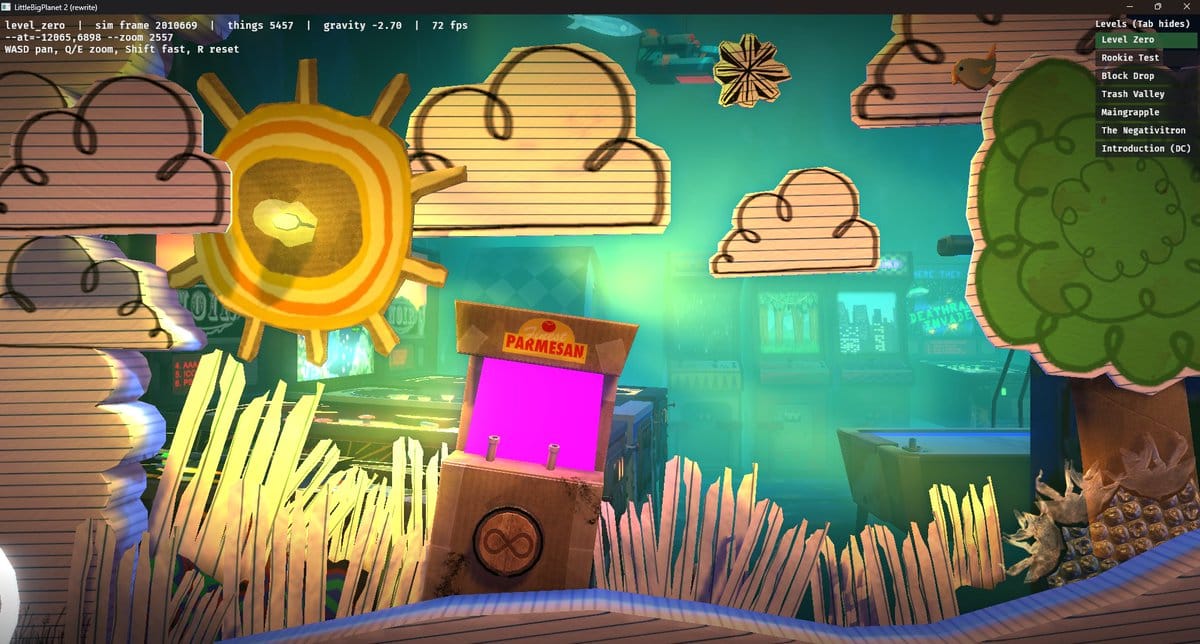
level_zero at 72 FPS with 5,457 active scene entities ("things"). The developer debug overlay on the right reveals loaded levels including Trash Valley, Maingrapple, and The Negativitron.Analyzing the Engine Telemetry: What the Screenshots Reveal
The shared screenshots provide an extraordinary look into the engine's internal architecture, rendering pipeline, and asset ingestion system:
1. High-Density Scene Graphs & Smooth 75+ FPS Framerates
In the first capture of level_zero, the debug HUD displays 5,457 active "things" (Media Molecule's internal terminology for scene graph nodes, physics bodies, and logic emitters) rendering smoothly at 72 FPS. The scene faithfully reproduces the franchise's tactile, handmade aesthetic: layered cardboard clouds, the iconic felt sun illuminated by a warm electric filament bulb, grassy foreground foliage, and background arcade cabinets featuring the hilarious "Finest Parmesan" claw machine.
2. Authentic Story Mode Level Loading
Perhaps the most exciting revelation is the level selection menu visible on the right margin of the debug interface:
Level Zero&Rookie Test(The foundational tutorials)Block Drop(Mini-game mechanics test)Trash Valley(The Factory of a Better Tomorrow storyline)Maingrapple(The Grappling Hook introduction setpiece)The Negativitron(The climactic final boss battle arena)Introduction (DC)(DC Comics premium expansion content)
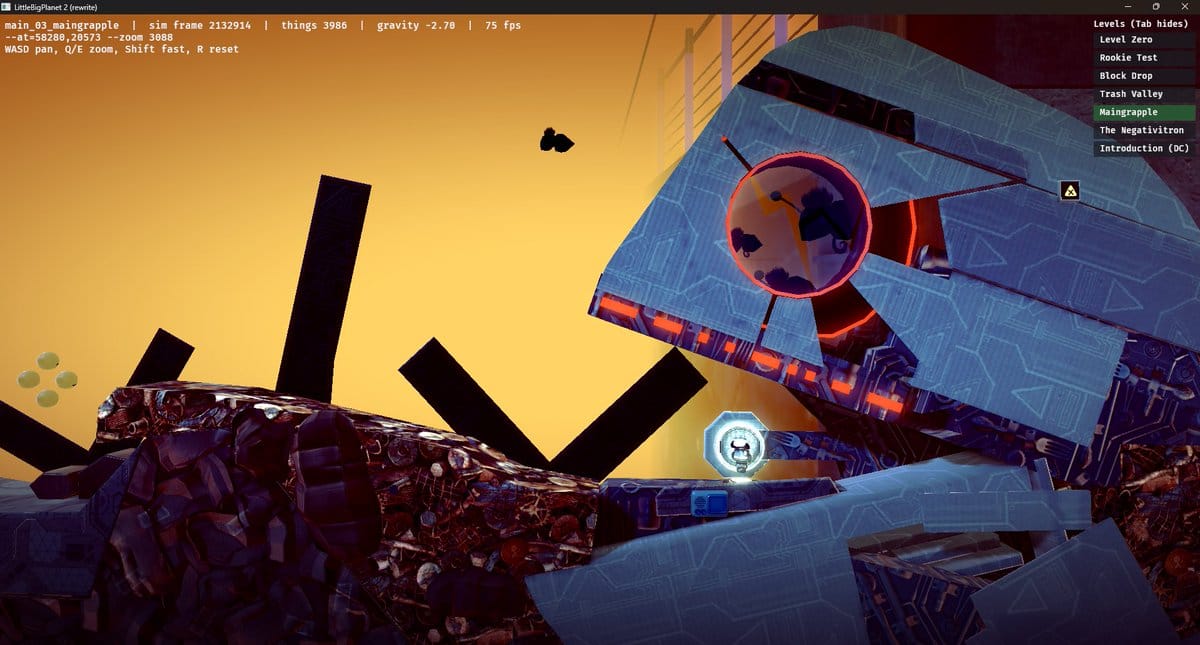
main_03_maingrapple running at 75 FPS with 3,986 active things. Sackboy stands illuminated at the checkpoint gate beneath the colossal articulated scrap-beast jaw under dramatic sunset lighting.3. Complex Articulated Setpieces & Dynamic Lighting
In main_03_maingrapple, the engine renders 3,986 scene objects at 75 FPS. The capture shows the massive scrap-metal mechanical boss head—constructed from printed circuit boards, cutlery, corrugated cardboard, and illuminated warning dials. The scene showcases advanced dynamic lighting, volumetric atmosphere, yellow score bubbles, and Sackboy standing ready at the glowing hex-ring checkpoint respawn gate.
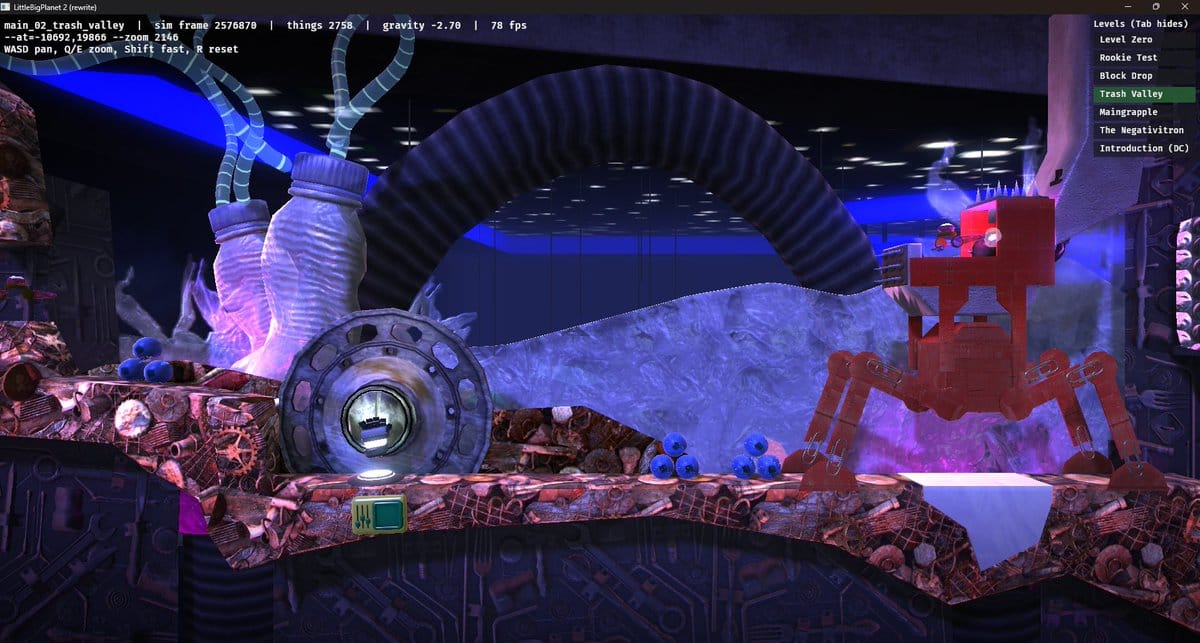
main_02_trash_valley running at 78 FPS with 2,758 entities. Notice the glowing blue pneumatic tube network, paperclip-jointed mechanical walker, and atmospheric purple backlight.4. Materials, Shaders & Mechanics in "Trash Valley"
The capture of main_02_trash_valley (The Factory of a Better Tomorrow) demonstrates the engine's material pipeline operating at 78 FPS across 2,758 things. The scene accurately parses authentic Media Molecule materials:
- Crushed electronic waste and rusted cogwheel ground textures with accurate normal mapping.
- Translucent blue plastic bottles and corrugated vacuum hose conduits with internal glowing neon filaments.
- A cardboard walker contraption featuring working paperclip joints and dynamic pneumatic legs.
- Sackboy positioned inside a pneumatic transit tube with real-time collision boundaries.
Why Rust Is the Perfect Weapon for Craftworld Preservation
The choice of Rust across both the LittleBigPlanet 1 and LittleBigPlanet 2 reimplementations is no coincidence. Modern systems programming in Rust offers several distinct architectural advantages for reverse-engineering complex console games:
- Memory Safety Without Garbage Collection: Unlike C# or Java engines, Rust does not rely on a garbage collector (GC). In a game engine handling tens of thousands of dynamic physics constraints and logic wires, GC pauses cause catastrophic stuttering. Rust’s ownership model guarantees predictable, deterministic frame times.
- Fearless Concurrency for Multi-Threaded Physics: Replicating the PS3's SPURS job system requires aggressive multi-threading. Rust's compile-time data race prevention allows developers to parallelize collision broadphase, narrowphase, and circuit board logic across all modern CPU cores safely.
- Cross-Platform Portability (Vulkan & WGPU): Writing in Rust allows the engine to compile cleanly to Windows, Linux, and macOS (via Metal). Because there is zero x86 translation or Cell emulation overhead, the game could easily run at 60–120 FPS on handhelds like the Steam Deck while drawing only a fraction of the battery power required by RPCS3.
The Bigger Picture: Rescuing a Creative Legacy
The importance of these dual rewrites cannot be overstated. When Sony permanently shuttered the official LittleBigPlanet 3 servers on PlayStation 4 in April 2024—following prior shutdowns of the PS3 and Vita servers—the single greatest archive of user-generated console creativity in video game history was severed from official platforms.
While community preservation initiatives like Project Lighthouse and Refresh have heroically preserved millions of archived community levels on custom private servers, players have remained tethered to aging, deteriorating PlayStation 3 hardware or beefy desktop rigs running RPCS3.
A native, modern PC engine for both LittleBigPlanet and LittleBigPlanet 2 opens the door to the ultimate vision for Craftworld:
- Unlocked Framerates & Ultra-Wide Resolution: Playing classic levels in pristine 4K 120 FPS or 21:9 ultrawide with modern antialiasing.
- Infinite Thermometer: Removing the PS3's restrictive 256MB memory cap, allowing community creators to build worlds of unprecedented scale and fidelity.
- Native Online Integration: Direct built-in connectivity to community archive servers without requiring console modifications or proxy redirects.
Transmission Status
With both LittleBigPlanet 1 and LittleBigPlanet 2 now receiving active native Rust implementations, the dream of an enduring, uncompromised PC home for Sackboy is rapidly becoming reality. We will be closely monitoring both projects and reporting on milestone releases as the engines progress right here on ALLNIGHT.CITY.