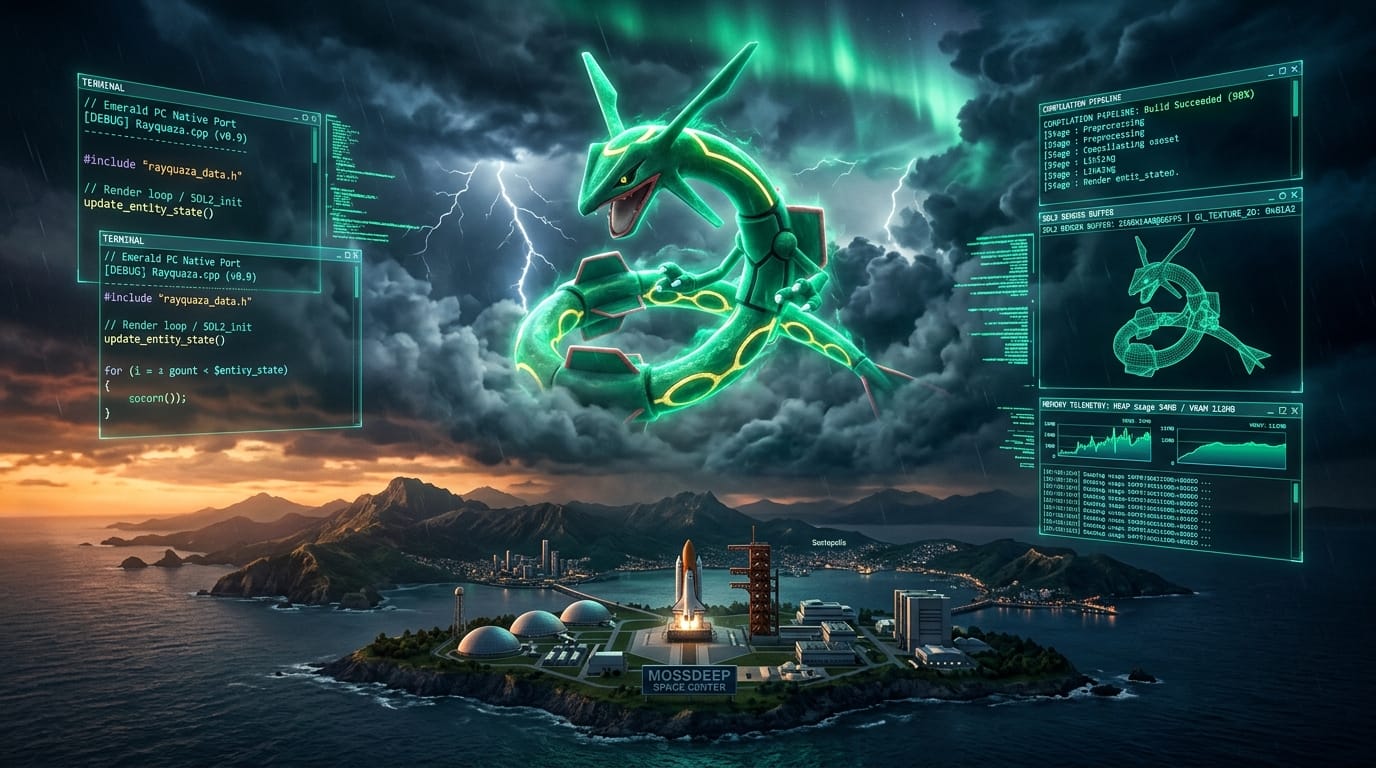

For over two decades, experiencing Pokémon Emerald on PC meant launching an emulator—spinning up a virtual ARM7TDMI processor, translating Game Boy Advance memory registers, and accepting the inherent latency of software virtualization. That paradigm has officially shifted. Developer Yvonne Aizawa has released pkmemerald, a native desktop port of pokeemerald-expansion that compiles the third-generation Pokémon engine directly into native machine code for Linux and Windows.
Rather than emulating a console, the project—available open-source on GitHub at Yvonne-Aizawa/pokemon-emerald-recomp—marries the complete C decompilation of Pokémon Emerald with modern host abstractions. By coupling upstream game logic with native SDL2 display pipelines and GBA hardware stubs, pkmemerald delivers the definitive Hoenn adventure with the responsiveness, moddability, and precision of a true PC title.
Decompilation Meets Native Host Compilation
Unlike binary static recompilers that reverse-engineer compiled ROMs into intermediate representation, pkmemerald builds directly on the monumental reverse-engineering work of the pret team and the expanded rh-hideout/pokeemerald-expansion branch:
Clean-Room Submodule Architecture: The repository maintains upstream pokeemerald-expansion as an untouched Git submodule under reference/. All host-specific platform code, GBA hardware register stubs (platform/include/gba/), and desktop glue logic live in an isolated platform/ directory. Build-time patches adapt upstream source headers without polluting the canonical game engine code.
- 32-Bit Memory Layout Fidelity: The Game Boy Advance's 16.78 MHz ARM7TDMI processor used 32-bit pointers and registers. To maintain complete ABI fidelity and prevent struct packing discrepancies or pointer truncation bugs, pkmemerald compiles explicitly as a 32-bit binary (via
gcc-multilibon Linux andMinGW-w64-i686on Windows). - Hardware Stubbed in C: The original Game Boy Advance I/O registers—display control (
REG_DISPCNT), background scrolling offsets, DMA controllers, and timer interrupts—are mapped to native C memory structures that feed framebuffers directly into SDL2 textures. - Zero CPU Emulation Overhead: The game's script execution engine, pathfinding routines, battle calculations, and RNG functions execute directly on host x86/x64 processor cores at native clock speeds.
The Power of the Expansion: Gen 9 Mechanics in Hoenn
What sets pkmemerald apart from standard vanilla decompilation ports is its tight integration with pokeemerald-expansion. Players are not restricted to the 2004 Game Boy Advance battle sandbox; the port integrates decades of competitive battle engine refinements:
| Feature Category | GBA Original (2004) | pkmemerald Native Port |
|---|---|---|
| Architecture | ARM7TDMI 16.78 MHz CPU | Native 32-bit Host Binary (SDL2 Backend) |
| Battle Mechanics | Gen 3 ruleset (Type-dependent damage) | Physical/Special split, Fairy type, Gen 9 moves, abilities & items |
| Pokémon Roster | Hoenn Pokédex (386 total) | Expanded generation support with modern battle sprites & forms |
| Save System | 128 KiB raw Flash chip sector dump | Human-readable JSON with auto-calculated checksums |
| Audio Processing | DirectSound 8-bit DAC PWM | Bit-exact GBA audio or interpolated low-pass smoothing |
| Display Controls | Fixed 240×160 resolution | Arbitrary window scaling, borderless fullscreen, instant fast-forward |
Human-Readable JSON Saves: Modder’s Dream
One of the project's most remarkable innovations is its reimagined save architecture. While classic emulators dump and read opaque 128 KiB binary blobs (.sav), pkmemerald persists game progress as structured JSON (pkmemerald.json) in the user's application data directory (%APPDATA%\pkmemerald\ on Windows or ~/.local/share/pkmemerald/ on Linux):
{
  "game": {
    "player": {
      "name": [188, 203, 199, 195, 202],
      "gender": 0,
      "trainerId": 48291,
      "money": 999999,
      "coins": 9999
    },
    "flags": {
      "FLAG_SYS_POKEMON_GET": true,
      "FLAG_SYS_POKEDEX_GET": true
    },
    "blocks": { ... }
  }
}- Direct Variable & Flag Editing: Players and ROM hackers can edit story variables (
game.vars), event flags (game.flags), and trainer wealth directly in any text editor while the game is closed. - Decrypted Pokémon Structures: Individual party members and PC storage boxes are saved fully decrypted with explicit enum strings (e.g.,
"SPECIES_TORCHIC"), rather than encrypted GBA bitfields. When the game launches, pkmemerald recalculates the Pokémon struct checksums automatically, preventing corrupt-data flags. - Bidirectional Flash Migration: The executable includes a built-in migration utility (
pkmemerald --convert-save IN OUT) capable of converting existing 128 KiB GBA flash images to JSON and vice versa, preserving decades-old emulator saves.
Audio Pipeline & Crash Telemetry
The audio engine provides two distinct playback modes: an exact GBA emulation pipeline that reproduces the distinctive crispness of the Game Boy Advance's DirectSound mixing, and a smoothed audio pipeline (--smooth-sound) that applies interpolation and low-pass filtering to remove legacy sampling artifacts. Players can also record in-game music and sound effects directly to lossless WAV files using the -a [filename].wav command-line argument.
For stability and development triage, the engine features an automated crash harness. If an unhandled signal or memory exception occurs, pkmemerald captures a detailed forensic post-mortem into a timestamped file within crashes/:
- Crashing function symbol and host instruction pointer.
- Complete host call stack backtrace.
- Active in-game callback contexts (identifying whether the engine crashed during an overworld battle, menu transition, or contest sequence).
Legal Clean-Room Design & How to Build
Following the strict legal precedent established by decompilation projects like sm64-port and Ship of Harkinian, pkmemerald distributes zero copyrighted assets, proprietary graphics, music tracks, or compiled ROM binaries. To generate the game executable, users compile the source locally while the build pipeline pulls asset data from their own legitimately sourced reference assets:
# Clone repository and initialize submodules
git clone https://github.com/Yvonne-Aizawa/pokemon-emerald-recomp.git
cd pokemon-emerald-recomp
git submodule update --init

# Linux 32-bit build (requires gcc-multilib and libsdl2-dev:i386)
cmake -S . -B build -DCMAKE_BUILD_TYPE=RelWithDebInfo
cmake --build build -j$(nproc)

# Windows cross-compilation via MinGW-w64
tools/fetch_sdl2_mingw.sh
cmake -S . -B build-win --toolchain cmake/mingw-i686.cmake
cmake --build build-win -j$(nproc)
cmake --build build-win --target package
The resulting package produces a standalone pkmemerald.exe and SDL2.dll that runs instantly with zero runtime dependencies. Controls can be rebound through pkmemerald.ini, with native keyboard mapping and full SDL2 gamepad support out of the box.
Preservation Through Recompilation
As classic handheld consoles age and hardware displays degrade, native recompilation and source ports represent the highest tier of digital preservation. By liberating Pokémon Emerald from the hardware constraints of the Game Boy Advance while embracing the extensive balance and content upgrades of pokeemerald-expansion, pkmemerald offers a glimpse into the future of classic Pokémon gaming—native, high-performance, and infinitely extensible.
Resources & Links
- GitHub Repository: Yvonne-Aizawa/pokemon-emerald-recomp on GitHub
- Upstream Engine: rh-hideout/pokeemerald-expansion
- Platform Backend: SDL2, CMake 3.20+, GCC 32-bit / MinGW-w64.