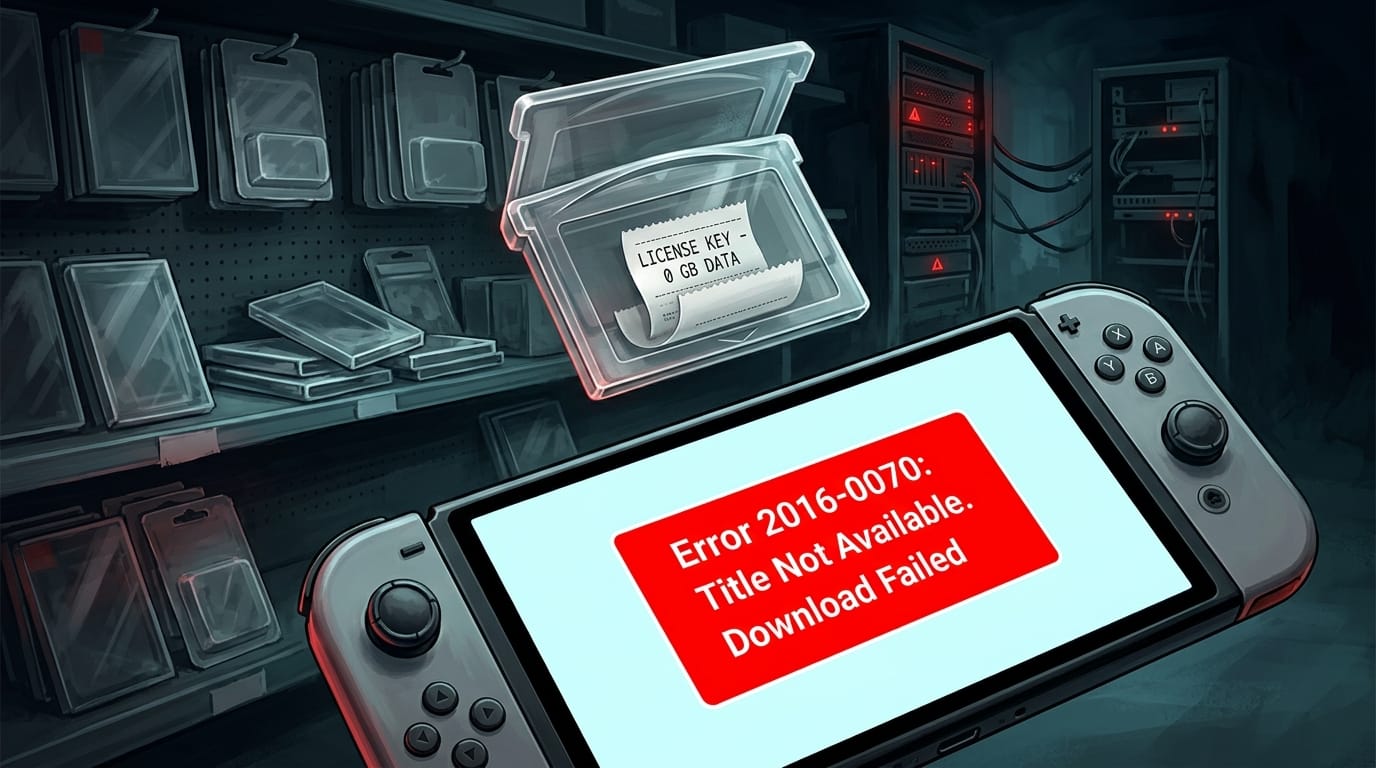

Imagine walking into a retail store, picking a video game off the shelf, paying full price at the register, popping the brand-new cartridge into your Nintendo Switch 2—and being greeted by an immediate, unfixable error code. You didn't buy a bootleg. You didn't buy a used copy with damaged pins. You bought an official, sealed retail release. Yet, your brand-new system informs you that the game cannot boot, cannot download, and cannot be played.
That exact nightmare became reality this week as early buyers of Rudolph the Red-Nosed Reindeer (published by budget mainstay GameMill Entertainment) plugged their retail cartridges into the Nintendo Switch 2, only to be stopped dead in their tracks by Error Code 2016-0070. The cause? The publisher had botched its backend server upload on Nintendo’s eShop CDN, pushing a dummy 82MB placeholder instead of the actual 2GB game package.
And because the retail cartridge was not a real cartridge, but a glorified Game Key Card (GKC) containing exactly zero bytes of playable game data, hundreds of holiday shoppers found themselves holding a completely useless piece of plastic e-waste on Day One.
What Is a 'Game Key Card'—and Why Is It an Insult to Consumers?
For decades, the social contract of console gaming was sacred: you buy a cartridge or a disc, you put it in the console, and you play. No mandatory accounts, no server pings, no day-one bandwidth ransoms. If the power was on, the game was playable.
In recent years, however, publishers have aggressively pushed Game Key Cards. While packaged in standard retail plastic cases and physically shaped like Nintendo game cartridges, these cards hold zero actual game files. Instead, they contain only a cryptographic license entitlement ticket.
The moment you slide a Game Key Card into your console, the system reaches out to Nintendo’s servers over the internet to download the entire game into your internal storage or expandable microSD Express card. But here is the kicker: you still have to keep the physical card inserted into the console every single time you want to play.
Pause and consider the sheer corporate cynicism at work here. Game Key Cards do not offer the convenience of digital distribution, nor do they offer the preservation and autonomy of physical media. Instead, they meticulously combine the absolute worst attributes of both formats:
- From Digital, You Inherit Every Liability: You get zero offline playability out of the box. You are forced to surrender gigabytes of expensive local storage. You are tethered to home broadband. And if the publisher botches a server-side upload—or if you don’t have internet access while traveling—your purchase is completely unplayable.
- From Physical, You Inherit Every Inconvenience: You still have to carry a tiny, fragile plastic wafer in your travel case. You still have to physically get up and swap cartridges every time you switch games. You still risk losing or damaging the card. And the planet is burdened with millions of tons of non-recyclable plastic cases and shrinkwrap.
The Anatomy of Error 2016-0070
The recent outcry on Reddit's Nintendo Switch community highlights the inevitable breaking point of this model.
When users inserted the retail Rudolph Game Key Card into their Switch 2, the console attempted to perform its mandatory license handshake with Nintendo's content servers. But because GameMill failed to properly link and publish the full ~2GB Switch 2 payload to the regional eShop backend, the servers threw Error Code 2016-0070: software entitlement missing or title unavailable.
Standard troubleshooting—rebooting the console, checking system updates, clearing cache, re-inserting the cartridge—is completely powerless to resolve Error 2016-0070. Why? Because the problem is entirely server-side. The consumer owns nothing on their physical cartridge except a pointer to a broken URL on Nintendo's CDN.
Think about the sheer absurdity of this situation. If this had happened with a genuine physical cartridge, the game would have booted up instantly from on-board ROM, even if a day-one patch had been delayed. But with a Game Key Card, a minor administrative clerical error in a publisher’s digital operations department transforms a store-bought physical item into a literal brick.
Pure Corporate Greed: Why Publishers Love Key Cards
Why does this anti-consumer format exist in the first place? The answer, as always, is penny-pinching corporate greed.
When publishers manufacture physical cartridges for Nintendo platforms, Nintendo charges them based on the storage capacity of the mask ROM chips (ranging from 8GB and 16GB up to 32GB and 64GB). For budget publishers who churn out licensed family titles and bargain-bin retail fodder, paying for a 4GB or 8GB ROM chip eats into their razor-thin profit margins.
By opting for Game Key Cards, publishers purchase the cheapest, lowest-density silicon possible—chips that only need enough storage to hold a few kilobytes of encrypted certificate keys. They offload the storage costs onto the consumer (who has to buy expensive high-speed storage cards) and offload the distribution bandwidth costs onto Nintendo's servers, while pocketing full retail price at brick-and-mortar stores.
Worse still, this practice intentionally exploits casual consumers. While retail boxes feature a small, easily overlooked banner reading "Full Game Download Required," parents, grandparents, and casual shoppers shopping for holiday gifts at Target, Walmart, or GameStop have no idea they are buying a plastic shell with no game inside. They expect a plug-and-play Nintendo experience; what they get is a server handshake failure.
The Day-One Server Apocalypse
For years, game preservationists have warned about what will happen in ten or fifteen years when Nintendo, Sony, and Microsoft eventually shut down the digital storefront servers for older consoles. When the Nintendo DS, Wii, and Wii U storefronts closed, digital purchases became stranded. But real physical cartridges from the NES in 1985, the Game Boy in 1989, or the Nintendo 64 in 1996 still boot and play flawlessly today, four decades later.
Game Key Cards represent the deliberate murder of physical preservation. When the Switch 2 eShop servers are eventually decommissioned decades from now, every single Game Key Card ever manufactured will become instant landfill—inoperable plastic relics that can never download their payloads again.
What the Rudolph Error 2016-0070 debacle proves is that we don’t even have to wait fifteen years for the server apocalypse. The server apocalypse is happening on Day One. You don't have to wait for corporate end-of-life notices; all it takes is one misconfigured SKU, one regional licensing delay, or one server glitch, and your retail purchase is dead on arrival.
Vote With Your Wallets: Say No to Plastic Receipts
If the gaming community does not push back against Game Key Cards, publishers will continue to normalize this predatory practice until genuine physical media is completely eradicated from retail shelves.
A Game Key Card is not a physical game. It is a physical receipt wrapped in single-use plastic, sold to consumers who are paying for the illusion of ownership. When you see a retail box that says "Full Game Download Required" with a Game Key Card inside, leave it on the shelf. If publishers refuse to put the game on the card, they don't deserve your money.