
There was a time when experiencing Halo: Combat Evolved required lugging twenty-pound CRT televisions and monolithic black Xbox consoles into a friend’s basement, stringing neon yellow CAT-5 Ethernet cables across shag carpeting for 16-player System Link matches. In 2003, Gearbox and Bungie expanded that horizon with Halo Custom Edition on PC, cementing the franchise’s cult status through user-created battlegrounds. But over the last several years, retro PC multiplayer has languished in an uneasy limbo: trapped between community workarounds and Microsoft’s increasingly neglected, cheater-plagued Master Chief Collection (MCC).
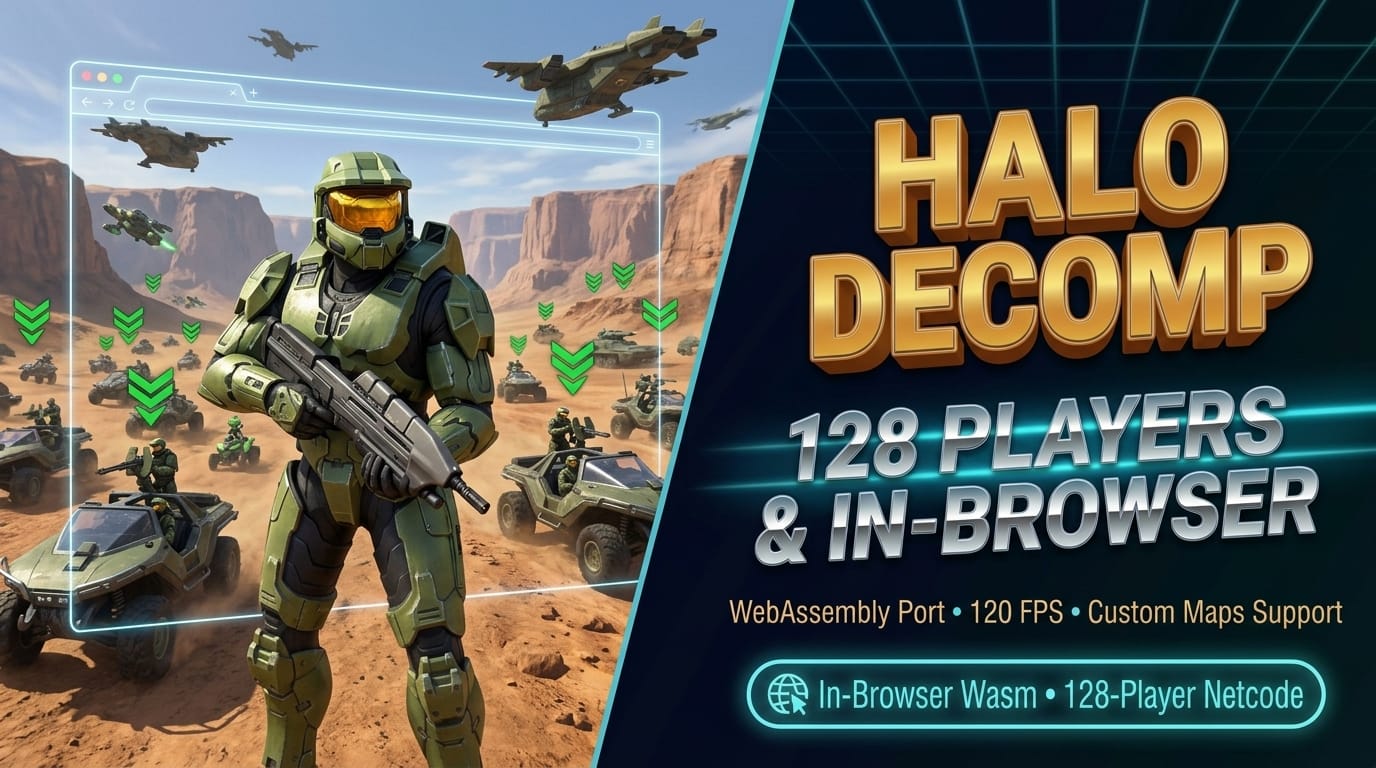
Suddenly, that entire paradigm is collapsing. Over the past seventy-two hours, the Halo: Combat Evolved decompilation scene has sprinted forward at breakneck speed, smashing through twenty-five-year-old engine ceilings and showcasing a future that feels almost surreal: 128-player massive combined-arms warfare on custom maps, and full, native 120 FPS gameplay running directly inside a web browser.
Halo in the Browser: 120 FPS via WebAssembly
The first bombshell dropped courtesy of developer Mitch (@mitchellhynes), who revealed a milestone that once belonged strictly to science fiction: Halo: Combat Evolved compiled to WebAssembly (Wasm) and executing natively inside a standard browser at a blistering, locked 120 frames per second.
We did it! 120 FPS in browser
— Mitch (@mitchellhynes) September 28, 2026
This is not a sluggish cloud-streamed video feed with input lag, nor is it an emulator wrapper emulating x86 or Xbox hardware. Because the game’s core codebase has been painstakingly reconstructed into clean, compilable C/C++, developers can target modern LLVM compilation backends directly. Paired with WebGL and WebGPU shader pipelines, the original Blam! engine renders seamlessly inside a web tab.

The implications of this achievement cannot be overstated. Imagine the golden age of PC LAN parties reborn with absolute zero friction: no multi-gigabyte installer wizards, no intrusive kernel-level anti-cheat drivers, no Steam sign-ins, and no Microsoft account DRM handshakes. You open a URL in Chrome, Brave, or Firefox, and within three seconds, you are strafing on Blood Gulch or trading plasma pistol overcharges in Hang 'Em High. It democratizes one of the greatest competitive shooters ever conceived for an entirely new generation.
The 128-Player Revolution: 'Extinction' Shatters Engine Bounds
While Mitchell Hynes conquered the web frontend, developer Jonas Volman (@bnununana) shattered the engine’s foundational networking constraints. On original Xbox and PC network stacks, Halo was hardcoded for 16 players (with fragile third-party memory patches pushing up to 32). Ancient packet size buffers, rigid tick rates, and synchronization bottlenecks meant that true large-scale warfare was physically impossible on original binaries.
No longer. Volman showcased Halo: Combat Evolved operating with an astonishing 128 simultaneous players on a single dedicated server.

The showcase took place on Extinction, arguably the most iconic custom map in Halo Custom Edition history. Created by Dennis and community modders in the mid-2000s, Extinction was famous for its gargantuan canyon topography, deployable Forward Operating Bases, drivable Scarab walkers, and pilotable Longsword bombers and Pelican dropships. With 128 players, the map transforms into a relentless, breathtaking combined-arms meatgrinder reminiscent of Battlefield or PlanetSide—all underpinned by Bungie’s golden triangle of guns, grenades, and melee physics.
Halo Custom Edition maps will soon be playable with 128 players
— Jonas Volman (@bnununana) September 29, 2026
youtu.be/jjpJcfuZBXM
In a subsequent update accompanied by custom map previews, Volman confirmed that full custom map compatibility is nearing completion, dropping an electric teaser for the community:
Extinction 100+ playtest soon?
— Jonas Volman (@bnununana) September 29, 2026
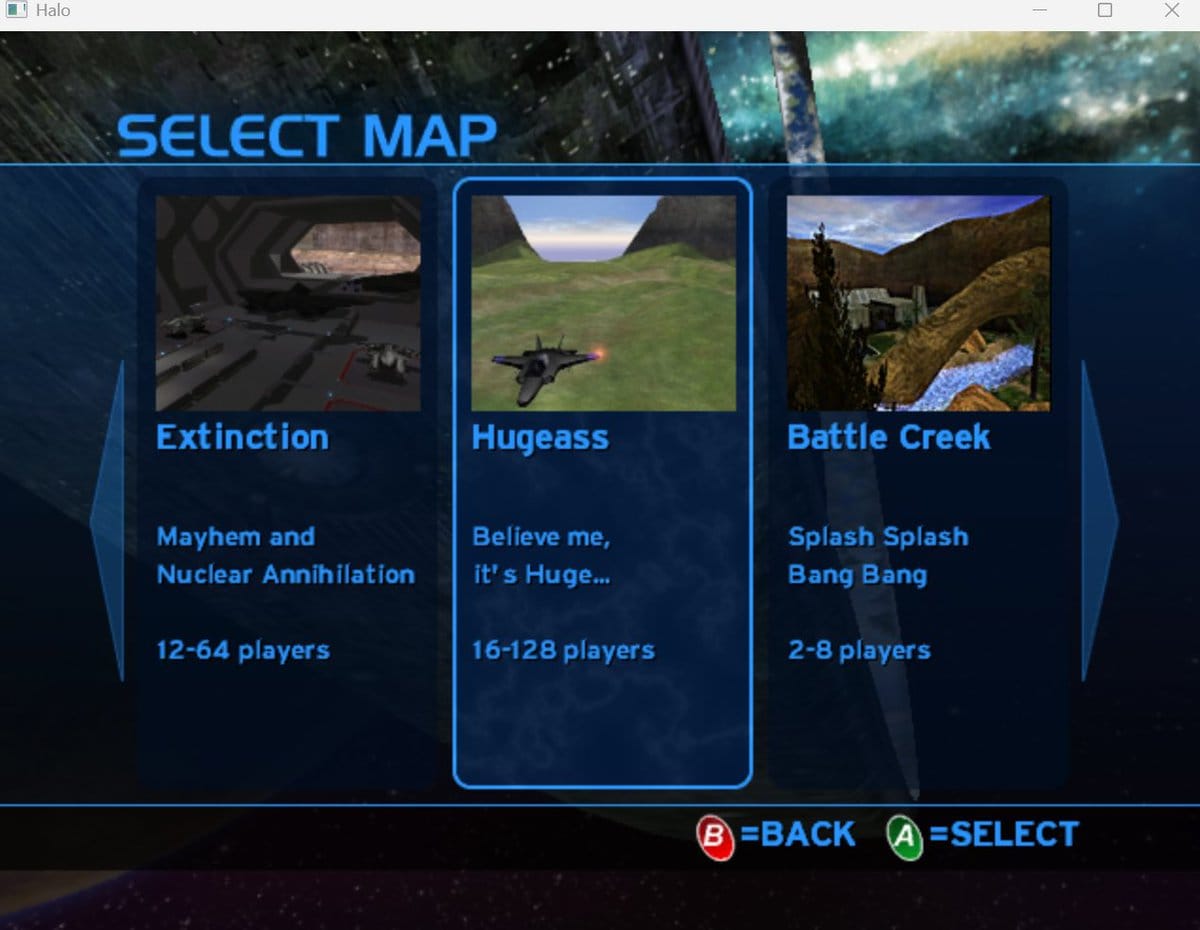
The prospect of a public 100+ player playtest has sent shockwaves through the competitive and modding communities. For two decades, Halo modders designed sweeping maps with vehicle squadrons that the original netcode could never genuinely populate. That dream is now finally within reach.
The MCC Dilemma: Why Decompilation Is the Only Salvation
The meteoric ascent of the Halo CE decompilation arrives at a critical juncture for the franchise. For years, Microsoft positioned Halo: The Master Chief Collection as the definitive, unified archive of the series. Yet in 2026, the reality for everyday PC players is bleak:
- Rampant, Unchecked Cheating: High-tier MCC matchmaking is routinely paralyzed by blatant aimbotters, invulnerability scripts, and spinbot hackers. Despite constant community reports, Microsoft and 343 Industries have largely shuttered active anti-cheat iterations.
- Broken Networking & Host Migrations: Ancient peer-to-peer holdovers and unoptimized relay servers result in desynchronized hit registration and mid-match disconnects that plague classic Halo 2 and Halo 3 lobbies.
- Walled-Garden Ecosystem: Custom maps and mods in MCC remain shackled behind Steam Workshop friction, strict file validation checks, and an inflexible matchmaking architecture.
This is why the broader Halo community is watching the CE decompilation with rapturous excitement. We aren’t just cheering for 128-player chaos on Extinction; we are hoping that these imminent stress tests prove the viability of a completely community-owned future.
The ultimate dream—and the one that the reverse-engineering community is rallying around—is the total decompilation of Bungie’s entire golden era: Halo: Combat Evolved, Halo 2, Halo 3, Halo 3: ODST, and Halo: Reach.
When game source code is liberated from closed proprietary blobs, the community gains the power to write modern client-server network topologies, deploy robust server-side anti-cheat defenses, implement rollback netcode, and host community servers with dedicated administrative tooling. The community did it for Super Mario 64, The Legend of Zelda: Ocarina of Time (Ship of Harkinian), and Jak and Daxter (OpenGOAL). Halo deserves nothing less.
A Renaissance on the Horizon
The speed at which developers like Jonas Volman and Mitchell Hynes are advancing proves that passion, transparency, and modern compiler tech can accomplish in months what corporate custodians neglected for years.
As the community gears up for the upcoming Extinction 100+ player stress tests, one thing is abundantly clear: Halo’s legendary sandbox isn’t dying in the corporate graveyard of neglected live-service clients. It is being reborn in browser tabs and 128-player dedicated servers, more vibrant and unstoppable than ever before.
“Keep your eyes on @bnununana and @mitchellhynes on X for announcements regarding the upcoming public playtests.”