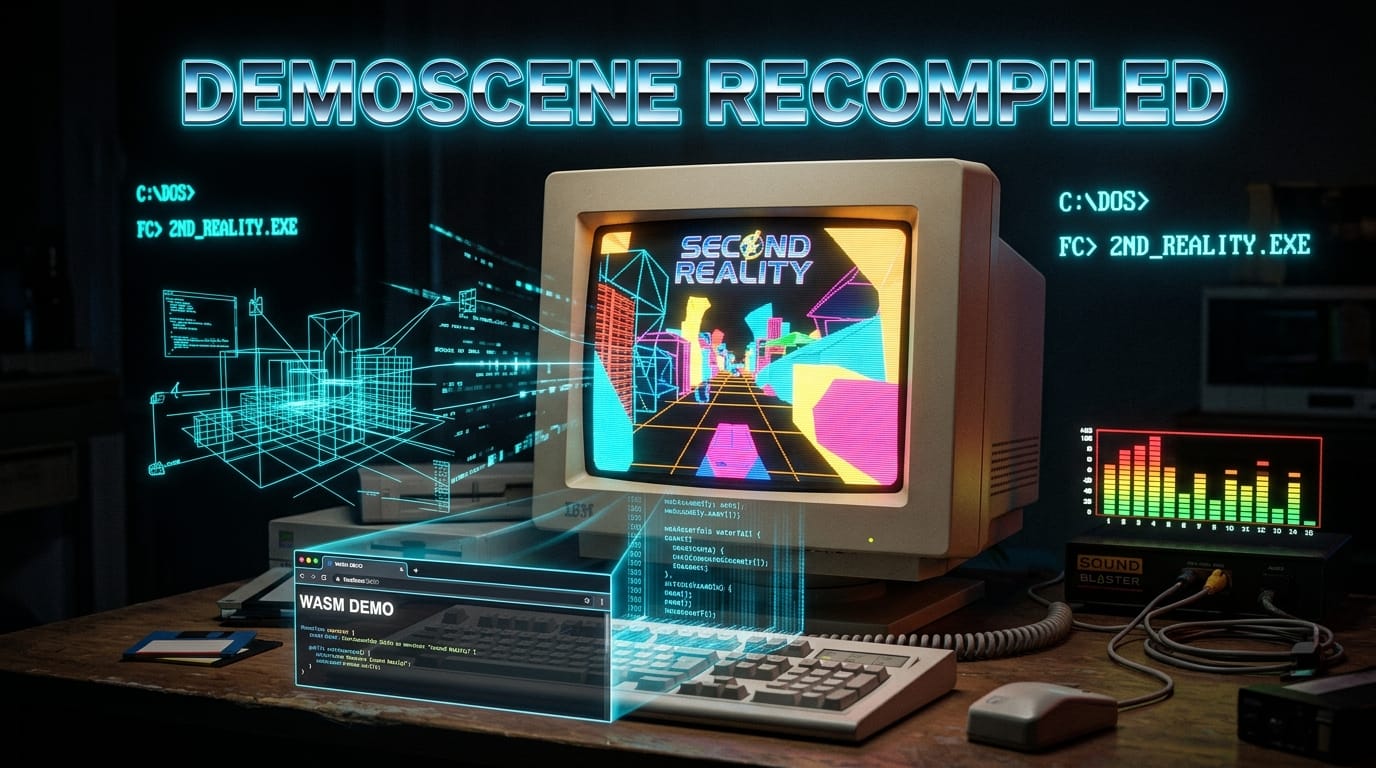

In the early 1990s, the IBM PC-compatible was widely dismissed as a clunky, utilitarian "beige business box." Built for spreadsheet calculations, WordPerfect memos, and database queries, it lacked the dedicated custom coprocessors and custom blitters of the Commodore Amiga or Atari ST. To the mainstream tech world, the PC was considered fundamentally incapable of fast, fluid, hardware-pushing multimedia art. Then the Demoscene arrived—and shattered every assumption the industry held about computer hardware.
Operating entirely outside corporate labs, teenage hackers across Finland, Sweden, and Germany bypassed DOS operating system APIs, directly manipulated unmanaged x86 registers, and engineered mathematical miracles out of raw silicon. Now, developer treylorswift has unveiled demoscene-recomp, an open-source project that translates the original x86 DOS code of demoscene masterpieces—including Future Crew's legendary Unreal (1992) and Second Reality (1993)—into native C and compiled WebAssembly, running flawlessly in modern browsers at authentic 70 Hz VGA refresh rates.
The Cultural Revolution: When Hackers Conquered the PC
To appreciate why running these productions today matters, you have to understand the staggering cultural impact the demoscene exerted in the early 1990s. In an era before commercial 3D graphics cards (decades before 3dfx Voodoo, Direct3D, or OpenGL), demosceners operated under brutal hardware constraints: an Intel 80386 or 80486 CPU clocked at a modest 33 or 66 MHz, 640 KB of conventional memory, an unaccelerated VGA frame buffer, and a basic Sound Blaster audio card.
At Finnish demoparties like Assembly, programmer collectives didn't just display computer graphics—they competed like digital gladiators to see who could coax the most mind-bending audiovisual spectacle out of unassisted PC silicon:
- Future Crew's Unreal (Assembly 1992 - 1st Place): Stunned the international community by delivering multi-plane parallax scrolling, Gouraud-shaded 3D vector objects, and multi-channel tracker audio composed by Skaven and Purple Motion. It sent a shockwave through the tech world: the PC was no longer an office machine; it was an audiovisual powerhouse.
- Future Crew's Second Reality (Assembly 1993 - 1st Place): Universally regarded by computer historians as one of the top 10 greatest software hacks of all time. When it debuted on a massive projector at Assembly '93, the crowd fell into stunned silence before erupting into a roaring standing ovation. It achieved what engineers at Intel and IBM believed was technically impossible: real-time plasma rendering, 3D rotating polyhedra, textured tunnel flythroughs, and fully rendered voxel landscapes years before commercial 3D engines hit store shelves.
- The Modern Tech Lineage: The demoscene wasn't just a subculture; it was the crucible that forged the modern gaming industry. Core members of Future Crew went on to found Remedy Entertainment (creators of Max Payne, Alan Wake, and Control), founded Futuremark / UL (the creators of 3DMark), and took senior leadership roles shaping modern GPU architectures at NVIDIA and AMD.
The Hacker Ethos: "They told us the PC couldn't do it, so we did it anyway." The demoscene proved that software craftsmanship and algorithmic ingenuity could bypass raw hardware limitations. They redefined what personal computing was capable of.
Beyond Emulation: How demoscene-recomp Works
Historically, experiencing classic DOS demoparty releases in a browser meant embedding an in-browser DOSBox emulator. While functional, full machine emulation in WebAssembly introduces significant drawbacks: heavy CPU overhead, audio buffer crackling, and timing jitter that ruins the demos' frame-perfect musical synchronization.
demoscene-recomp takes a radically different, clean-room approach:
| Stage | Technical Process | Preservation Outcome |
|---|---|---|
| 1. Execution Tracing | Whole-Run x86 Trace Recording | The demo is executed within a specialized emulator that logs every single basic block of x86 machine instructions actually executed by the CPU across the entire runtime. |
| 2. Trace-to-C Translation | Instruction-for-Instruction Lifting | The logged execution blocks are translated directly into optimized C code, preserving original instruction semantics and exact emulated cycle timings. |
| 3. WebAssembly Compilation | Native Web Assembly Runtime | The generated C code is compiled directly into WebAssembly, paired with lightweight software models of only the peripheral hardware the demo communicates with (PIT timer, VGA CRTC registers, Sound Blaster DSP). |
| 4. Event Verification | Cycle-Accurate Event Parity | Every hardware interrupt, I/O port read, and vertical blanking event is validated against the original hardware traces to guarantee 100% sync. |
Because the demo's original loaders, music players, and rasterization algorithms run as native compiled code rather than being interpreted inside an emulated guest OS, the browser overhead is virtually nonexistent.
Pure 70 Hz VGA Fidelity & Modern Enhancements
Original IBM VGA hardware ran at an exact vertical refresh rate of 70 Hz. Because modern monitors typically run at 60, 120, 144, or 240 Hz, classic demos often suffered from hideous frame judder when played on non-native displays. demoscene-recomp synchronizes directly with browser display timings, delivering silky-smooth motion on high-refresh displays.
The web player also incorporates thoughtful preservation enhancements:
- Smooth City (Second Reality): An optional visual enhancement of the iconic 3D city flythrough that interpolates the camera animation to a locked 70 frames per second with sub-pixel polygon edge rasterization (toggleable, off by default to preserve the original 1993 baseline).
- CRT Phosphor Scanlines: An authentic scanline and softening shader replicating the warm glow and curvature of a classic cathode-ray tube monitor.
- Section Jumps & Pause Mode: Instant chapter selection allowing users to jump directly to iconic scenes, paired with a frame-pause feature that captures pixel-perfect PNG screenshots at the demo's original 320x200 resolution.
- Expanded Productions: In addition to Unreal and Second Reality, the repository features Triton's Crystal Dream 2 (1993, with an interactive end menu) and NoooN's Stars: Wonders of the World (1995).
- BBS & Modern UI: The interface features both a classic ANSI BBS theme (rendered in authentic IBM VGA 8x16 font) and a sleek modern dark theme.
Preserving the Golden Age of Creative Code
In 2020, Finland and Germany formally recognized the demoscene as part of UNESCO's intangible cultural heritage—the very first digital computer subculture to receive such status. Yet cultural heritage is only as durable as the media required to run it.
By transforming raw 16-bit DOS executables into auditable, open-source C and ultra-fast WebAssembly, projects like demoscene-recomp ensure that the foundational hacks that inspired modern 3D graphics will remain accessible, playable, and inspiring for generations to come.
Links & Resources
- Play in Your Browser: demoscene-recomp Live Web Terminal
- Source Code & Build Tools: treylorswift/demoscene-recomp on GitHub
- Future Crew Productions: Second Reality (1993) • Unreal (1992)