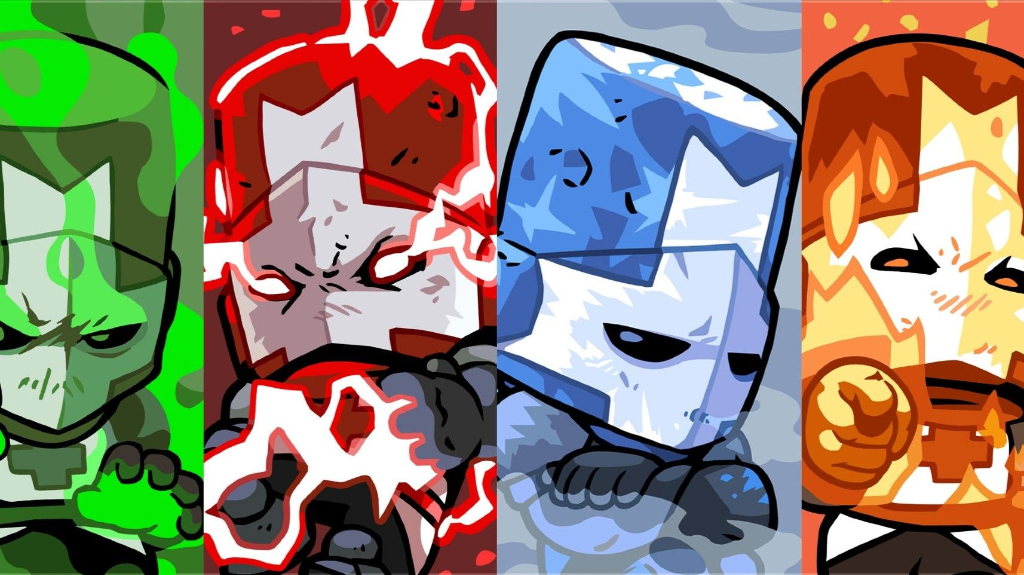

In August 2008, independent studio The Behemoth (founded by artist Dan Paladin and Newgrounds creator Tom Fulp) conquered Xbox Live Arcade with Castle Crashers. With its brilliant blend of slapstick medieval humor, four-player couch co-op, RPG leveling, and signature hand-drawn Flash vector animation, it became a defining classic of the digital download era and eventually made its way to PC, PlayStation, and Nintendo Switch.
Yet for over fifteen years, retro gaming enthusiasts have playfully wondered what Castle Crashers would have looked like had it released just one console generation earlier—sitting alongside legendary four-player GameCube staples like Super Smash Bros. Melee, Mario Kart: Double Dash!!, and Super Monkey Ball.
Now, developer myuu-151 has made that dream an astonishing reality. Enter Castle Crashers GC—a native, homebrew GameCube demake and port that compiles the game's actual engine to run directly on physical Nintendo GameCube hardware (and modern emulators like Dolphin).
The Architecture: Castle-Crashers-Recomp and Octave
Rather than attempting a superficial fangame clone in an engine like Unity, Castle Crashers GC is powered by an authentic, multi-tiered reverse-engineering stack:
- Castle-Crashers-Recomp: The foundational engine—a native C++ clean-room reimplementation of the 2012 Steam PC version (
castle.exe). The toolchain decrypts the game's proprietary.pakarchives, unwraps embedded SWF files, rewrites compiled Flash bytecode into standard execution flows, and extracts text, font tables, and sound banks directly. - Octave-libogc: A tailored GameCube engine framework built on devkitPPC and libogc. It provides low-level abstractions for GameCube hardware interfaces: GX display lists, ARAM memory controllers, asynchronous disc streaming, GameCube controller inputs, and memory card serialization.
- Hardware Native: The resulting project compiles directly into a standard GameCube
.isoor.elf, fully bootable on physical hardware via Swiss and SD Card adapters, or through the Dolphin emulator.
Taming Flash Vectors on the Flipper GPU
Bringing Castle Crashers to the GameCube is a breathtaking engineering feat because the game was originally constructed entirely out of Adobe Flash vector art. On modern PCs and the Xbox 360, hardware fill rates and floating-point power can rasterize smooth bezier curves effortlessly. The Nintendo GameCube’s 2001 Flipper GPU, however, possesses no concept of vector math—it is a fixed-function hardware pipeline designed strictly for textured polygons.
To overcome this, Castle Crashers GC implements a custom real-time vector tessellation engine (renderer_gx.cpp):
- Dynamic Triangle Meshing: The first time any character, weapon, or enemy appears on screen, the engine slices its Flash vector curves into hundreds of colored triangles.
- GX Display List Compilation: These tessellated triangles are packed into native GameCube GX display lists so the Flipper GPU can render them at maximum speed.
- The ARAM Shape Cache: A small shape takes 1–2 ms to tessellate, but massive boss graphics (such as the Painter in
level53) can take 50 to 500 ms. To prevent stutter during intense brawls, the developer built an asynchronous pre-caching pipeline ("Shapes Made Ahead") that tessellates heavy shapes behind loading screens and caches them inside the GameCube's 16 MB of Auxiliary RAM (ARAM)!
The 24MB RAM Battle: Reclaiming 1.9MB of Main Memory
Perhaps the steepest hill to climb was memory management. The Nintendo GameCube possesses only 24 MB of main 1T-SRAM. While that was plenty for 2001 console games, Castle Crashers was engineered for PCs with gigabytes of available virtual memory.
Early GameCube test builds were running perilously close to the brink—massive stages like the Industrial Castle and the Carriage Chase were dipping down to less than 3 MB of free system memory, triggering out-of-memory crashes.
std::istringstream stripped away 412 KB of bloated libstdc++ locale and exception tables.
Trimming Unused Octave Modules: Pruning skeletal mesh animators, 3D particle nodes, and unused Lua script bindings stripped an additional 1.4 MB of dead weight.
Executable Footprint: Reduced the final game ELF from 4.45 MB down to just 3.5 MB, leaving ample headroom for big multiplayer battles.
Couch Co-op, Memory Cards, and Hardware Features
Despite being a demake on 25-year-old hardware, Castle Crashers GC does not compromise on the core gameplay experience:
- 4-Player Couch Co-Op: Full four-player simultaneous multiplayer using classic GameCube controllers, complete with analog stick movement and pressure-sensitive face buttons.
- GameCube Memory Card Support: Saves player progression, character levels, unlocked animal orbs, and weapon caches directly to authentic GameCube memory cards.
- Real Hardware Diagnostic Logging: Built-in SD Card hardware hooks allow developers and testers to log performance profiles, ARAM census statistics, and memory allocations directly to SD cards on real consoles running via Swiss.
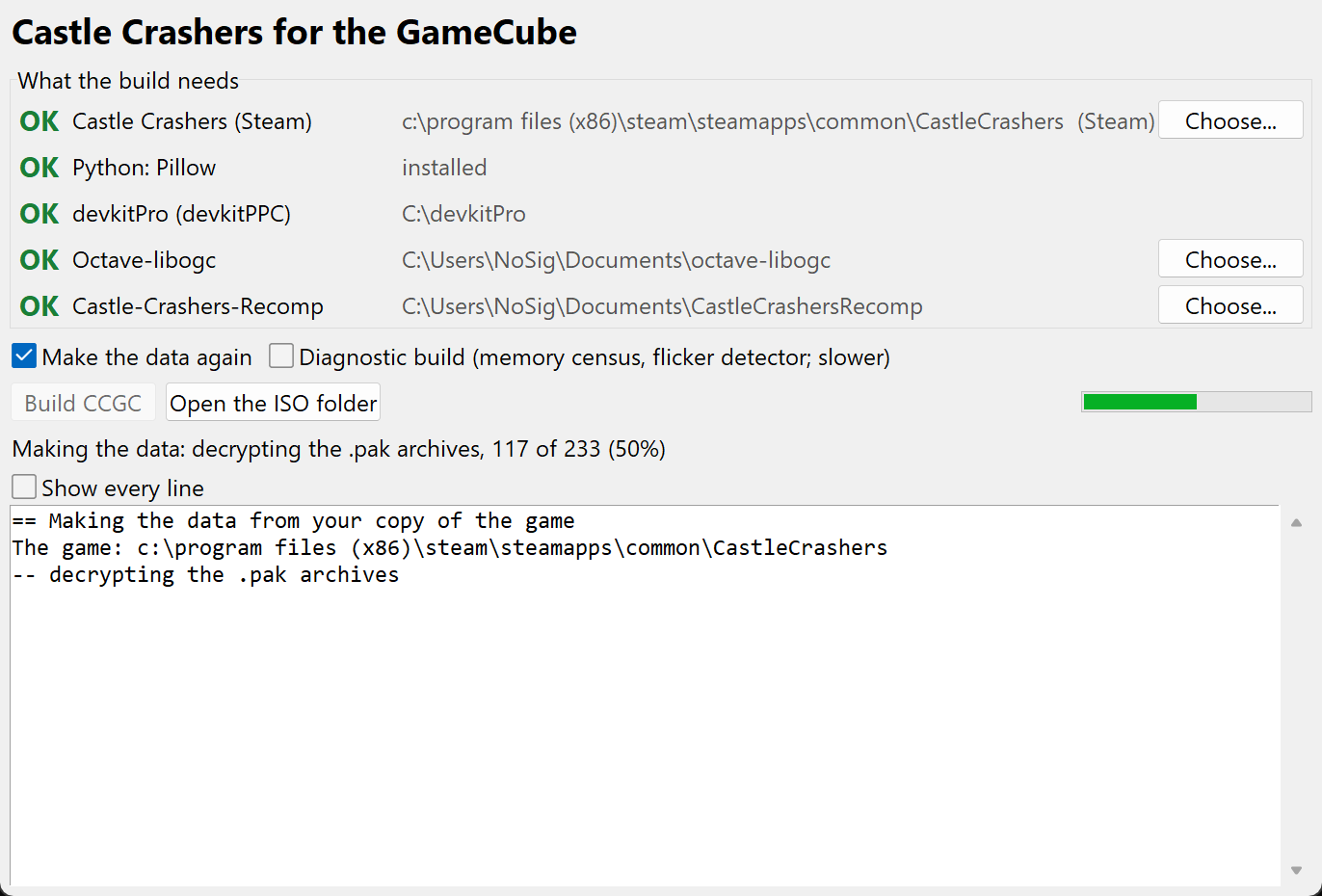
- One-Click Builder UI: Includes an automated
Build CCGC.batlauncher that checks your devkitPPC environment, extracts assets from your Steam installation, and outputs a ready-to-burn GameCube ISO in minutes.
How to Build and Play
In accordance with strict video game preservation ethics, no copyrighted assets, audio tracks, or proprietary code from The Behemoth are included in the repository. The build pipeline operates directly on your legally owned PC copy:
- Own a copy of Castle Crashers on Steam.
- Clone the Castle-Crashers-GC, Castle-Crashers-Recomp, and Octave-libogc repositories side by side.
- Ensure you have Python 3 (with Pillow) and the devkitPPC / libogc toolchain installed.
- Run
Build CCGC.bat. The automated setup locates your Steam install (App ID204360), decrypts the assets, tessellates shapes, and compiles the final.iso. - Load the ISO into Dolphin or boot it on real GameCube hardware using Swiss!
The Preservation Verdict
While the modern retro scene has seen countless PC decompilations and 60 FPS remasters, the reverse—taking a modern indie classic and meticulously re-engineering its vector pipeline to run natively on a 2001 console—is one of the most creatively inspiring accomplishments in recent memory.
Dust off your GameCube wavebirds, call three friends over, and prepare to storm the castle.