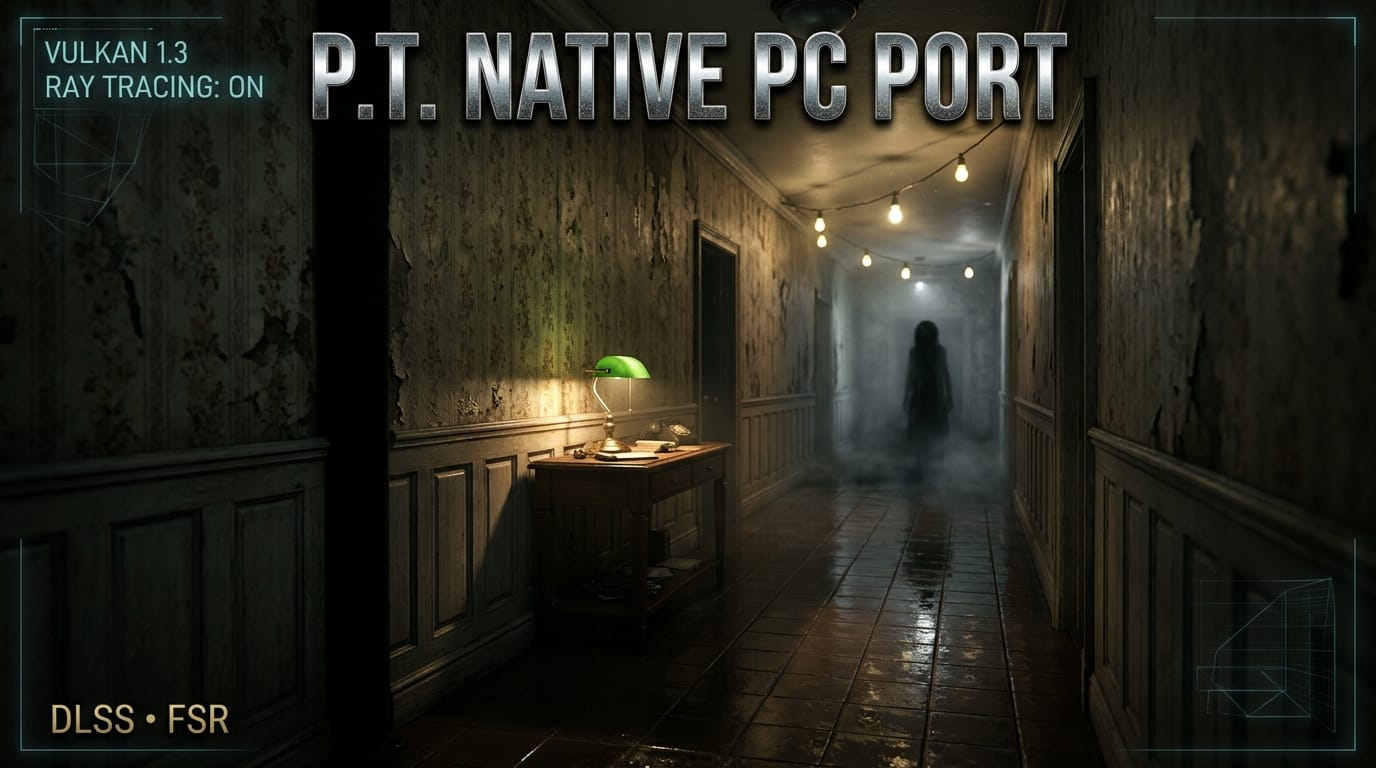

In August 2014, an unassuming horror demo titled P.T. landed on the PlayStation Store, instantly redefining the psychological horror genre. Directed by Hideo Kojima and filmmaker Guillermo del Toro, the claustrophobic, endlessly looping residential corridor served as an interactive viral teaser for the ill-fated Silent Hills. When Konami cancelled the project in April 2015, they took the unprecedented step of expelling P.T. from PlayStation Network servers entirely—rendering it impossible to re-download and trapping one of gaming's greatest artistic achievements on aging PS4 hard drives. Now, more than a decade later, developer Lorean Xavier has achieved the ultimate preservation milestone: P.T. has officially arrived as a native PC port.
Crucially, this is not a fan remake rebuilt from scratch in Unreal Engine or Unity, nor is it running inside an emulation container. The project—released as LoreanXavier/pt-pc—is a clean-room, native C++ engine re-implementation engineered directly for modern Windows and Linux hardware.
Clean-Room Legal Architecture: Preserving Without Piracy
To insulate the project from corporate legal takedowns and adhere strictly to software preservation best practices, the pt-pc repository and its installers distribute zero copyrighted assets, proprietary game code, or encrypted ROM data.
Instead, the native executable acts as a modern runtime engine that ingests the original assets from a legally dumped PlayStation 4 copy (specifically release CUSA01127):
- Direct Asset Ingestion: The installer extracts the three requisite PS4 archive files—
chunk1.psarc,texture.qar, andpathid_list_ps4.bin—placing them beside the PC executable. - No Firmware or Eboot Required: The original console executable (
eboot.bin), encrypted system modules, and proprietary Sony OS calls are discarded entirely. The PC binary reconstructs game state, room geometry, lighting, audio triggers, and scripting logic natively. - Full Walkthrough Continuity: The port faithfully reproduces the complete experience from the opening concrete cellar wake-up to the final phone call, radio transmission, and street cutscene.
Next-Gen Engine Pipeline: Vulkan 1.3, Ray Tracing, and DLSS
While the port provides a 1:1 "Original PS4" graphics preset that replicates the exact 2014 console presentation, Lorean Xavier has supercharged the engine with modern PC graphics technologies built on SDL3 and pure Vulkan 1.3:
| Feature Category | Engine Capabilities | Technical Implementation |
|---|---|---|
| Display & Frame Pacing | Unlocked Frame Rates • Ultrawide | Windowed, Borderless, or Exclusive Fullscreen at any resolution with decoupled tick rates. |
| Hardware Ray Tracing | Ray-Traced Shadows, AO & Reflections | Utilizes Vulkan Ray Queries for sharp/soft shadow maps, contact shadows, ambient occlusion, and dynamic puddle reflections. |
| Temporal Upscalers | NVIDIA DLSS 4.5 • AMD FSR 3.1 • Intel XeSS | Full support for native-resolution anti-aliasing (DLAA, FSR Native AA) and custom scaling ratios. |
| Frame Generation | DLSS FG • FSR 3 Frame Generation | NVIDIA Frame Generation on RTX 40 series; AMD FSR 3 Frame Generation on Radeon RX 5000+ hardware. |
| Enhanced Textures | 2x AI Upscaled Texture Cache | Offline texture enhancement powered by embedded Real-ESRGAN and ncnn inference, cached locally to disk. |
Solving the Microphone Puzzle with Local Machine Learning
One of P.T.'s most notorious mechanics was its final puzzle, which famously required players to whisper into the PlayStation 4's DualShock 4 microphone or PlayStation Camera. Rather than stripping this iconic mechanic or hardcoding a generic button prompt, the PC port ingeniously integrates embedded local AI inference:
On-Device Voice Recognition: The port bundles whisper.cpp (running OpenAI's lightweight Whisper speech-to-text model) paired with Silero VAD (Voice Activity Detection). It processes microphone audio entirely locally in real-time, listening for the crucial spoken words. For players without a microphone, the developer included a fallback hotkey (J) configured via pt.ini.
Expanded Features: Museum, VR, and Speedrunning
Beyond technical fidelity, the release includes a staggering suite of developer and preservation tools accessible directly in-game:
- The Digital Museum: A dedicated preservation archive that catalogued the game's subliminal flash frames, radio broadcasts with full multi-language transcripts, uncompressed photo fragments, 3D character models, and previously cut content unearthed from the game data.
- Loop Browser: After finishing the teaser, players can freely jump to any specific iteration of the looping hallway.
- OpenXR Virtual Reality: Experimental VR support utilizing the Khronos OpenXR loader, allowing players to walk the terrifying hallway in full head-tracked stereoscopic 3D.
- Photo Mode & Free Camera: Dedicated camera flight controls (
F6andF7) with adjustable aperture, field of view, tilt, and flashlight controls. - Native Speedrun Integration: Built-in loop split timers with live TCP synchronization to LiveSplit server protocols.
- Native Linux & Steam Deck: Runs out of the box on SteamOS as a non-Steam game with zero Proton translation overhead.
- Lua 5.1 Modding Engine: A dedicated
mods/directory allowing the community to inject custom textures, sound files, and Lua scripts responding to game state triggers.
Preservation Triumphs Over Corporate Erasure
In the project's documentation, Xavier acknowledged the developers of the shadPS4 emulator, whose frame-by-frame rendering behavior served as the definitive baseline for verifying visual and physics accuracy during development.
When Konami erased P.T. from existence a decade ago, it stood as a horrifying harbinger of the all-digital future: a world where seminal cultural works could be unceremoniously vaporized on corporate whim. By reverse-engineering its data formats and building an open-source, Vulkan-powered PC runtime, the preservation community has ensured that Kojima and del Toro's masterpiece will endure indefinitely on open platforms.
Downloads & Documentation
- GitHub Repository & Releases: LoreanXavier/pt-pc (v1.0.1)
- Setup Installers: Windows Setup (
P.T.PC.Port.Setup.exe) & Linux/SteamOS binary - Asset Requirements: Lawfully dumped PS4 game files (
CUSA01127) - Source Code License: MIT Open Source