
On October 13, 2026, Xbox CEO Asha Sharma sent an internal memo to “Team Xbox employees globally” that accidentally said the quiet part out loud: the company is losing. Not to Sony. Not to Nintendo. To a bunch of hobbyists with decompilers, a Discord server, and a lot more free time than respect for copyright law. Microsoft then published that memo on its own news site, dressed it up in a nice key art, and called it “Introducing Xbox Labs.”
So let’s be brutally clear about what Xbox Labs is, because the company will spend the next year pretending it’s a visionary research lab. It isn’t. It’s a fire alarm. It’s a trillion-dollar corporation discovering, live on its own corporate blog, that the games it spent decades locking to hardware it controls are being freed, one decompilation project at a time, by people it never paid and cannot stop. And the funniest part? It’s calling this leadership.
What Xbox Labs Actually Is
Strip away the corporate gloss and the memo describes something almost comically small: a “small group of game makers, engineers and scientists” — Xbox’s own words — tasked with turning “emerging ideas into things our players and developers can experience.” A leader named Scott has been asked to stand it up. Xbox promises it will “build in the open, learn from what people do, and measure success by whether more people are playing and creating.”
Now read the actual substance of the memo — the part where the largest game publisher on Earth describes the community’s work in its own terrified words:
“In recent weeks, we’ve seen games rapidly decompiled and rebuilt to run on hardware they were never originally designed to support. Windows PC builds have been translated to run on Apple Silicon or ported to run inside a browser through WebAssembly and WebGPU… Perhaps more surprisingly, we’ve seen many of the biggest games in the world have been remixed into the source code of another.”
— Asha Sharma, Xbox CEO, in a company-wide memo
That is the CEO of Xbox admitting, in writing, that reverse engineering is reshaping the entire industry faster than her company can react to it. And then comes the sentence that gives away the whole racket: “These are unmistakably good outcomes for players, even when (and sometimes because) they challenge our existing business models.”
Read that last clause again. “Challenge our existing business models.” That’s corporate for the thing you’re doing away from us is better than the thing we’re selling you, and we’ve just noticed. Sharma isn’t announcing a strategy. She’s filing a witness statement.
The Tell: “Responsible Stewards of IP” Means “We Will Sue”
Here is the sentence that undoes the entire warm-and-fuzzy performance. Tucked at the very end of the memo, after all the talk of open building and happy players, comes the caveat every corporate love letter keeps in its back pocket: “Our priorities aren’t changing. We remain committed to the 4Cs, to making great games, to our hardware and to being responsible stewards of IP and the communities built around it.”
“Responsible stewards of IP” is not a value. It is a legal position. It is corporate for “everything you just rebuilt belongs to us, and the lawyers are still on retainer.” You can “build in the open” all you want — the instant your open build brushes against a franchise that shows up in an earnings deck, stewardship becomes a cease-and-desist, and the “community” becomes a defendant.
Players spotted the grift in real time. When gaming journalist Rebs Gaming (@Mr_Rebs_) flagged that the CEO’s remarks cover “the community Halo mods,” the reply underneath cut straight to the bone:
XBOX CEO Asha Sharma just addressed the recent surge in games being “decompiled and rebuilt to run on hardware they were never originally designed to support.” This includes the community Halo mods.— Rebs Gaming (@Mr_Rebs_) October 13, 2026
translation - we’re fucked and we will sue the hell out of anyone doing this— JohnnyDepp (@wtfwestworld) October 13, 2026
That two-sentence exchange is the whole story, and it’s worth more than the entire corporate memo. Xbox Labs is not a surrender. It’s a land grab of goodwill: stand up a “small group” to be seen “building in the open,” hoover up the community’s free labor and best ideas, then decide which projects get blessed and which get threatened. It costs the company almost nothing, and it lets it wear the community’s clothes while keeping the community’s work.
The Wave They’re Nervous About
So what, exactly, is scaring a company this big into writing an all-staff memo about “the tether between software and hardware”? The same thing we’ve been documenting all year. The reverse-engineering scene has quietly assembled a body of work that would have sounded like a fever dream five years ago:
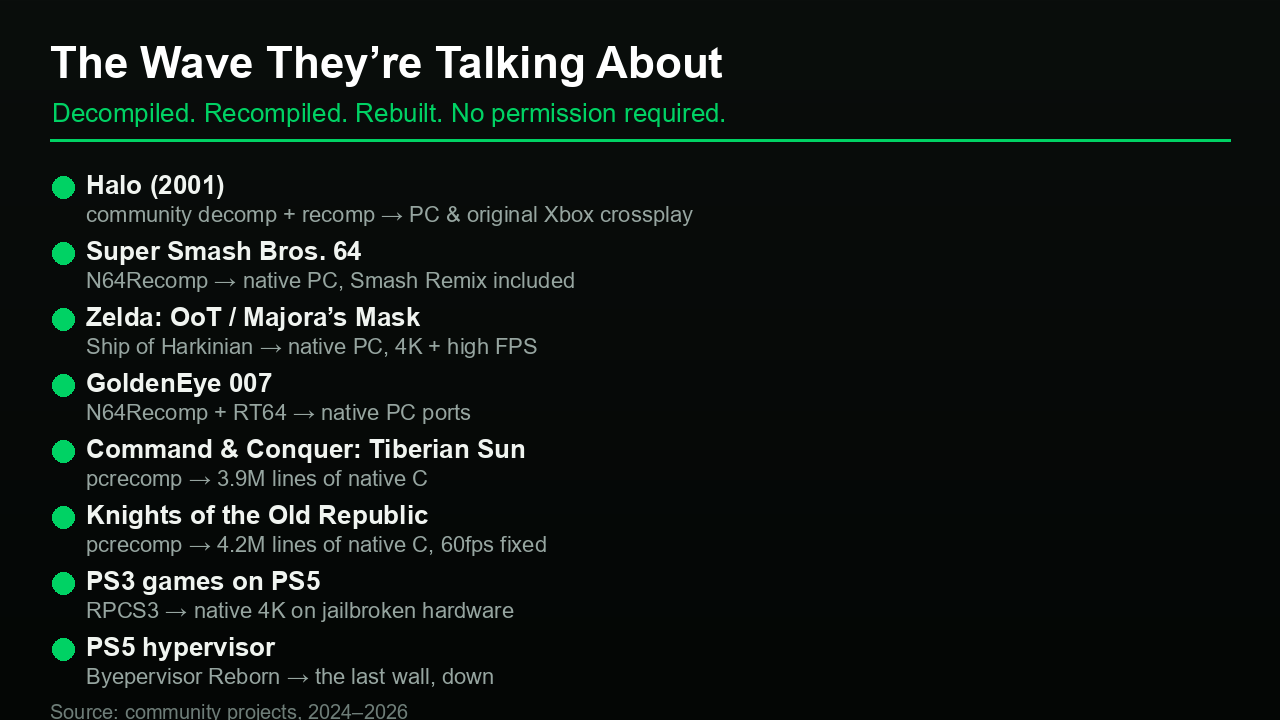
Every one of those exists because somebody decided the software they paid for should keep working — and then just built it, with no budget, no roadmap, and no permission from anyone. Xbox’s own memo concedes the browser-based builds are “now approaching 90% global browser support.” That isn’t a hack for forum nerds. That’s a redistribution platform running on top of the open web, and it is not going away.
Exhibit A: A Memo About Games That Never Mentions Playing One
There is a tell in every corporate memo about video games, and it’s never the numbers. It’s the nouns. In a message about “the future of play,” Xbox CEO Asha Sharma never says the word play. Not once. No level. No match. No boss fight. No couch, no controller, no friend’s basement. What she says is “72 billion hours,” “business models,” “the 4Cs,” “emerging technologies,” “agents,” and “responsible stewards of IP.”
That is not the vocabulary of someone who has ever loved a game. It is the vocabulary of someone who has inherited one. Players appear in the memo as a unit of consumption — “more people than ever playing” — never as people who remember where they were when the ring first appeared over the horizon. The past is “legacy support.” The games are “franchises.” The community is something you “build around it,” the way you build a fence around a lot.
You can always tell a memo about Halo was written by someone who has never heard the ring, because the whole thing treats the thing you love as a line item. So here’s the translation:
| Corporate Says | Corporate Means |
|---|---|
| “unmistakably good outcomes for players” | You found a way to keep playing the games we sold you without paying us again, and we’ve decided to frame that as our success. |
| “the tether between software and hardware” | Our business model — described abstractly enough that nobody in the room has to say the word “money.” |
| “build in the open” | Publish a friendly blog post. Keep the lawyers. |
| “responsible stewards of IP” | We will sue. Politely. |
| “measure success by whether more people are playing and creating” | If the numbers go up, we take credit. If they don’t, we quietly close the group and never mention it again. |
| “emerging technologies” | The things you built without us, which we are now “exploring.” |
| “we remain committed to our hardware” | We remain committed to selling you hardware. |
Somewhere in Redmond, a spreadsheet has a row labeled “franchise asset.” It has never once been labeled “the best Saturday of 2004.” And that gap — between the people who lived in these games and the people who now own them — is the entire reason a hobbyist with a decompiler understands Halo better than the company that named a division after it.
We’re not claiming to know what the CEO plays behind closed doors. We don’t have to. The memo says it for her.
The Receipts: Two Decades of “Trust Us”
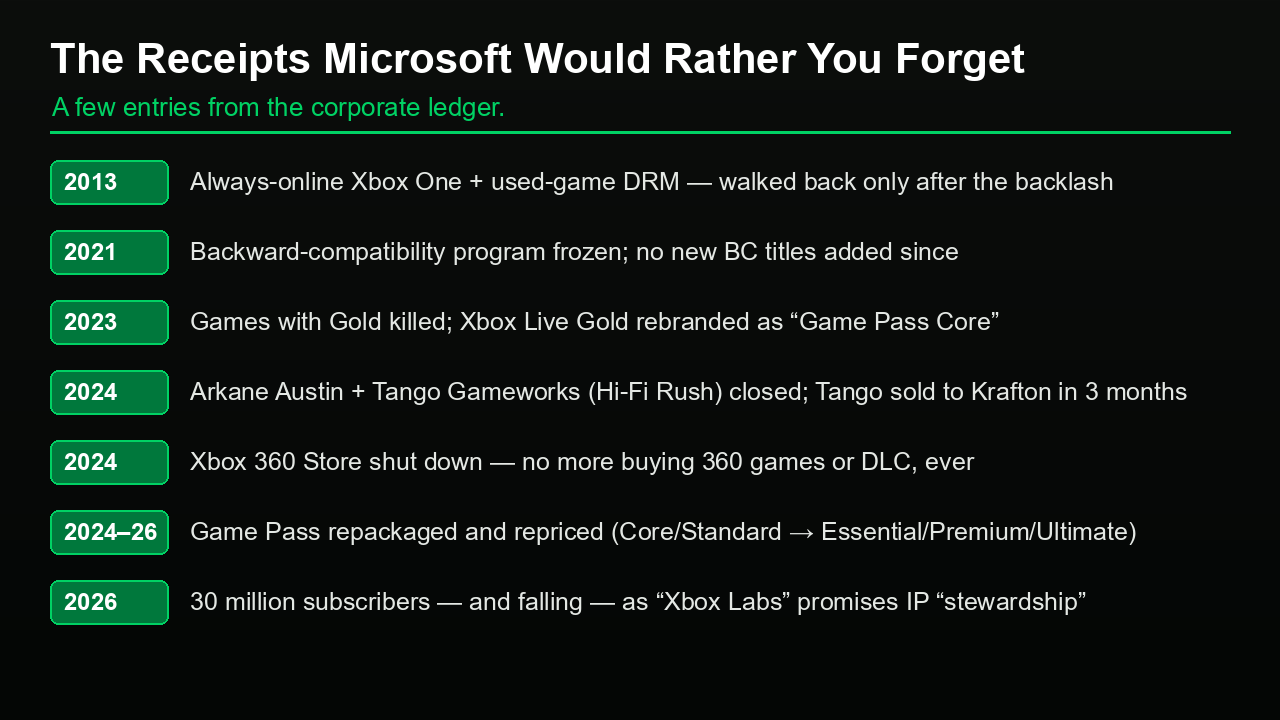
If you’re tempted to feel warm about Xbox Labs, let’s take a stroll down the ledger first. This is the same company that wants you to believe it is now, suddenly, the player’s friend. Here’s the history it’s hoping you forgot:
| When | What Xbox Did |
|---|---|
| 2013 | Announced an always-online Xbox One with draconian used-game restrictions and 24-hour check-ins — then quietly reversed every one of them only after the backlash threatened the launch. |
| 2021 | Froze the backwards-compatibility program. No new legacy titles added since — a quiet, permanent cap on how much of its own history Xbox is willing to preserve. |
| 2023 | Killed Games with Gold and quietly rebranded Xbox Live Gold as “Game Pass Core,” swapping a library of keepable games for a smaller rotating set. |
| 2024 | Shuttered Arkane Austin and Tango Gameworks (the Hi-Fi Rush team) in a brutal round of cuts — then sold Tango off to Krafton barely three months later. Award-winning studio in, firesale out. |
| 2024 | Shut down the Xbox 360 Store. Hundreds of digital-only 360 games and DLC became permanently unbuyable. If you didn’t buy it before the deadline, it’s gone — that’s “preservation” in Microsoft’s own house style. |
| 2024–26 | Repackaged and repriced Game Pass yet again (Core/Standard giving way to Essential / Premium / Ultimate), putting the best value behind ever-pricier tiers — while the subscriber count slid to roughly 30 million and falling. |
| 2026 | Launched “Xbox Labs” to “build in the open” — right after everything above — and reasserted “responsible stewardship of IP” in the same breath. |
Notice the through-line, because it’s not subtle. Every single one of those decisions made your library smaller, your ownership weaker, or your wallet lighter — and not one of them was forced on Microsoft by technology. The Xbox One could play used discs. The 360 Store could have stayed open. Those studios could have kept their jobs. Every one of these was a choice, made by people who looked at a spreadsheet and decided your nostalgia was worth more as leverage than as respect.
And now, after twenty years of that, the company wants to sit down at the same table as the modders and call it “building in the open.” You don’t get to close the museum, sell the exhibits, freeze the archive, fire the curators — and then show up as the patron of preservation the moment volunteers rebuild it all for free.
Xbox Labs Is Damage Control, Not a Vision
Look at how carefully the memo hedges, and you’ll see there is no actual commitment anywhere in it. Even where it promises to explore, it protects the status quo: “LABS gives us a way to explore new technology without abandoning the work already underway.” Translation: nothing is going to change. No price cuts. No restored storefronts. No unfrozen back-compat list. No promise to stop hammering modders. Just a holding pattern designed so that the shareholder deck doesn’t read like a surrender.
That’s what a “lab” is for in a company like this. Not to build the future — to absorb the present before it disrupts the quarter. Stand up a small group, put out a friendly blog post, take credit for the community’s breakthroughs, and keep selling the same vault-tight ecosystem you’ve always sold. Xbox Labs is not a lighthouse. It is duct tape over a crack that is, very visibly, getting wider by the week.
Why Do We Even Need Them Anymore?
Here is the question the memo is dancing around, and the one the entire industry refuses to ask out loud: if a handful of hobbyists can decompile, recompile, and rebuild a game faster than the company that owns it can form a committee — what, exactly, is the company for?
Be specific, because the answer gets thinner every year. What does a publisher still provide in 2026?
- Not the games. The games already exist. They were finished, often decades ago, and many of the best ones will never be beaten by anything shipped this decade.
- Not the access. Access is a storefront you can lose, a subscription you rent, a server that gets sunsetted. That’s not a product — that’s a hostage situation with a login screen.
- Not the preservation. They’ve proven, repeatedly, that they’ll shutter the store and delist the archive the moment it stops being profitable. The community is the only party keeping the history alive.
- Not the innovation. Widescreen support, high frame rates, mod and texture support, cross-platform play, hypervisor access — the community shipped all of that first, for free, and often against the platform owner’s wishes.
What’s left is the toll booth: the storefront, the subscription, the license. The middleman function. And a toll booth is only worth what the road is worth — and the community just built a road around it. The dinosaur isn’t a predator anymore. It’s a paywall with a logo on it, and the paywall is starting to leak.
Do the math on what Xbox is actually selling you in 2026. It isn’t software you own — you own nothing, you license everything, and the license dies with the service. It isn’t hardware you control — the console is a locked box that won’t even read the discs from two generations ago. It isn’t even a promise that the games will stay available, because they’ve shown you the exact opposite, in writing, with the 360 Store. What you’re paying for is permission. And permission is the one thing the decompilation scene has made entirely optional.
The Best Games Have Already Been Made
Let’s say the quiet part even louder. The best games have already been made. The 1990s and 2000s are the canon — the platformers, the RPGs, the shooters, the fighters, the adventures that defined what this medium could be. Those games are finished. They exist. They’re on our old discs and our old drives and our old cartridges, and they are never going to be remade into something better, because “better” isn’t what made them great.
What the industry has spent twenty years doing is re-selling you that canon — remastered, re-released, re-subscribed, re-licensed, again and again, each pass a little more expensive and a little less yours. What the community has spent the same twenty years doing is making it run: natively, at any resolution, at any frame rate, on any machine, forever, for free. One of those two efforts is a public good. The other is a subscription funnel with a marketing budget.
You do not need a new console to play a game from 1999. You need the source. And the source is coming, project by project, whether the platform owners like it or not.
The Tools They Can’t Ban
Here is the thing Xbox Labs was written about, and here is why the panic is real: the tools are already out there, they belong to nobody, and there is no way to put them back in the bottle.
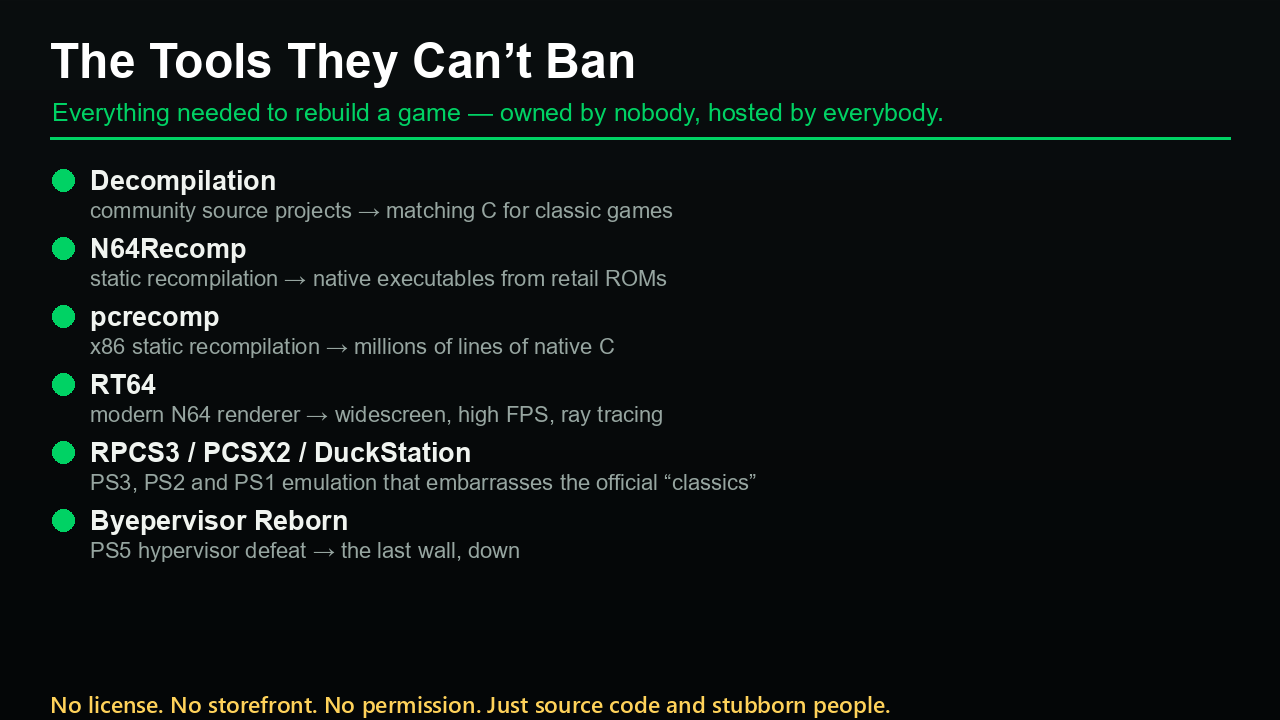
Try to sue a static recompiler. Try to send a cease-and-desist to a repository that has been forked ten thousand times. Try to DMCA a matching decompilation that’s already mirrored across three continents and a peer-to-peer network the moment it’s published. This is the fundamental asymmetry the memo can barely bring itself to name: a corporation can own a game, but it cannot own a technique. The moment decompilation, static recompilation, and open emulation became community practices instead of corporate products, the game was over. You can’t un-invent a compiler.
They Can’t Win — And Xbox Labs Quietly Admits It
Every enforcement strategy the industry has tried has failed the same way: the code gets taken down, then re-uploaded. A repository disappears and three mirrors appear in its place. A modder gets a letter and the archive is on a dozen hard drives before lunch. The takedown is friction, and friction is a delay, and delay is a few weeks. That’s the whole scoreboard. Meanwhile the actual engineering — the hard part — is done once and lasts forever.
That’s why Xbox Labs exists at all. If you genuinely believed your IP walls were unbreakable, you wouldn’t write an internal memo about “games rapidly decompiled and rebuilt.” You’d write a press release about your next exclusive. The memo is a concession wearing a vision-statement costume, and the “lab” is the fig leaf. When a giant starts studying the thing eating it instead of fighting it, you’re watching it lose.
The Bottom Line
So where does that leave us? Exactly where the last few years have been pointing, and it’s the same lesson we keep re-learning the hard way: never trust these companies — not with your library, not with your hardware, and not with your history. They will close the store, freeze the archive, sell the studio, hike the subscription, and rebrand the betrayal as a feature. Then they’ll write you a warm memo about “community” the moment volunteers prove the games can live without them.
Trust the people who decompile for free, at midnight, for a game from 1997 that nobody is paying them to care about. Trust the people who write emulators and static recompilers because they believe your software should outlive its storefront. Trust the people who just cracked open a console hypervisor and the people who rebuilt a plumber’s first 3D adventure and a squirrel’s bad fur day onto hardware the publishers never bothered to support. Those are the people building a future where the games you bought twenty-five years ago keep working — on your terms, on your hardware, forever.
Xbox Labs wants to “build in the open” now. Cute. We already did. We’ve been building in the open this whole time — no budget, no memo, no CEO, no permission, no lawsuit budget, just source code and stubborn people. That’s precisely why we don’t need them anymore. Microsoft can keep its lab, its tiers, its stewardship, and its lawyers. We’ve got the tools, we’ve got the source, and we’ve got each other. The dinosaurs can watch.
Resources & Links
- Xbox Announcement: Introducing Xbox Labs — Xbox Wire (October 13, 2026)
- Community Reaction: Rebs Gaming (@Mr_Rebs_) — and JohnnyDepp (@wtfwestworld)
- Recompilation Toolchains: N64Recomp · pcrecomp · RT64
- Emulation & Preservation: RPCS3 (PS3) · PCSX2 (PS2) · DuckStation (PS1)
- Why it matters: The games you already own should outlive the storefronts that sold them. No permission required.