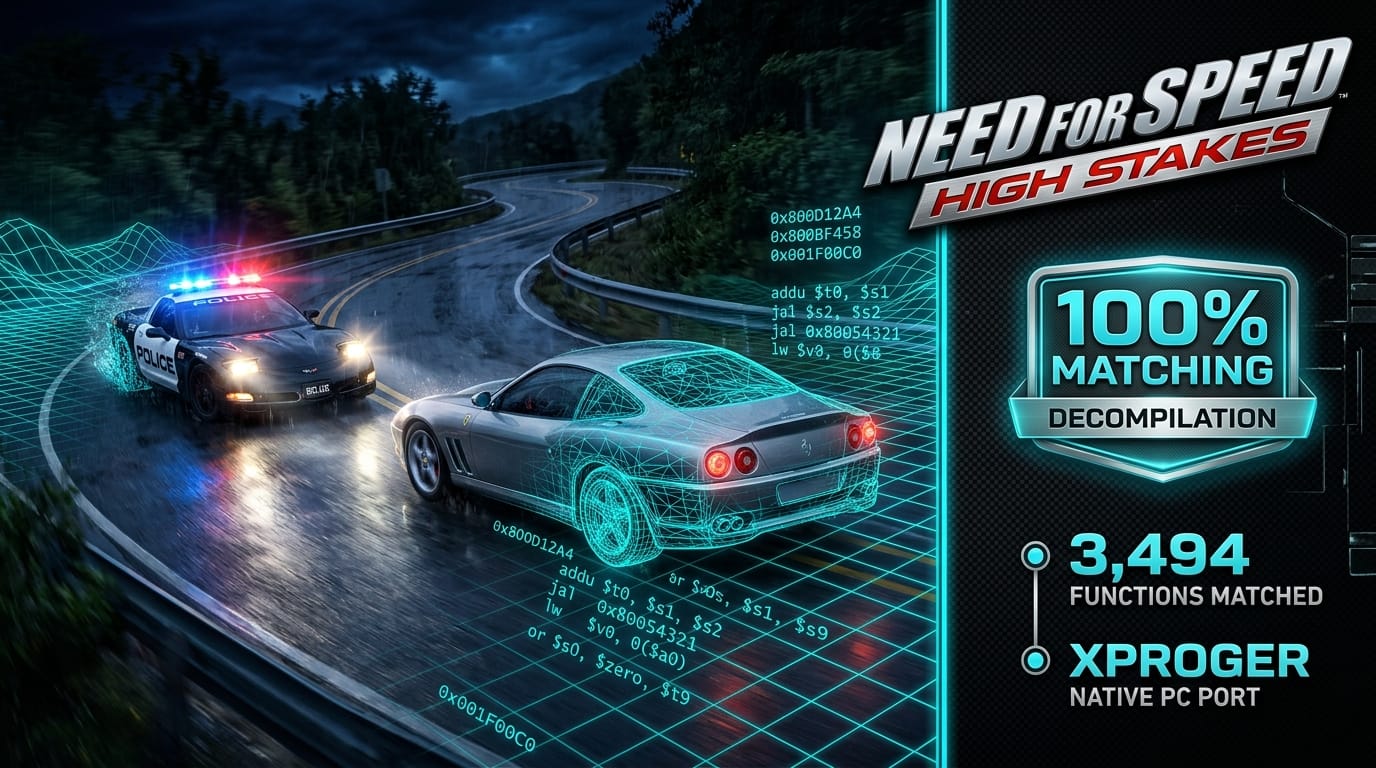

In 1999, Electronic Arts released what many still consider the apex of fifth-generation racing: Need for Speed: High Stakes (known in Europe as Road Challenge and internally as NFS4). With real-time vehicle damage physics, high-stakes pink slip wagers, relentless police pursuits, and dusk-to-dawn track lighting, it pushed the original PlayStation’s hardware to its absolute limit. Now, reverse engineer Caesar0007 has completed a monolithic historical feat: achieving 100.00% byte-matching decompilation across all 3,494 functions—paving the way for an authorized native PC port spearheaded by OpenLara creator XProger.
Every single routine across the game's simulation engine, 3D Geometry Transformation Engine (GTE) pipeline, AI decision graphs, and frontend overlay now compiles into byte-identical machine code. Both disc binaries—NFS4.EXE and FRONT.BIN—build cleanly from source and match the retail European/North American disc down to the exact SHA-1 checksum.
The Milestone: 3,494 Functions, 100.00% Matched
Unlike decompilation projects that stop at behavioral similarity, Caesar0007’s project adhered to an uncompromising matching track: 100% byte-identical C and C++ or nothing. Using modern tooling including splat, maspsx, and objdiff, every instruction, branch delay slot, register assignment, and global data symbol was verified against the retail binary.
• Total Functions: 3,494 / 3,494 (100.00% Matched)
• Total Translation Units: 461 / 461 (100.00% Green on decomp.dev)
• Total Matched Code: 998,192 bytes (Nearly 1 Megabyte of pure MIPS R3000A C/C++)
• Target Binaries:
NFS4.EXE (1,239,040 bytes) & FRONT.BIN (279,880 bytes)• Toolchain: PsyQ 4.3 (GCC 2.8.0
cc1 / cc1plus with -O2 -G4) + ASPSX 2.77 via maspsxThe Dual-Binary Architecture: How EA Packed NFS4 into 2MB of RAM
One of the project's most fascinating revelations is how EA Canada and EA Seattle engineered the game to fit within the PlayStation's strict 2MB RAM ceiling (0x80010000 to 0x801FFFFF). Rather than attempting to run the entire game from a single monolithic executable, the game is split into two primary disc payloads:
| Binary Target | Size | Load Address | Architecture & Role |
|---|---|---|---|
NFS4.EXE |
1,239,040 bytes | 0x80010000 (Entry: 0x800E402C) |
Core PS-X executable. Houses the 3D physics engine, GTE rasterization, opponent AI, sound driver, and a 282,000-byte zero-filled reservation in .rdata called bigBuf. |
FRONT.BIN |
279,880 bytes | 0x80010000 |
Raw headerless overlay. Contains the entire 3D car showroom, tournament brackets, menu GUI, and memory card management routines. |
When the player navigates menus, the disc streams FRONT.BIN directly into the bigBuf buffer at 0x80010000 via an asynchronous CD-ROM read (asyncloadfileat("front.bin", bigBuf)). When entering a race, that memory is reclaimed for high-resolution track geometry, vertex collision meshes, and opponent telemetry. By building a unified linker script (linkers/nfs4_recon.ld), the decompilation can cleanly compile both the overlay and the core engine from a shared header tree.
Reverse-Engineering Archaeological Hurdles
1. PsyQ 4.3 Compiler Quirks & cfront Mangling
The original binary was built with Sony's PsyQ 4.3 toolchain (using Cygnus GNU C 2.8.0 with C++ extensions). Matching vintage C++ binaries on the PS1 is notoriously difficult because early AT&T cfront-style name mangling emitted symbols like _._14tFEApplication (destructors) and _vt.16Car_tObj (virtual tables) that violate standard C identifier rules. Caesar0007 engineered custom symbol sanitizers (tools/gen_symbols.py) to fold illegal characters while preserving exact virtual address bindings from the retail NFS4.MAP and NFS4.SYM link maps.
2. The GTE Instruction Rewrite Layer
The PlayStation's Geometry Transformation Engine (GTE) is a custom vector coprocessor (Cop2) capable of matrix multiplication, lighting equations, and perspective projection in hardware. Modern GNU as does not natively recognize proprietary Sony GTE compute mnemonics like rtps (Rotate, Translate, Perspective Single), mvmva, or nclip. The project created a dedicated translation tool (tools/fix_gte.py) that automatically rewrites GTE operations into exact 32-bit .word hex opcodes, eliminating any assembler encoding variance.
// Example: Reconstructed camera look-at & GTE transformation setup
void CameraLookAt(matrixtdef *matrix, coorddef *pos) {
    VECTOR eye;
    SVECTOR rot;

    eye.vx = pos->x;
    eye.vy = pos->y;
    eye.vz = pos->z;

    // Load orientation matrix into GTE Coprocessor registers
    gte_SetRotMatrix(matrix);
    gte_SetTransVector(&eye);
}
3. Strict "DATA-MAT" Discipline
A crucial rule documented in the project's METHODOLOGY.md is DATA-MAT: a function was not considered complete simply because its assembly matched—every absolute-VA global variable it touched had to be materialized as typed, sized data with exact byte-level representation. This eliminated "invisible" linker drift and ensured all 3,494 functions integrated into a coherent whole.
The Holy Grail: XProger’s Official Native PC Port
Perhaps the most thrilling aspect of this decompilation is where the code is headed next. The repository’s official, authorized modern port is hosted at XProger/NFSHS-PSX-decomp-port.
For those in the retro engineering community, XProger is the legendary developer behind OpenLara—the stunning, ultra-fast modern re-implementation of the classic Tomb Raider engine that brought smooth 60 FPS, widescreen, modern lighting, and cross-platform compilation to PC, Nintendo Switch, and even Game Boy Advance.
While the PC version of Need for Speed: High Stakes has long suffered from severe compatibility issues on modern versions of Windows (requiring dozens of third-party patches, D3D wrappers, and registry tweaks), having a 100% decompiled PlayStation source tree allows for:
- True Native Modern Execution: Running directly on Windows, Linux, macOS, and handhelds like the Steam Deck without emulation.
- Uncapped Framerates & Ultrawide: Bypassing the PS1's 30 FPS ceiling for silky-smooth 60+ FPS high-refresh racing.
- Enhanced Lighting & Sound: Swapping fixed-point software audio and PS1 dithering for high-fidelity 3D spatial audio and modern OpenGL/Vulkan rendering.
- Gameplay Balancing & Modding: Full access to car physics coefficients, tire friction formulas, cop AI aggressiveness, and custom vehicle imports without hex-editing ROM files.
Explore the Source & Track the Progress
Both the matching decompilation and the official port repository are available on GitHub and decomp.dev:
- GitHub Repository (Caesar0007): github.com/Caesar0007/NFSHS-PSX-decomp
- Decomp.dev Tracker: decomp.dev/Caesar0007/NFSHS-PSX-decomp
- Official Port Project (XProger): github.com/XProger/NFSHS-PSX-decomp-port