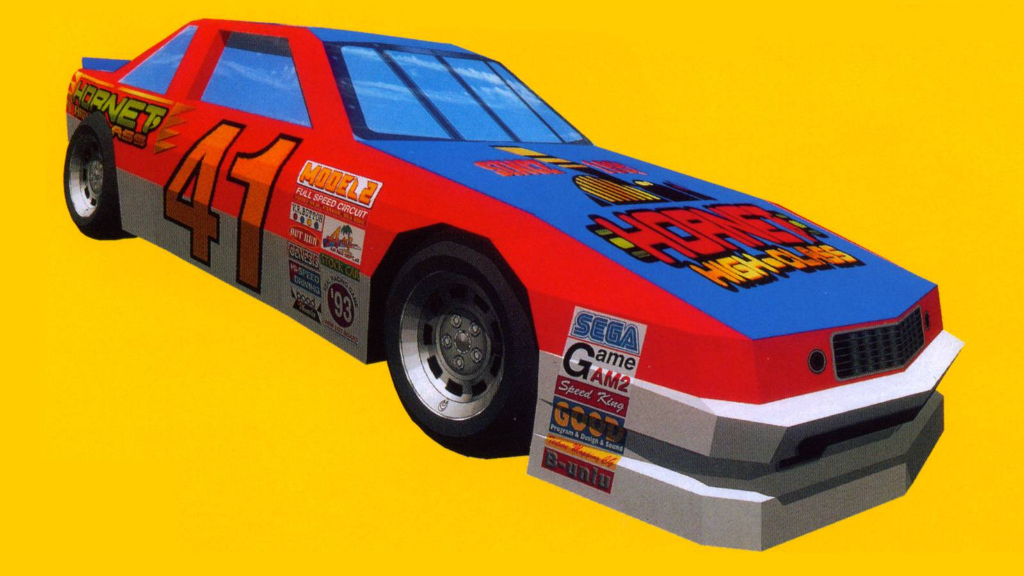

Few sounds in the history of arcade gaming are as instantly recognizable or adrenaline-inducing as the booming, energetic voice of Takenobu Mitsuyoshi screaming "DAYTONAAAAA!" into an arcade cabinet speaker. When Sega AM2 and director Toshihiro Nagoshi unleashed Daytona USA in 1993 on the groundbreaking Sega Model 2 arcade board, it revolutionized three-dimensional gaming. Delivering 60 FPS (technically 57.5 Hz) texture-mapped polygonal graphics, four-speed manual shifters, motorized force-feedback steering, and eight-player linked cabinet battles, it became the gold standard of arcade motorsport.
For more than three decades, however, playing an authentic, uncompromised version of Daytona USA at home has been notoriously difficult. The 1995 Sega Saturn port was famously compromised by a rushed 20 FPS framerate, the Dreamcast’s Daytona USA 2001 featured overly sensitive steering physics, and modern emulators like MAME or the legacy Model 2 Emulator demand significant emulation overhead while lacking native PC display enhancements.
Now, the arcade king has officially arrived on personal computers in the purest, most mind-bending form imaginable. Developer alphanu1 (Ben, creator of the Sega Model 2 MiSTer FPGA core) has unleashed daytona-arcade-recomp—a complete, frame-perfect static binary recompilation of Daytona USA into portable, native C++20.

Zero Emulation: The Multi-Processor Recompilation Miracle
What makes daytona-arcade-recomp fundamentally different from running an emulator like MAME is that there is no CPU emulator, no interpreter, and no JIT compiler in the shipping build. Every single instruction executed by the game has been statically analyzed, decoded, and recompiled ahead of time into native C++ functions that execute directly on your host CPU (x86-64 and ARM64).
Achieving this on the Sega Model 2 is an extraordinary engineering feat because the arcade board was not a single computer—it was an intricate symphony of multiple specialized, concurrent processors:
- Main CPU (Intel i960KB @ 25 MHz): The rare 32-bit RISC processor that runs game logic, vehicle physics, collision detection, and AI. Every single i960 instruction has been statically recompiled into C++, strictly matching MAME’s execution semantics while utilizing native host floating-point operations.
- Coprocessor (Fujitsu MB86234 TGP @ 50 MHz): The dedicated geometry processor that handles 3D world transformations, matrix multiplication, and camera projection. The game uploads a 2,024-word microcode program into the TGP from ROM at startup. daytona-arcade-recomp takes this uploaded microcode and statically recompiles it to native C++ as well, verifying millions of instructions against MAME bit-for-bit.
- Sound Board (Motorola 68000 + YM3438 + 2x MultiPCM): The Model 1 audio board’s M68K program is also statically recompiled into native C++ using the same ahead-of-time pipeline, driving native C++ emulations of the Yamaha FM synthesizer and Sega MultiPCM sample chips over SDL3 audio.
- Geometrizer & Rasterizer: Reimplemented as a high-performance native pipeline, offloading 3D polygon rasterization and System 24 2D tilemaps to modern GPU backends (Vulkan, Direct3D 12, or Metal via the SDL3 GPU API), alongside an exact software CPU fallback.
daytona93) and the definitive Revision A 1994 release (daytona), compiling each into its own independent, optimized native binary.Modern Enhancements: Ultrawide, Super-Sampling, and 500+ FPS
While the recompilation engine guarantees frame-exact parity with the original 1993 hardware when running at stock settings, daytona-arcade-recomp introduces a suite of transformative visual and gameplay enhancements that make the arcade classic shine on modern displays:
1. True Widescreen and Ultrawide (21:9)
Rather than merely stretching a 4:3 box or slapping borders on the sides, the engine expands the 3D rendering camera viewport. The geometrizer’s side clip planes are widened dynamically to provide full 16:10, 16:9, and 21:9 ultrawide panoramic fields of view. Players can choose to keep the classic 496x384 HUD centered in the middle of the screen or push lap times, position gauges, and the mini-map to the far edges of their widescreen monitor.
2. Internal Super-Sampling (2x, 3x, 4x)
Through its modern GPU renderer, the engine can draw 3D geometry at 2x, 3x, or 4x internal super-sampling while seamlessly preserving the authentic pixel art tilemaps, original texture filtering, and iconic low-poly Model 2 aesthetic. Because there is zero emulation overhead, the game easily tears through benchmarks at 250 to over 500 frames per second on desktop hardware.
3. Extended Draw Distance
The original arcade game divided courses into a 16x16 grid and strictly budgeted 5,000 polygons per frame to keep within the Model 2 hardware limits, causing distant scenery to pop in. daytona-arcade-recomp provides an adjustable scenery draw distance slider (from default out to "Furthest") by hooking into the course cell visibility tables and unlocking polygon budgets.
Authentic Arcade Controls and Real Force Feedback
Playing Daytona USA with a digital D-pad has never done the game justice. Sega designed the arcade cabinet with an industrial 270-degree steering wheel, linear pedals, an authentic 4-speed gate shifter, and powerful motor force feedback.
daytona-arcade-recomp delivers full native hardware peripheral support via SDL3:
- True Analogue Steering & Pedals: Independent binding for steering wheels, pedal boards, and handbrakes across separate USB devices, with configurable deadzones, linearity curves, and lock range calibration.
- 4-Speed H-Pattern Shifting: Full support for gated 4-speed manual shifters (gears 1–4) alongside bumper-based sequential paddle shifting.
- Genuine Force Feedback Decoding: The game decodes original Sega drive board motor commands directly from memory (centering forces, friction, road vibration, collision jolts, and high-speed cornering pull). These are translated directly into SDL3 haptic effects for direct-drive and gear-driven force feedback steering wheels, falling back to dynamic rumble on modern controllers.
Multiplayer: Arcade Link Play Over LAN and Wi-Fi
One of the most thrilling aspects of the 1994 Revision A release was multiplayer cabinet networking. In arcades, operators could link up to eight cabinets together using optical fiber and a specialized communication board (837-10537).
daytona-arcade-recomp achieves what was once thought impossible outside of physical arcade rooms: it re-implements the Model 2 communication board ring network over standard TCP/UDP sockets!
Players can link two or more computers over local Wi-Fi or Ethernet—or run multiple cabinet profiles on a single PC with split ports. By entering the arcade's built-in Test Mode (F2) and assigning one machine as the MASTER and the others as SLAVE cabinets with unique car numbers, players can race against each other in real-time, just like in a 1990s arcade, with cross-platform multiplayer fully tested across Windows, macOS, and Linux.
Extreme Verification: 2 Billion Instructions Checked
In the world of static recompilation, maintaining 100% bug-for-bug game parity is the ultimate challenge. The creator didn't rely on guesswork or loose approximations. The project employs an exhaustive differential lockstep testing suite using MAME and hardware logic captures as verification oracles:
- In a 20,000-frame full-race stress test, over 2.16 billion i960 instructions, 597 million TGP instructions, and 261 million M68K sound instructions were verified to match MAME byte-for-byte and frame-for-frame.
- Every hardware subsystem—from 80-bit floating point math to buffer RAM hashes and polygon rasterization lists—has been mathematically proven identical to original arcade behavior.
- The project also runs on an experimental PlayStation Vita target, proving the portability of the C++ runtime on low-power handhelds.
How to Build and Play
In adherence to strict game preservation standards, no Sega proprietary code, ROM dumps, textures, or audio samples are included in the repository. Users must supply their own legally owned MAME-format ROM set (daytona93.zip or daytona.zip):
- Clone the repository from GitHub: alphanu1/daytona-arcade-recomp.
- Place your ROM archive into the
roms/directory. - Run the automated setup script (
./setup.shon Linux/macOS orpowershell -ExecutionPolicy Bypass -File setup.ps1on Windows). The toolchain will compile the dependencies, analyze your ROM, generate native C++ code, and build your executable. - Launch
build/daytona(orbuild\Release\daytona.exe) to configure controls, graphics, and hit the track!
Transmission Status
From Super Mario 64 and Zelda on the N64, to Jak and Daxter on PS2, to Bloodborne on PS4, the static recompilation revolution continues to reshape the landscape of interactive history. With daytona-arcade-recomp, Sega's greatest arcade achievement has been liberated from fragile 30-year-old PCBs and preserved forever as a screaming, 500 FPS native PC masterpiece.
Gentlemen, start your engines.